
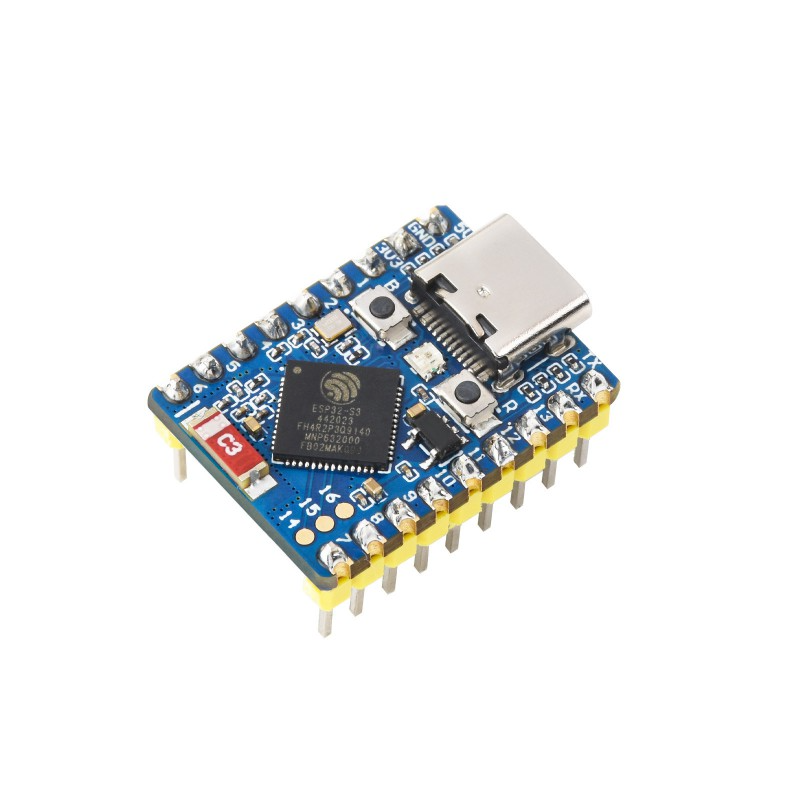
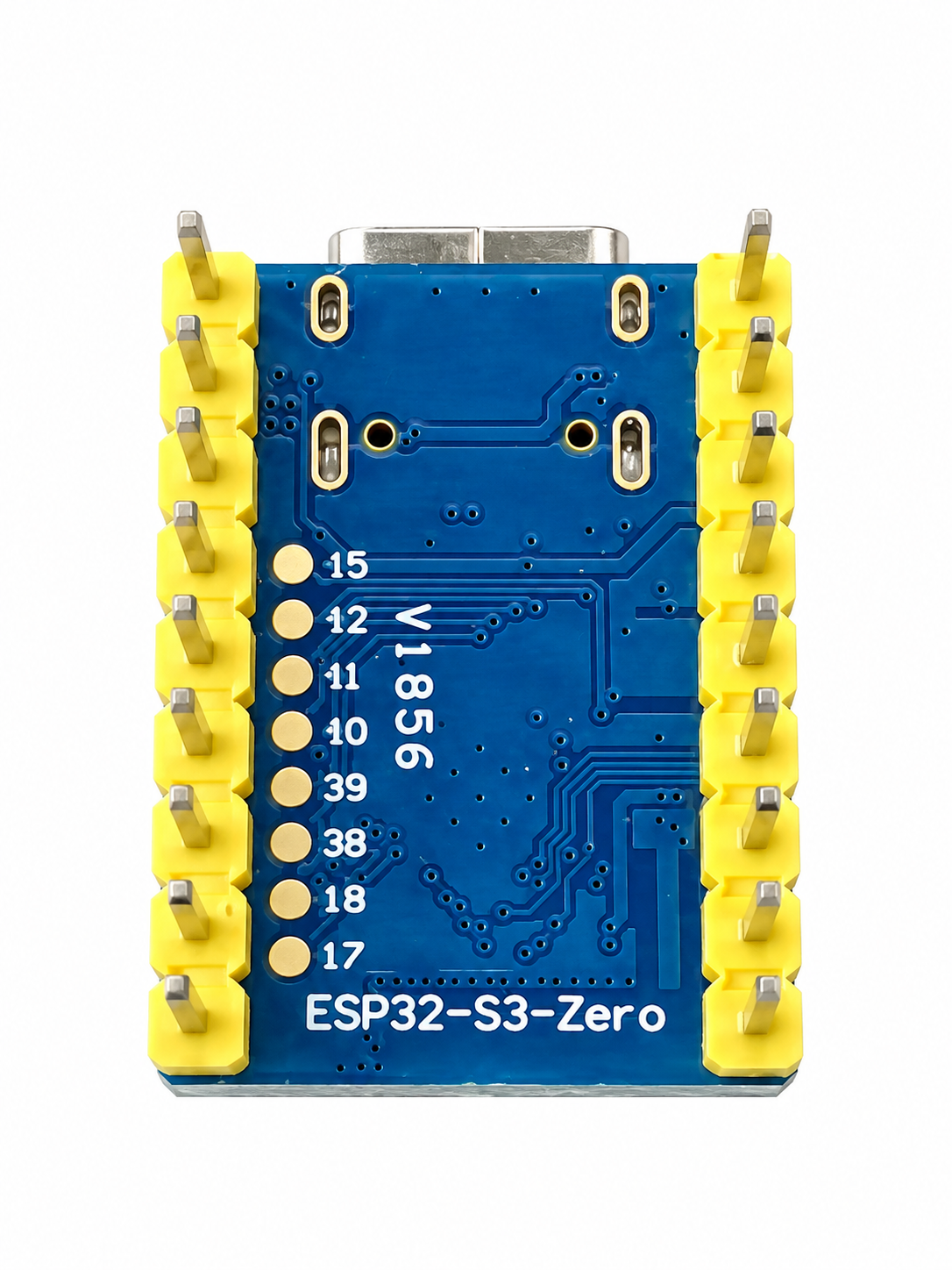
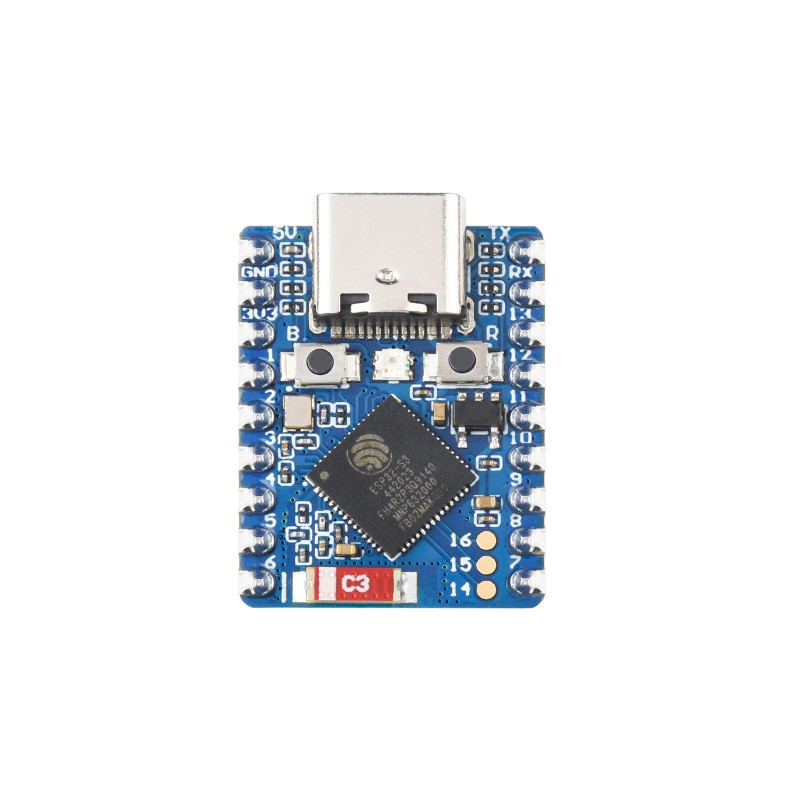
ESP32-S3-Zero-M Mini Development Board (Pre-Soldered Header)
₹483.80 incl. GST (₹410.00 + GST)
ESP32-S3-Zero-M Development Board is an ultra-compact dual-core ESP32-S3 board featuring 240MHz processing, 4MB Flash, 2MB PSRAM, 2.4GHz Wi-Fi, Bluetooth 5 LE, native USB Type-C, 24 GPIOs, and a built-in WS2812 RGB LED. With pre-soldered headers, it is ideal for IoT, AIoT, wearable devices, robotics, smart home, and embedded projects.
ESP32-S3-Zero-M Development Board – 4MB Flash 2MB PSRAM with Pre-Soldered Headers
Product Description
The ESP32-S3-Zero-M Development Board is an ultra-compact and high-performance development platform based on the ESP32-S3FH4R2 dual-core Xtensa LX7 processor. With a clock speed of up to 240MHz, integrated 2.4GHz Wi-Fi, Bluetooth 5 LE, and hardware support for AI acceleration, the board provides a powerful solution for modern IoT, embedded, robotics, and AIoT projects.
This version comes with pre-soldered headers, allowing the board to be used immediately with compatible breadboards and female headers without requiring additional soldering. Its small footprint makes it especially useful for portable electronics, wearable devices, compact sensors, and space-constrained robotic systems.
The ESP32-S3-Zero-M includes 4MB Flash and 2MB PSRAM, providing additional memory resources for firmware, data processing, graphics, sensor applications, and other embedded tasks. The ESP32-S3 platform also provides specialized instructions suitable for AI and signal-processing workloads.
The board features a USB Type-C native USB interface and does not require a separate external USB-to-UART converter chip for standard USB communication. It also includes an onboard WS2812 RGB LED connected to GPIO21, making it convenient for status indication, debugging, and lighting effects.
With 24 programmable GPIOs and support for interfaces such as SPI, I2C, UART, and I2S, the board can be connected to a wide range of sensors, displays, audio devices, actuators, and communication modules.
Features
- Based on ESP32-S3FH4R2 dual-core LX7 microcontroller
- Dual-core 32-bit Xtensa LX7 processor
- Clock speed up to 240MHz
- 4MB Flash memory
- 2MB PSRAM
- 2.4GHz Wi-Fi
- Bluetooth 5 LE
- Native USB Type-C interface
- 24 programmable GPIO pins
- Onboard WS2812 RGB LED
- RGB LED connected to GPIO21
- Onboard ceramic antenna
- Castellated / stamp-hole style board design
- Pre-soldered headers
- Supports SPI, I2C, UART, and I2S
- AI and signal-processing support
- Compact and lightweight form factor
- Suitable for wearable and portable applications
- Compatible with Arduino IDE, ESP-IDF, and MicroPython
Specifications
| Parameter | Specification |
|---|---|
| Product Type | ESP32-S3-Zero-M Development Board |
| Main MCU | ESP32-S3FH4R2 |
| Processor | Dual-Core Xtensa LX7 |
| Clock Speed | Up to 240MHz |
| Flash Memory | 4MB |
| PSRAM | 2MB |
| Wireless | 2.4GHz Wi-Fi & Bluetooth 5 LE |
| USB | USB Type-C / Native USB |
| GPIO | 24 Programmable Pins |
| RGB LED | WS2812 |
| RGB LED Pin | GPIO21 |
| LDO Regulator | ME6217C33M5G |
| LDO Output | Up to 800mA |
| Antenna | Onboard Ceramic Antenna |
| Board Design | Castellated / Stamp Hole |
| Header Type | Pre-Soldered |
| Interfaces | SPI, I2C, UART, I2S |
| Dimensions | Approximately 23.5 × 18mm |
| Development Support | Arduino IDE, ESP-IDF, MicroPython |
Design and Construction
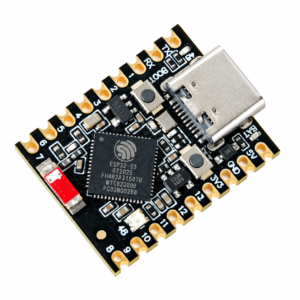
The ESP32-S3-Zero-M is designed around an ultra-compact Zero-style PCB layout, making it suitable for applications where board size is an important consideration.
Its castellated edge design allows the board to be used not only as a development board but also as an embedded module in custom PCB designs. The onboard ceramic antenna provides wireless connectivity without requiring a separate external antenna for typical applications.
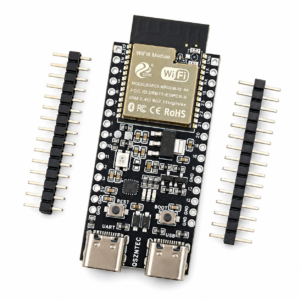
The pre-soldered headers make the development board convenient for immediate prototyping and breadboard-based projects.
The integrated RGB LED provides a simple visual output that can be used for debugging, status indication, wireless connection feedback, or custom lighting effects.
Working Principle
The ESP32-S3 acts as the main processing and connectivity controller for the project. Firmware can be uploaded through the USB Type-C interface using supported development environments such as Arduino IDE, ESP-IDF, or MicroPython.
The processor can receive data from connected sensors and peripherals through GPIO, I2C, SPI, UART, and I2S interfaces and can control external devices such as LEDs, motors, displays, and other actuators.
The integrated Wi-Fi and Bluetooth LE connectivity allows the board to communicate with wireless networks, smartphones, computers, IoT devices, and other connected systems.
The available Flash and PSRAM memory provide additional resources for more demanding applications such as graphical interfaces, data processing, AI-assisted applications, and larger embedded programs.
Onboard RGB LED
The board includes an WS2812 RGB LED connected to GPIO21.
The programmable RGB LED can be used for:
- System status indication
- Wi-Fi connection status
- Bluetooth status
- Sensor alerts
- Debugging
- User-interface effects
- Decorative lighting
Wireless Connectivity
The ESP32-S3-Zero-M supports 2.4GHz Wi-Fi and Bluetooth 5 LE, making it suitable for a wide range of wireless applications.
Wi-Fi can be used for:
- IoT cloud connectivity
- Web servers
- Remote monitoring
- Wireless data transfer
- Smart home devices
- Network-controlled robotics
Bluetooth LE can be used for:
- Smartphone communication
- BLE sensors
- Remote controls
- Wearable devices
- Short-range wireless configuration
Typical Application Scenarios
AIoT Applications
The ESP32-S3-Zero-M is suitable for edge-AI and AIoT projects involving sensor processing, voice-related applications, image processing, and intelligent automation.
Wearable Devices
Its compact size makes it suitable for smart wearables, portable controllers, fitness devices, and other small battery-powered electronics.
Smart Home
The board can be used for compact Wi-Fi/Bluetooth sensor nodes, smart switches, environmental monitoring devices, and home automation controllers.
DIY Robotics
The small form factor makes it suitable for micro-robots, small drones, robotic sensors, wireless controllers, and other compact robotic systems.
Applications
- IoT projects
- AIoT applications
- Smart home systems
- Wireless sensor nodes
- Wearable electronics
- Portable electronics
- Mini robotics
- Drones
- Embedded systems
- Bluetooth projects
- Wi-Fi projects
- Camera and image-processing projects
- Voice and audio projects
- Sensor monitoring
- Automation projects
- Arduino projects
- MicroPython projects
- ESP-IDF development
- Educational electronics
- Custom PCB development
- Compact product prototypes
Package Includes
- 1 × ESP32-S3-Zero-M Development Board
- Pre-Soldered Headers
Product Disclaimer
Product images are shown for illustrative and representational purposes only. The actual board may vary slightly in PCB colour, component placement, connector design, LED appearance, antenna arrangement, chip marking, or other visual details depending on the manufacturing batch.
USB Type-C cable, sensors, breadboards, jumper wires, batteries, and other accessories shown in product images are not included unless specifically mentioned in the package contents.
Specifications such as memory configuration, GPIO availability, regulator characteristics, and connector arrangement should be verified against the exact hardware version before use in a final or production application.
Important Notes
Pre-Soldered Version
This product is the pre-soldered header version, ready for direct use with compatible breadboards and female headers.
USB Interface
The board uses a native USB Type-C interface, allowing convenient programming and USB communication without requiring a separate external USB-to-UART converter chip for standard supported USB functions.
GPIO Availability
Although the board exposes 24 programmable GPIO pins according to the supplied specifications, not every ESP32-S3 GPIO may be freely available for every application because some pins can have dedicated board functions.
Power Supply
Use a suitable power source and ensure the connected peripherals do not exceed the capabilities of the onboard regulator and USB power source.
Recommended Related Products
Explore relevant alternatives and complementary products selected from the full Robosap catalogue.
- ESP32 S3 Zero S3Fh4R2 Mini DEV Board WiFi+Bluetooth TYPE C ARDUINO ESP SUPERMINI
- ESP32-AIVoice-Z01 AI Large Model(LLM) Development Kit ChatGPT-4o/Llama 3 Voice Assistant Chatbot, Multi-model support
- nanoESP32-C6 N8 ESP32 C6 Development Board with Wi-Fi 6, BLE 5, Zigbee, Thread and Dual USB Type-C
- ESP32-S3-N16R8 Development Board 16MB Flash 8MB PSRAM
- ESP32-C6 Super Mini Development Board
- ESP32 Type-C CP2102 30 Pin Dev Board – Dual Core WiFi+BT
Frequently Asked Questions
1. What is the ESP32-S3-Zero-M?
The ESP32-S3-Zero-M is a compact ESP32-S3 development board designed for IoT, AIoT, robotics, wearable, and embedded projects.
2. What processor does it use?
It uses the ESP32-S3FH4R2 dual-core Xtensa LX7 processor.
3. What is the maximum clock speed?
The processor can operate at up to 240MHz.
4. How much Flash and PSRAM does the board have?
The board has 4MB Flash and 2MB PSRAM.
5. Does it support Wi-Fi?
Yes. It supports 2.4GHz Wi-Fi.
6. Does it support Bluetooth?
Yes. The board supports Bluetooth 5 LE.
7. Does it have USB Type-C?
Yes. It features a USB Type-C native USB interface.
8. Does it have a built-in RGB LED?
Yes. The board includes a WS2812 RGB LED connected to GPIO21.
9. How many GPIO pins are available?
The supplied specification lists 24 programmable GPIO pins.
10. Can I use it with Arduino IDE?
Yes. The board is suitable for Arduino IDE development.
11. Can I use MicroPython?
Yes. It is suitable for MicroPython development.
12. Can I use ESP-IDF?
Yes. The board is compatible with Espressif's ESP-IDF development framework.
13. Is the header already soldered?
Yes. This product is the pre-soldered header version.
14. Can it be used for robotics?
Yes. Its small size, GPIO interfaces, Wi-Fi, Bluetooth LE, and processing capabilities make it suitable for compact robotics and drone projects.
15. Can it be embedded into a custom PCB?
Yes. Its castellated edge design makes it suitable for integration into custom PCB designs and embedded products.
16. What is the board size?
The approximate board dimensions are 23.5 × 18mm.
17. Does it have an external antenna?
No. The board uses an onboard ceramic antenna.
18. Is the USB cable included?
No. The package includes the ESP32-S3-Zero-M development board with pre-soldered headers unless otherwise specified.Only logged in customers who have purchased this product may leave a review.



Reviews
There are no reviews yet