

ESP32 WiFi+Bluetooth Dual Core ESP32 Development Board 38Pin
₹389.40 incl. GST (₹330.00 + GST)
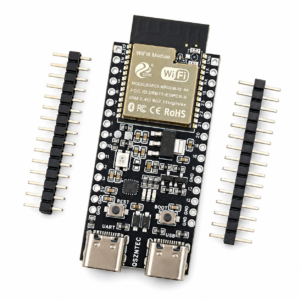
Package contains: 1 nos ESP-WROOM-32 WiFi+Bluetooth Dual Core Development Board 38Pin
Product Description
The ESP32 38-Pin Development Board is a versatile and powerful microcontroller development platform featuring integrated Wi-Fi, Bluetooth, and Bluetooth Low Energy (BLE) connectivity. Based on the ESP32 chip, it is designed for a wide range of IoT, automation, robotics, wireless communication, sensor, and embedded applications.
The board features a dual-core Xtensa 32-bit LX6 processor with an adjustable clock frequency of up to 240MHz, providing sufficient processing performance for applications ranging from low-power sensor networks to more demanding tasks such as audio streaming, voice processing, and data communication.
A built-in CP2102 USB-to-TTL converter provides reliable USB serial communication with a computer and supports automatic programming, eliminating the need for manually switching between programming and operating modes. The board is compatible with the Arduino ESP32 development environment and can also be developed using supported Windows and Linux environments.
With 4MB SPI Flash, 520KB SRAM, extensive GPIO, UART, I2C, I2S, SPI, SDIO, capacitive touch, Hall sensor, and other peripheral interfaces, the ESP32 provides a flexible platform for developing connected and intelligent embedded devices.
Features
- 38-pin ESP32 development board
- Integrated Wi-Fi connectivity
- Integrated Bluetooth and BLE
- Dual-core Xtensa 32-bit LX6 CPU
- Clock frequency adjustable from 80MHz to 240MHz
- CP2102 USB-to-TTL serial converter
- Automatic programming/download support
- Compatible with Arduino ESP32
- Supports Windows and Linux development environments
- 4MB SPI Flash
- 520KB on-chip SRAM
- 448KB ROM
- 8KB RTC SRAM for low-power operation
- Deep-sleep and low-power operating modes
- Capacitive touch sensor support
- Integrated Hall sensor
- UART, SPI, I2C, and I2S interfaces
- SDIO and SD card interface support
- Ethernet interface support
- Suitable for IoT and embedded applications
- Immersion-gold PCB finish
Specifications
| Parameter | Specification |
|---|---|
| Product Type | ESP32 Development Board |
| Board Version | 38-Pin |
| MCU | ESP32 |
| CPU | Dual-Core Xtensa 32-bit LX6 |
| Clock Frequency | 80MHz – 240MHz |
| Wi-Fi | Integrated |
| Bluetooth | Integrated |
| BLE | Supported |
| USB-to-TTL | CP2102 |
| ROM | 448KB |
| SRAM | 520KB |
| RTC SRAM | 8KB |
| SPI Flash | 4MB |
| GPIO | 38-Pin Board |
| Interfaces | UART, SPI, I2C, I2S, SDIO |
| Other Peripherals | Capacitive Touch, Hall Sensor |
| Programming | USB Serial / Automatic Download |
| Development Support | ESP32 Arduino, Windows, Linux |
Design and Construction
The ESP32 development board is designed in a compact 38-pin form factor, providing convenient access to the ESP32’s GPIO and peripheral interfaces. The board uses an immersion-gold PCB finish for improved contact reliability and durability.
The onboard CP2102 USB-to-TTL converter provides a convenient connection between the development board and a computer. This allows users to upload programs, monitor serial data, and communicate with the ESP32 without requiring a separate USB-to-serial converter.
The board provides access to multiple digital interfaces and peripherals, allowing external sensors, displays, motors, communication modules, storage devices, and other components to be connected.
Working Principle
The ESP32 acts as the main processing unit of the development board. It executes the user’s programmed application and controls connected sensors, actuators, and peripherals.
The integrated Wi-Fi, Bluetooth, and BLE capabilities allow the board to communicate wirelessly with smartphones, computers, routers, cloud platforms, and other connected devices.
Programs can be developed using compatible ESP32 development environments such as the Arduino IDE and uploaded through the CP2102 USB-to-TTL interface. The automatic download feature simplifies programming by automatically switching the ESP32 into the required programming mode.
For battery-powered applications, the ESP32 supports deep-sleep and low-power operation, allowing the system to reduce power consumption while maintaining selected monitoring functions.
Connectivity and Peripherals
The ESP32 provides a wide range of integrated interfaces for connecting external hardware, including:
- UART: Serial communication with external devices.
- I2C: Communication with sensors, displays, and other peripherals.
- SPI: High-speed communication with compatible devices.
- I2S: Suitable for digital audio applications.
- SDIO/SD: Interface support for storage and related peripherals.
- Capacitive Touch: Supports touch-based input.
- Hall Sensor: Enables magnetic-field sensing.
- Ethernet: Supports suitable Ethernet-based applications.
Low-Power Operation
The ESP32 includes several power-management capabilities for applications where energy efficiency is important. During deep-sleep operation, the main CPU can be powered down while selected low-power functions continue monitoring the system.
This makes the board suitable for battery-powered IoT devices, wireless sensors, remote monitoring systems, and other applications requiring low-power operation.
Development Support
The board can be programmed using the ESP32 Arduino framework, making it suitable for both beginners and experienced developers. It can also be developed using supported Linux and Windows environments.
The USB-to-TTL interface simplifies firmware uploading and serial debugging, while automatic download support makes repeated programming more convenient.
Applications
- IoT Devices: Develop connected sensors and smart devices.
- Home Automation: Control lights, appliances, sensors, and other devices.
- Robotics: Provide wireless control and processing for robots.
- Wireless Sensor Networks: Collect and transmit sensor data.
- Smart Home Systems: Connect and control household devices.
- Industrial Automation: Suitable for monitoring and control applications.
- Bluetooth Projects: Develop Bluetooth-enabled devices and controllers.
- BLE Applications: Build low-power Bluetooth communication systems.
- Wi-Fi Projects: Create web-connected and network-enabled devices.
- Audio Applications: Suitable for compatible audio streaming and processing projects.
- Remote Monitoring: Transmit sensor and system information wirelessly.
- Wearable Devices: Suitable for compact wireless embedded projects.
- Educational Projects: Useful for learning microcontrollers, IoT, Wi-Fi, and Bluetooth.
- Embedded Systems: Suitable for custom electronics and automation projects.
Package Includes
- 1 × ESP32 38-Pin Wi-Fi Bluetooth BLE Development Board with CP2102
Product Disclaimer
Product images are provided for reference and may differ slightly from the actual product in terms of colour, component placement, PCB layout, markings, or appearance depending on the manufacturing batch.
Specifications are based on the provided product information and may vary depending on the specific ESP32 board version or manufacturer. Please verify the board’s pin configuration, power requirements, USB interface, and technical specifications before connecting external components.
Always follow the manufacturer’s recommended operating conditions and safety guidelines when using the development board.
Frequently Asked Questions (FAQs)
1. What is the ESP32 38-Pin Development Board?
The ESP32 38-Pin Development Board is a versatile microcontroller board with built-in Wi-Fi, Bluetooth, and BLE connectivity for IoT, automation, robotics, and embedded projects.
2. What processor does the ESP32 use?
It features a dual-core Xtensa 32-bit LX6 processor with a clock frequency adjustable from 80MHz to 240MHz.
3. Does this ESP32 board support Wi-Fi?
Yes. The ESP32 has integrated Wi-Fi connectivity for wireless networking and IoT applications.
4. Does it support Bluetooth and BLE?
Yes. The board supports both Bluetooth and Bluetooth Low Energy (BLE) communication.
5. How many pins does this development board have?
This version features 38 pins for connecting sensors, modules, displays, actuators, and other peripherals.
6. What USB-to-serial chip is used?
The board uses the CP2102 USB-to-TTL converter for USB serial communication and programming.
7. Does it support automatic programming?
Yes. The CP2102-based interface supports automatic download/programming, making firmware uploading easier.
8. How much Flash memory does the board have?
The board includes 4MB SPI Flash for storing firmware and application data.
9. How much SRAM does the ESP32 have?
The ESP32 provides approximately 520KB of on-chip SRAM, along with additional RTC memory for low-power operation.
10. Can this board be programmed using Arduino IDE?
Yes. It is compatible with the ESP32 Arduino development environment, making it suitable for beginners and advanced users.
11. Can I use the ESP32 with sensors and modules?
Yes. The board provides multiple GPIO and peripheral interfaces for connecting sensors, displays, motors, relays, communication modules, and other devices.
12. Which communication interfaces are available?
The ESP32 supports interfaces such as UART, I2C, SPI, I2S, and SDIO, depending on the application and pin configuration.
13. Does the ESP32 support low-power operation?
Yes. It supports deep-sleep and other low-power modes, making it suitable for battery-powered IoT and sensor applications.
14. Can the ESP32 be used for robotics?
Yes. Its processing capability, GPIO, Wi-Fi, Bluetooth, and BLE connectivity make it suitable for robotics and wireless control projects.
15. What are the common applications of this ESP32 board?
It can be used for IoT, home automation, robotics, wireless sensor networks, smart devices, industrial automation, Bluetooth projects, and embedded systems.
16. Can the ESP32 be used for wireless sensor networks?
Yes. Its integrated Wi-Fi and BLE connectivity makes it suitable for collecting and transmitting sensor data wirelessly.
17. Does the board support Bluetooth Low Energy applications?
Yes. BLE support makes it suitable for low-power wireless communication, wearable devices, beacons, and smart sensors.
18. What operating systems can be used for development?
The ESP32 can be developed using supported Windows and Linux environments, as well as compatible development frameworks.
19. Is this board suitable for beginners?
Yes. Its Arduino compatibility, USB programming interface, and extensive community support make it suitable for learning ESP32 programming and IoT development.
20. What is included in the package?
The package includes 1 × ESP32 38-Pin Wi-Fi Bluetooth BLE Development Board with CP2102.
Only logged in customers who have purchased this product may leave a review.




Reviews
There are no reviews yet