
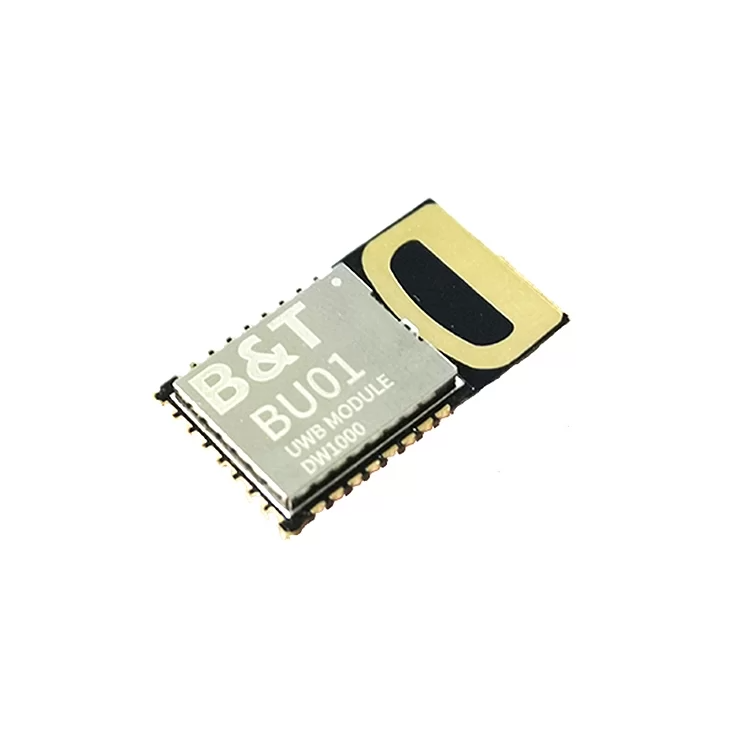
Ai-Thinker BU-01 / BU01 UWB Module – DW1000 Indoor Positioning Transceiver
₹1,567.04 incl. GST (₹1,328.00 + GST)
The BU01 UWB Wireless Positioning Module is a compact 3.5GHz–6.5GHz Ultra-Wideband module designed for accurate indoor positioning, ranging, RTLS, robotics, and IoT applications. It supports TWR and TDOA positioning, SPI communication, programmable transmit power, and data rates up to 6.8Mbps. With 2.8V–3.6V operation and less than 1mA sleep current, it is ideal for compact, low-power wireless tracking and positioning systems.
BU01 UWB Wireless Positioning Module – 3.5GHz to 6.5GHz Ultra-Wideband Transceiver
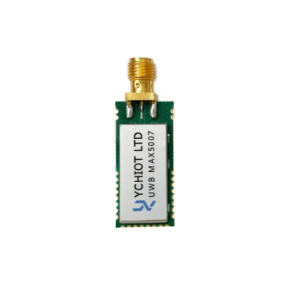
The BU01 UWB Wireless Positioning Module is a compact Ultra-Wideband communication and positioning module designed for indoor positioning, real-time location systems (RTLS), ranging, asset tracking, robotics, and wireless communication applications. With a compact size of approximately 23 × 13 × 2.9mm, the module is suitable for integration into space-constrained embedded systems and portable devices.
The module operates across the 3.5GHz to 6.5GHz UWB frequency range and complies with the IEEE 802.15.4-2011 UWB standard. Its Ultra-Wideband technology enables precise ranging and positioning capabilities while providing strong resistance to multipath fading and interference, making it suitable for challenging indoor environments.
The BU01 supports two-way ranging (TWR) and Time Difference of Arrival (TDOA) techniques for location and distance measurement applications. When integrated with a suitable RTLS infrastructure, multiple modules can be used to determine the position of mobile tags or devices and extend the communication and positioning capabilities of a wireless system.
The module provides an SPI communication interface, allowing it to communicate with a host microcontroller or processor. It supports selectable data rates of 110kbps, 850kbps, and 6.8Mbps, providing flexibility for different communication requirements.
With a low-power design and sleep-mode consumption of less than 1mA, the module is suitable for battery-powered devices and wireless tags. It operates from a 2.8V to 3.6V power supply and supports programmable transmit power for system optimization.
Features
- Compact UWB wireless positioning and communication module
- Ultra-Wideband operating frequency from 3.5GHz to 6.5GHz
- Compliant with IEEE 802.15.4-2011 UWB standard
- Supports indoor positioning and real-time location systems
- Supports Two-Way Ranging (TWR)
- Supports Time Difference of Arrival (TDOA)
- Strong resistance to multipath fading
- High interference resistance
- Suitable for high-density UWB tag deployments
- Supports programmable transmit power
- Low-power sleep mode
- Sleep current below 1mA
- Supports SPI communication interface
- Supports multiple data rates
- Data rates: 110kbps, 850kbps, and 6.8Mbps
- Suitable for RTLS infrastructure
- Useful for distance and position measurement
- Simple integration into embedded systems
- Compact size for space-constrained applications
- Suitable for battery-powered wireless devices
Specifications
| Parameter | Specification |
|---|---|
| Product Type | UWB Wireless Positioning Module |
| Module Size | 23 × 13 × 2.9mm ±0.2mm |
| Operating Frequency | 3.5GHz – 6.5GHz |
| Standard | IEEE 802.15.4-2011 UWB |
| Supply Voltage | 2.8V – 3.6V |
| Sleep Power Consumption | Less than 1mA |
| Communication Interface | SPI |
| Supported Data Rates | 110kbps, 850kbps, 6.8Mbps |
| Ranging | Two-Way Ranging (TWR) |
| Positioning Method | TDOA |
| Transmit Power | Programmable |
| Multipath Resistance | Supported |
| Interference Resistance | High |
| Application | RTLS, Positioning, Ranging & Wireless Communication |
Design and Construction
The BU01 features a highly compact form factor of approximately 23mm × 13mm × 2.9mm, allowing it to be integrated into small electronic devices, wireless tags, robotics platforms, tracking devices, and embedded systems.
The module is designed to simplify UWB integration by providing the required RF functionality in a compact module. This can reduce the complexity involved in designing a UWB RF section from the ground up.
Its UWB communication capability provides strong resistance to multipath effects and interference, which can be beneficial in indoor environments containing walls, furniture, equipment, and other reflective surfaces.
The module can be integrated with a suitable host controller through the SPI interface, allowing the main processor to configure and communicate with the UWB device.
Working Principle
The BU01 uses Ultra-Wideband radio communication to transmit and receive very short-duration wireless signals across a wide frequency spectrum.
For Two-Way Ranging (TWR) applications, two UWB devices exchange wireless messages and measure the time required for the signals to travel between them. The system can then calculate the approximate distance between the devices based on the measured signal travel time.
For TDOA-based positioning, multiple fixed UWB anchors receive signals from a mobile tag. By comparing the differences in signal arrival times at the anchors, the system can estimate the position of the tag.
When multiple UWB modules are deployed as part of an RTLS infrastructure, they can be used to track compatible tags, equipment, robots, or other moving objects within a defined indoor area.
The module’s high resistance to multipath fading and interference helps improve communication and ranging reliability in environments where radio signals may reflect from surrounding objects.
Communication Interface
The BU01 provides an SPI interface for communication with a host microcontroller or processor. SPI allows the controller to configure the module and exchange data with the UWB transceiver.
The supported data rates include:
- 110kbps
- 850kbps
- 6.8Mbps
The appropriate communication rate can be selected according to the application’s bandwidth, ranging, and system requirements.
Power and Low-Power Operation
The module operates from a 2.8V to 3.6V supply, making it suitable for many low-voltage embedded systems.
Its sleep-mode power consumption is specified as less than 1mA, making the module useful for battery-powered applications where the UWB device may spend extended periods in a low-power state.
Transmit power can also be programmed to help optimize the wireless system according to the application’s requirements.
Applications
- Indoor positioning systems
- Real-Time Location Systems (RTLS)
- Asset tracking
- Personnel tracking
- Robot positioning
- Autonomous robot navigation
- AGV positioning
- Indoor drone positioning
- Warehouse tracking systems
- Industrial equipment tracking
- Smart factory systems
- Indoor navigation
- Distance measurement
- UWB ranging systems
- Wireless tags
- Location tags
- Smart devices
- IoT positioning systems
- Logistics tracking
- Inventory tracking
- High-density tag systems
- Embedded wireless systems
- Robotics projects
- Research and development
- Educational UWB projects
Integration Considerations
The module is intended for integration into a larger embedded system and requires a suitable host microcontroller or processor for configuration and application-level operation.
For positioning applications, additional UWB devices or infrastructure may be required. For example, TWR applications generally require communication between UWB nodes, while TDOA positioning typically requires multiple fixed anchors and a mobile tag.
Installation, antenna orientation, enclosure materials, mounting position, firmware configuration, and surrounding RF environment can significantly affect UWB communication and positioning performance.
Related UWB Modules
Explore compatible UWB modules and development boards available from Robosap:
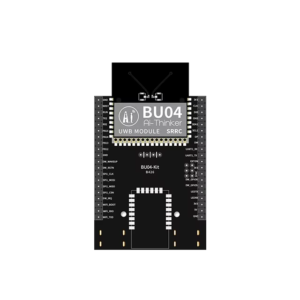
- NodeMCU-BU01 UWB Development Board for Indoor Positioning
- Qorvo DWM1000 UWB Transceiver Module
- Radar and UWB Modules
Downloads and Documentation
For detailed pin information, configuration, firmware support, electrical characteristics, and integration guidelines, refer to the manufacturer’s documentation:
Package Includes
- 1 × BU01 UWB Wireless Positioning Module
Product Disclaimer
Images are for representation only. Actual product appearance, PCB marking, connector style, antenna layout, colour, pin-header configuration, or included accessories may vary depending on the available production batch.
The specifications provided are reference information and may vary between hardware revisions. Always verify critical electrical, mechanical, firmware, RF, and communication specifications using the latest manufacturer documentation before production use.
UWB positioning and ranging performance depends on firmware configuration, antenna orientation, installation height, enclosure materials, target size, target movement, line-of-sight conditions, reflections, interference, and the surrounding environment. Actual range, positioning accuracy, angle accuracy, and current consumption should be confirmed from the latest documentation for the exact module revision.
This module is intended for use by users familiar with UWB communication, SPI interfaces, embedded systems, and RF-based positioning technologies.
FAQs
1. What is the BU01 UWB module used for?
The BU01 is designed for indoor positioning, distance measurement, ranging, RTLS, asset tracking, robotics, and IoT applications.
2. What does UWB mean?
UWB stands for Ultra-Wideband, a wireless technology that uses a wide frequency spectrum to support accurate ranging and positioning.
3. What frequency range does the BU01 support?
The module supports an operating frequency range of approximately 3.5GHz to 6.5GHz.
4. Which UWB standard does it support?
It is designed to comply with the IEEE 802.15.4-2011 UWB standard.
5. Does the module support indoor positioning?
Yes. It is suitable for indoor positioning and Real-Time Location System (RTLS) applications.
6. What is TWR?
TWR stands for Two-Way Ranging. It measures the signal travel time between UWB devices to estimate the distance between them.
7. What is TDOA?
TDOA stands for Time Difference of Arrival. It uses the difference in signal arrival times at multiple fixed UWB anchors to estimate the location of a mobile tag.
8. Can the BU01 be used for robot positioning?
Yes. It can be used for indoor robot positioning, AGV navigation, autonomous robots, and mobile robotic platforms.
9. Can it be used for asset tracking?
Yes. Multiple UWB modules can be deployed as part of an RTLS infrastructure for tracking compatible tags, equipment, tools, and other assets.
10. What communication interface does the module use?
The module uses an SPI interface for communication with a compatible microcontroller or processor.
11. What data rates are supported?
The module supports 110kbps, 850kbps, and 6.8Mbps data rates.
12. What supply voltage does the BU01 require?
The module operates from approximately 2.8V to 3.6V.
13. Is the BU01 suitable for battery-powered projects?
Yes. Its sleep-mode power consumption is specified as less than 1mA, making it suitable for many low-power wireless applications.
14. Does the module support programmable transmit power?
Yes. The module supports programmable transmit power, allowing the wireless configuration to be adjusted according to the application.
15. What is the size of the BU01 module?
The module is approximately 23 × 13 × 2.9mm, making it suitable for compact embedded devices.
16. Can the BU01 communicate with another UWB module?
Yes. Compatible UWB devices can communicate with each other for applications such as ranging and positioning, depending on the firmware and system configuration.
17. Can one BU01 module determine its own position?
A single module generally cannot provide complete positioning by itself. Positioning applications typically require multiple UWB devices, anchors, tags, and suitable positioning software or firmware.
18. Does the BU01 include an onboard display?
No. It is a UWB communication and positioning module and requires a host controller or development board for application control and data processing.
19. Can it be used with Arduino or other microcontrollers?
Yes, provided the controller supports the required SPI interface, voltage levels, and appropriate UWB software/firmware.
20. Can it be used with ESP32?
Yes. An ESP32 can potentially be used as the host controller through SPI, provided the required firmware, drivers, and voltage requirements are correctly implemented.
21. Is the module resistant to interference?
The module is designed to provide strong resistance to multipath fading and interference, although actual performance depends on the environment, installation, antenna orientation, and surrounding RF conditions.
22. Can it work in environments with many UWB tags?
Yes. The module is designed to support high tag density, making it suitable for applications where multiple wireless tags or devices operate within the same system.
23. What are the common applications of the BU01?
Common applications include RTLS, indoor navigation, robot positioning, AGV tracking, warehouse asset tracking, logistics, smart factories, IoT positioning, distance measurement, and UWB research projects.
24. Does the module require additional UWB infrastructure for RTLS?
Yes. Complete RTLS systems generally require multiple anchors, tags, a host controller, and appropriate positioning software.
25. Does the package include a development board?
No. The package normally includes 1 × BU01 UWB Wireless Positioning Module. Development boards, microcontrollers, antennas, cables, and other accessories are not included unless specifically mentioned.
26. Can the module be used directly without programming?
The module is intended for integration into an embedded system and normally requires appropriate firmware, configuration, and a host controller for application-level operation.
27. What affects UWB positioning accuracy?
Accuracy can be affected by antenna orientation, line of sight, reflections, obstacles, enclosure materials, installation height, firmware settings, target movement, interference, and the surrounding environment.
28. Is the BU01 suitable for DIY projects?
Yes. It can be used for DIY robotics, IoT, indoor positioning, asset tracking, automation, and embedded wireless projects, provided the user has the required UWB development knowledge and supporting hardware.
Downloads and Documentation
Use these manufacturer or reference documents to verify specifications, pin details, firmware support and integration requirements before designing your system. Documents may be updated by the manufacturer. Always confirm critical electrical and mechanical details with the latest official documentation before production use.Product Disclaimer
Images are for representation only. Actual product appearance, PCB marking, connector style, antenna layout, colour, pin-header configuration or included accessories may vary depending on the available production batch. Product description information listed here is collected from different internet sources, manufacturer pages, datasheets and reference documents, and may contain mistakes or become outdated. Always verify critical electrical, mechanical, firmware and safety details from the latest official manufacturer documentation before design, production or field installation. Radar, mmWave and UWB sensing performance depends on firmware, configuration, power supply quality, installation height, antenna direction, enclosure material, target size, target movement, reflections, interference, line-of-sight and surrounding environment. Distance, angle, accuracy and current values are reference values unless explicitly guaranteed by the latest manufacturer datasheet for the exact supplied revision.Additional information
| Weight | 0.00 g |
|---|---|
| Dimensions | 0.00 × 0.00 × 0.00 cm |
Only logged in customers who have purchased this product may leave a review.




Reviews
There are no reviews yet