
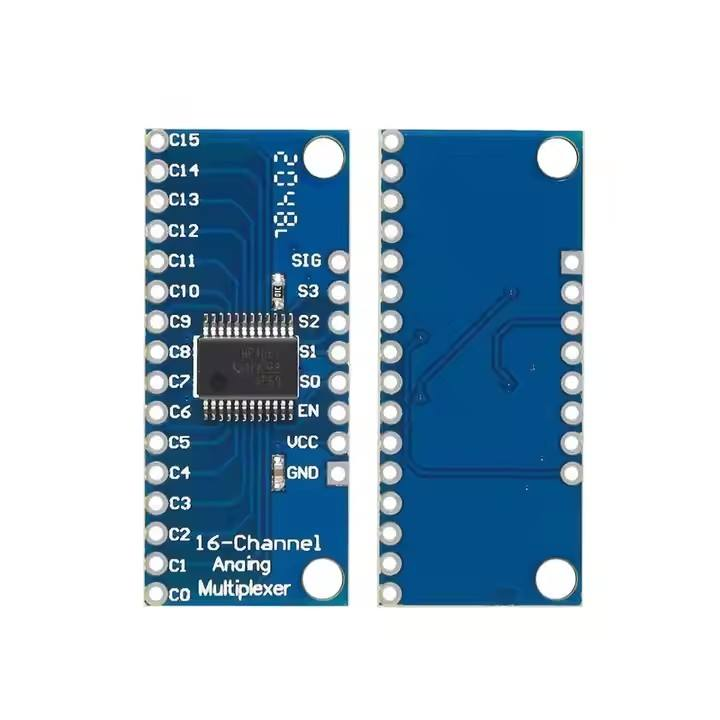
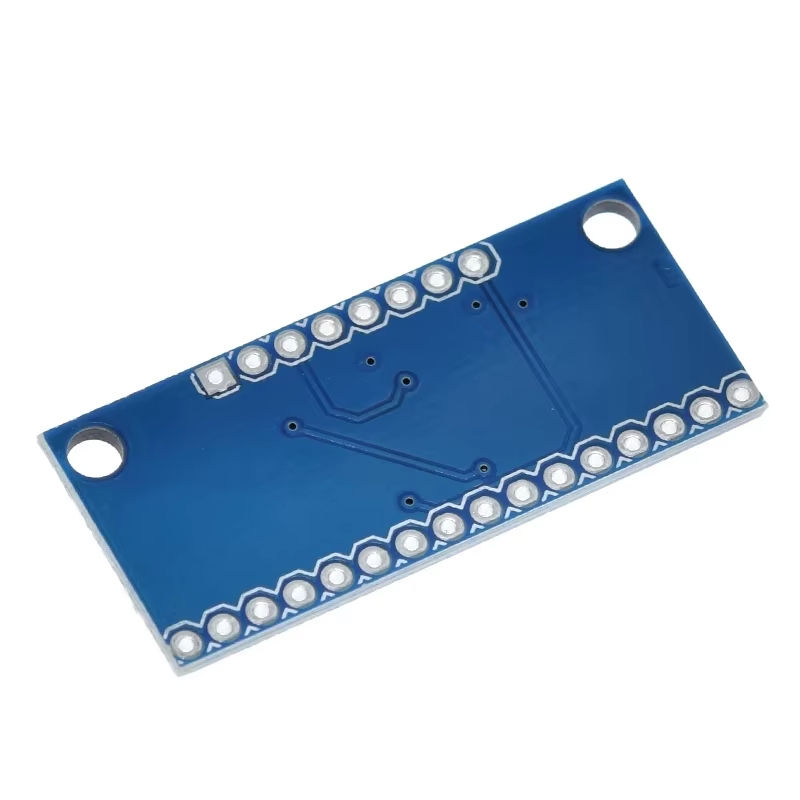
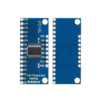
CD74HC4067 CMOS High-Speed 16-Channel Analog Multiplexer Module
₹55.76 incl. GST (₹47.25 + GST)
16-channel bidirectional analog and digital multiplexer module for connecting multiple sensors or signals using only four select pins and one signal pin.
Description
The CD74HC4067 16-Channel Analog Multiplexer/Demultiplexer Module allows a microcontroller to access up to 16 analog or digital signals through a single common signal pin.
The module works like an electronically controlled rotary switch. Based on the binary combination applied to the four channel selection pins, S0 to S3, the module connects the common SIG pin to one of the 16 channel pins, C0 to C15.
It supports both analog and digital signals, provided that the signal voltage remains between GND and the module supply voltage. Since the internal switches are bidirectional, signals can travel from the selected channel to the SIG pin or from the SIG pin to the selected channel.
This module is useful when a microcontroller does not have enough analog or digital input pins. Using four digital selection pins and one input or output pin, up to 16 sensors or signal sources can be connected.
The CD74HC4067 can also be used for selecting TTL-level serial signals from multiple devices. For example, the TX outputs of multiple sensors can be connected to different channels, while the SIG pin is connected to the microcontroller RX pin. Only the selected device will then be connected to the microcontroller.
For bidirectional serial communication, two multiplexer modules are normally required. One module can select the device TX line, while the second module selects the corresponding device RX line.
The module includes an EN enable pin. When EN is driven HIGH, all channels are disconnected from the SIG pin. When EN is LOW, the selected channel is connected.
Features
- 16 independently selectable channels
- Supports analog and digital signals
- Bidirectional signal operation
- Only four digital pins required for channel selection
- Single common SIG input/output pin
- Operates from 2V to 6V
- Compatible with 3.3V and 5V microcontrollers
- Break-before-make switching reduces channel crosstalk
- Enable pin for disconnecting all channels
- Suitable for sensors, switches, serial signals and signal routing
- Can be used as a multiplexer or demultiplexer
Specifications
| Parameter | Specification |
|---|---|
| IC | CD74HC4067 |
| Number of Channels | 16 |
| Channel Pins | C0 to C15 |
| Common Signal Pin | SIG |
| Selection Pins | S0, S1, S2 and S3 |
| Enable Pin | EN |
| Supply Voltage | 2V to 6V DC |
| Recommended Logic Compatibility | 3.3V and 5V |
| Signal Type | Analog or digital |
| Signal Direction | Bidirectional |
| Typical ON Resistance | Approximately 70Ω at 4.5V |
| Break-Before-Make Time | Approximately 6ns at 4.5V |
| Operating Temperature | -55°C to 125°C |
| Maximum Signal Voltage | Must remain between GND and VCC |
Pinout and Wiring
| Pin | Function |
| VCC | Module power supply, 2V to 6V |
| GND | Ground connection |
| SIG | Common analog or digital signal pin |
| EN | Enable input, LOW enables the module and HIGH disconnects all channels |
| S0 | Channel selection bit 0 |
| S1 | Channel selection bit 1 |
| S2 | Channel selection bit 2 |
| S3 | Channel selection bit 3 |
| C0 to C15 | Individual multiplexer channels |
Channel Selection Table
| S3 | S2 | S1 | S0 | Selected Channel |
| 0 | 0 | 0 | 0 | C0 |
| 0 | 0 | 0 | 1 | C1 |
| 0 | 0 | 1 | 0 | C2 |
| 0 | 0 | 1 | 1 | C3 |
| 0 | 1 | 0 | 0 | C4 |
| 0 | 1 | 0 | 1 | C5 |
| 0 | 1 | 1 | 0 | C6 |
| 0 | 1 | 1 | 1 | C7 |
| 1 | 0 | 0 | 0 | C8 |
| 1 | 0 | 0 | 1 | C9 |
| 1 | 0 | 1 | 0 | C10 |
| 1 | 0 | 1 | 1 | C11 |
| 1 | 1 | 0 | 0 | C12 |
| 1 | 1 | 0 | 1 | C13 |
| 1 | 1 | 1 | 0 | C14 |
| 1 | 1 | 1 | 1 | C15 |
Basic Microcontroller Connection
| CD74HC4067 Pin | Microcontroller Connection |
| VCC | 3.3V or 5V |
| GND | GND |
| S0 | Digital output pin |
| S1 | Digital output pin |
| S2 | Digital output pin |
| S3 | Digital output pin |
| EN | GND or a digital output pin |
| SIG | Analog input, digital input or digital output |
| C0 to C15 | Sensors or signal devices |
All connected devices and the multiplexer module must share a common ground.
Applications
- Connecting multiple analog sensors to one ADC pin
- Reading multiple potentiometers
- Monitoring multiple voltage signals
- Selecting digital switches or buttons
- Multiplexing TTL serial receive signals
- Sensor data acquisition systems
- Robotics and automation projects
- Arduino, ESP32, ESP8266, STM32 and Raspberry Pi projects
- Test equipment and signal-routing circuits
Package Includes
- 1 × CD74HC4067 CMOS High-Speed 16-Channel Analog Multiplexer Module
Product Disclaimer: The product image is for reference purposes only. The actual PCB colour, silkscreen printing, component appearance, board marking and layout may vary slightly depending on the manufacturing batch. Header pins may not be soldered and may require soldering before use.
The CD74HC4067 module is a signal multiplexer and does not provide voltage conversion, signal amplification, buffering or electrical isolation. The voltage applied to the SIG and C0 to C15 pins must remain between GND and the module supply voltage. Incorrect wiring, reverse polarity, excessive voltage or signals outside the supported range may damage the module or the connected microcontroller.
The module has internal switch resistance, which may affect highly sensitive or high-impedance analog measurements. Allow a short settling time after changing the selected channel before reading the signal.
Users must verify the pinout, operating voltage and compatibility with their circuit before powering the module. All connected devices should share a common ground. This module is intended for educational, prototyping and development applications and is not certified for medical, automotive, aerospace, safety-critical or life-support systems. Robosap is not responsible for damage caused by incorrect connection, improper handling, short circuit, electrostatic discharge or use outside the specified operating conditions.
Frequently Asked Questions
Can this module read 16 analog sensors using one analog pin?
Yes. Connect each analog sensor output to one of the C0 to C15 pins and connect SIG to the microcontroller analog input. Select each channel using S0 to S3 before reading the analog value.
Can it be used with an ESP32?
Yes. The module can operate at 3.3V and can be controlled directly by an ESP32. The analog signals must not exceed the ESP32 ADC input voltage range.
Can it be used with Arduino Uno?
Yes. Power the module from 5V, connect S0 to S3 to four digital pins and connect SIG to an analog or digital pin depending on the application.
Is the module bidirectional?
Yes. The selected channel and SIG pin are connected through an internal bidirectional switch.
What does the EN pin do?
The EN pin controls the complete module. EN must be LOW for normal operation. When EN is HIGH, SIG is disconnected from all 16 channels.
Can all 16 channels be read simultaneously?
No. Only one channel is connected to SIG at a time. The microcontroller must rapidly switch between channels and read them sequentially.
Can it handle voltages higher than VCC?
No. The signal applied to SIG or any channel pin must remain between GND and VCC.
Can it be used for UART communication?
It can be used to select TTL-level UART signals. One module can select multiple device TX outputs for a single microcontroller RX input. Two modules are normally required for complete two-way TX and RX communication.
Can it directly multiplex I2C devices?
Multiple multiplexers may be used to route SDA and SCL lines, but I2C bus pull-up resistors, voltage levels and bus behaviour must be considered. A dedicated I2C multiplexer may be more suitable for complex I2C systems.
Does the module provide electrical isolation?
No. The CD74HC4067 only switches signals. It does not provide electrical isolation or voltage conversion.
Only logged in customers who have purchased this product may leave a review.


Reviews
There are no reviews yet