
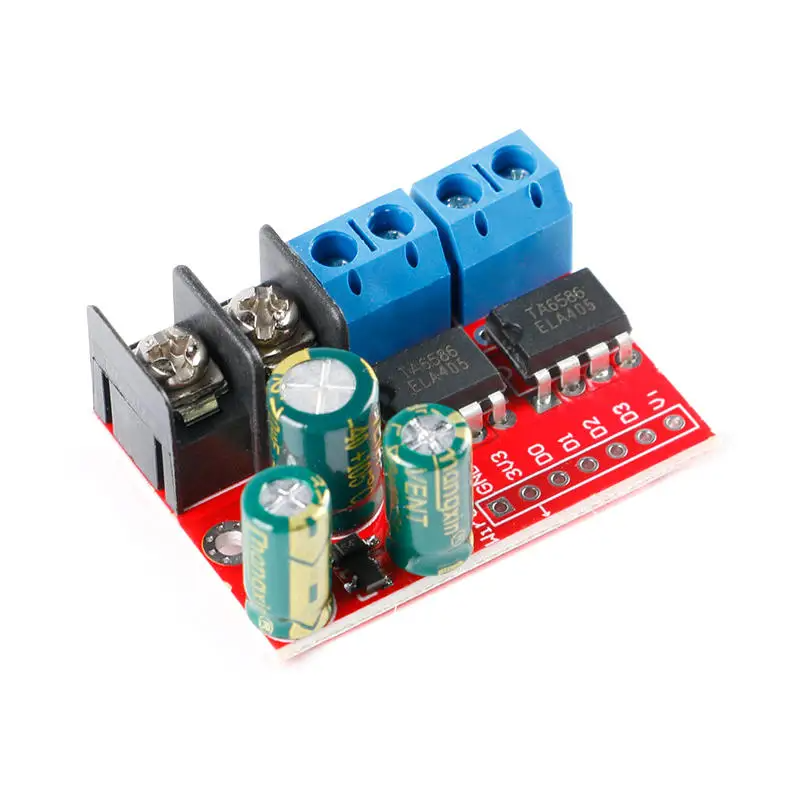
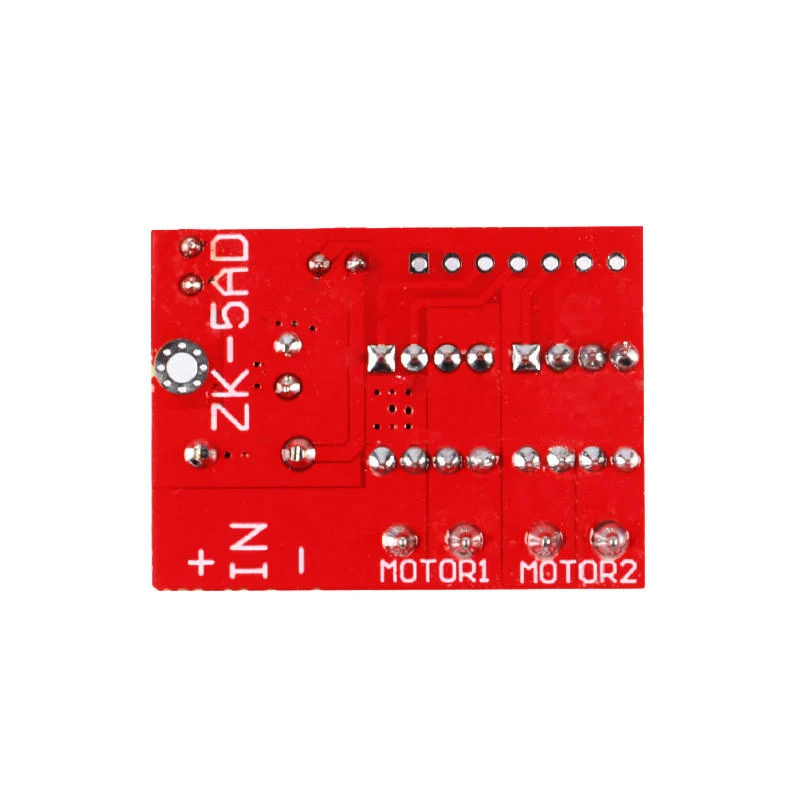
TA6586 3V-14V 5A Dual Channel DC Motor Drive Module with PWM Speed Regulation Super L298N ZK-5AD
₹200.60 incl. GST (₹170.00 + GST)
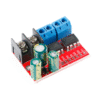
The ZK-5AD 5A Dual-Channel DC Motor Driver Module is a compact double H-bridge motor driver designed to control two DC motors independently. It supports 3V–14V DC input, up to 5A per channel, forward/reverse operation, and PWM speed control. Compatible with Arduino, ESP32, Raspberry Pi, and other controllers, it is ideal for robotics, RC cars, automation, and DIY motor-control projects.
The 5A Dual-Channel DC Motor Driver Module ZK-5AD is a compact and efficient motor control module designed to drive two DC motors independently or simultaneously. Featuring a double H-bridge motor driver design, it allows connected motors to operate in both forward and reverse directions, making it suitable for robotic vehicles, automation systems, RC projects, and other motor-driven applications.
The module supports a wide 3V to 14V DC motor supply range, allowing it to work with a variety of small and medium-sized DC motors. With a current capability of up to 5A per channel, it provides a practical solution for applications requiring higher motor current than basic low-power motor driver modules.
The ZK-5AD supports PWM speed regulation, allowing a compatible microcontroller to adjust motor speed by varying the PWM control signal. This makes it possible to achieve smoother acceleration, controlled movement, and variable-speed operation in robotic and automation applications.
The module uses a MOSFET-based motor driving circuit designed for efficient switching and reduced power losses. Its compact construction makes it convenient for integration into embedded systems, robot chassis, RC vehicles, conveyor mechanisms, and DIY electronics projects.
The driver can be controlled using digital signals from popular microcontrollers and development boards such as Arduino, ESP32, Raspberry Pi, and other compatible controllers. Its simple control interface makes it suitable for both beginner and advanced motor-control applications.
Features
- Dual-channel DC motor driver module
- Supports control of 2 DC motors
- Double H-bridge motor driver design
- Supports forward and reverse motor rotation
- Supports PWM motor speed regulation
- Wide motor supply voltage range of 3V to 14V DC
- Current capability of up to 5A per channel
- MOSFET-based motor driving circuit
- Independent control of two DC motors
- Suitable for simultaneous two-motor operation
- Compatible with Arduino and other microcontrollers
- Suitable for ESP32 and similar development boards
- Can be interfaced with Raspberry Pi using suitable logic-level control
- Compact and lightweight design
- Suitable for embedded motor-control applications
- Useful for robotics and RC vehicles
- Suitable for automation and mechanical systems
- Simple digital control interface
- Supports conventional H-bridge control logic
- Suitable for DIY electronics and prototype development
Specifications
| Parameter | Specification |
|---|---|
| Product Type | Dual-Channel DC Motor Driver Module |
| Model | ZK-5AD |
| Driver Type | Double H-Bridge |
| Motor Channels | 2 |
| Motor Type | DC Motors |
| Motor Supply Voltage | 3V to 14V DC |
| Current Capacity | Up to 5A Per Channel |
| Speed Control | PWM |
| Direction Control | Forward / Reverse |
| Control Inputs | D0, D1, D2, D3 |
| Logic High | DC 2.2V to 6.0V |
| Logic Low | DC 0.0V to 0.7V |
| Motor 1 Control | D0 and D1 |
| Motor 2 Control | D2 and D3 |
| Driver Technology | MOSFET-Based |
| Application | Robotics, RC Cars, Automation & DIY Projects |
Design and Construction
The ZK-5AD features a compact motor-driver PCB designed to provide dual-channel control in a relatively small form factor. The onboard double H-bridge circuit allows each connected DC motor to be driven in both directions by controlling the corresponding input signals.
The MOSFET-based design provides efficient switching of motor power and is suitable for applications where reliable motor control and higher current handling are required. The board provides dedicated control inputs for each motor, simplifying connection to an Arduino, ESP32, Raspberry Pi interface, or other compatible control system.
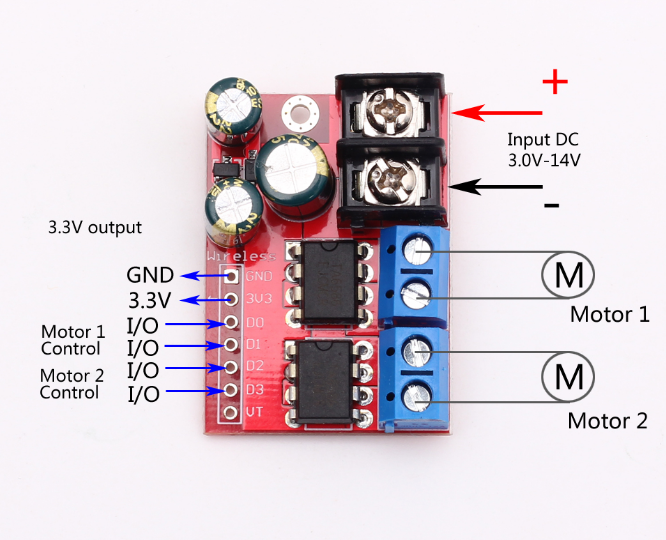
For Motor 1, the control inputs are D0 and D1, while Motor 2 is controlled using D2 and D3. By changing the logic state of these inputs, the direction and operating state of each motor can be controlled.
The module is designed for applications where two motors need to be controlled independently. It can be used in two-wheel drive robots, four-wheel robotic vehicles using suitable motor configurations, conveyor mechanisms, automated platforms, and custom mechanical systems.
Working Principle
The ZK-5AD uses a double H-bridge configuration to control the direction and speed of two DC motors.
Each motor is connected to its own H-bridge channel. For Motor 1, the D0 and D1 inputs determine the motor control state, while D2 and D3 control Motor 2.
By applying suitable HIGH and LOW logic signals to the control inputs, the H-bridge changes the polarity applied to the motor. This allows the motor to rotate forward or reverse. Appropriate control combinations can also be used to stop the motor.
For speed regulation, a PWM signal can be applied to the appropriate control input. By changing the PWM duty cycle, the average power delivered to the motor can be varied, allowing the motor speed to be adjusted.
The module accepts a HIGH-level control signal of approximately 2.2V–6.0V and a LOW-level signal of approximately 0.0V–0.7V. This allows it to interface with suitable digital control sources.
The motor supply voltage is provided separately according to the requirements of the connected motors, while the control inputs receive signals from the microcontroller or other compatible control source.
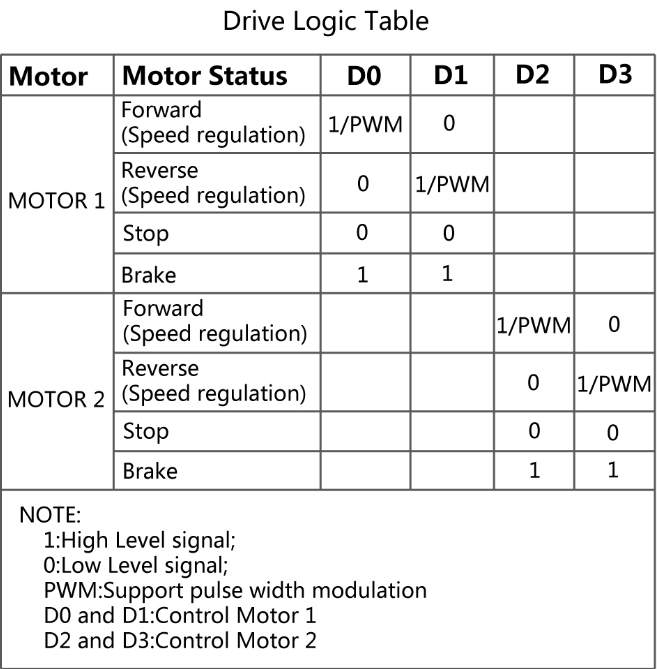
Conventional Control Method
- The module can control 2 DC motors separately.
- D0 and D1 control Motor 1.
- D2 and D3 control Motor 2.
- A HIGH-level control signal is approximately DC 2.2V–6.0V.
- A LOW-level control signal is approximately DC 0.0V–0.7V.
- D0–D3 can receive control signals from an MCU or other suitable signal source.
- Motor direction and operating state are determined according to the applicable drive logic table.
Applications
- Arduino robot cars
- Two-wheel drive robots
- Four-wheel robotic platforms
- RC cars
- DIY robotic vehicles
- Mobile robot platforms
- DC motor control projects
- Motor speed control systems
- Motor direction control systems
- Conveyor belt systems
- Automated mechanisms
- Small automation systems
- Industrial prototype systems
- Embedded motor controllers
- ESP32 motor-control projects
- Raspberry Pi motor-control projects
- Arduino automation projects
- Educational robotics projects
- STEM electronics projects
- Mechatronics projects
- DIY electronics projects
- Motorized mechanisms
- Custom robotic platforms
- Experimental vehicle projects
- Battery-powered motor systems
Package Includes
- 1 × 5A Dual-Channel DC Motor Driver Module ZK-5AD
Product Disclaimer
Product images are shown for illustrative and representational purposes only. The actual product may vary slightly in colour, dimensions, PCB layout, terminal arrangement, component placement, or appearance depending on the manufacturing batch.
DC motors, Arduino boards, ESP32 boards, Raspberry Pi boards, batteries, power supplies, wires, connectors, robot chassis, wheels, and other components shown in product images are not included unless specifically mentioned in the package contents.
The 5A current rating is the stated maximum channel capability and actual continuous operating current depends on motor characteristics, load, operating conditions, cooling, and power supply quality. Do not assume that every motor can continuously operate at 5A without appropriate thermal management.
Ensure that the motor supply voltage remains within the specified 3V–14V DC range and that the connected motor’s current requirements are appropriate for the driver.
The control input voltage levels should be maintained within the specified logic range. Always verify wiring and motor polarity before powering the module.
PWM speed control performance depends on the connected controller, PWM frequency, motor characteristics, load, and control configuration.
Related Products and Categories
Explore relevant products and category pages available from Robosap.
FAQs
1. What is the ZK-5AD motor driver module used for?
The ZK-5AD is used to control two DC motors from a microcontroller or other compatible control source. It provides motor direction and PWM speed control and is suitable for robotics, RC vehicles, automation systems, and DIY electronics projects.
2. How many DC motors can the ZK-5AD control?
The module can control two DC motors independently or simultaneously. Each motor has its own H-bridge control channel.
3. What is the motor voltage range of the ZK-5AD?
The supported motor supply voltage range is approximately 3V to 14V DC. The motor being used should be selected according to its rated operating voltage.
4. What is the maximum current capacity of the module?
The module is specified to support up to 5A per channel. Actual continuous current capability depends on the motor, load, operating conditions, cooling, and power supply.
5. Does the ZK-5AD support forward and reverse motor rotation?
Yes. The module uses a double H-bridge design that allows each DC motor to rotate in both forward and reverse directions by changing the control input signals.
6. Does the module support PWM speed control?
Yes. PWM (Pulse Width Modulation) can be used to regulate motor speed. By changing the PWM duty cycle, the average power supplied to the motor can be adjusted.
7. What type of motor driver circuit does the ZK-5AD use?
The module uses a double H-bridge motor driver configuration with MOSFET-based switching circuitry for controlling the connected DC motors.
8. Which inputs control Motor 1?
D0 and D1 are used to control Motor 1. The logic states applied to these inputs determine the motor's operating direction and state.
9. Which inputs control Motor 2?
D2 and D3 are used to control Motor 2. These inputs can be controlled independently from Motor 1.
10. What logic voltage is required for a HIGH signal?
The specified HIGH-level control signal is approximately 2.2V to 6.0V DC.
11. What voltage is considered a LOW control signal?
The specified LOW-level control signal is approximately 0.0V to 0.7V DC.
12. Can the ZK-5AD be controlled using Arduino?
Yes. The module can receive suitable digital and PWM control signals from an Arduino. It can be used for robot cars, motorized mechanisms, automation projects, and other Arduino-based applications.
13. Can the ZK-5AD be used with ESP32?
Yes. The module can be controlled using suitable ESP32 GPIO and PWM signals, provided the control signal levels and wiring are compatible with the driver.
14. Can the ZK-5AD be used with Raspberry Pi?
Yes. It can be controlled from a Raspberry Pi using appropriate GPIO signals and software. The motor power supply should be provided separately according to the motor requirements.
15. Can two motors be controlled independently?
Yes. Motor 1 and Motor 2 have separate control inputs, allowing their direction and speed to be controlled independently.
16. Can the module be used for a two-wheel robot?
Yes. It is well suited for two-wheel drive robot cars and mobile robots, where one motor can drive the left wheel and the other motor can drive the right wheel.
17. Can it be used for a four-wheel robot?
Yes, depending on the motor arrangement. Two motors can be connected to the two available channels, with appropriate motors mechanically coupled or connected according to the robot design. Ensure the combined motor current remains within the driver's capabilities.
18. Can the ZK-5AD control stepper motors?
The ZK-5AD is primarily designed for DC motor control. It should not be treated as a dedicated stepper motor driver unless the particular stepper configuration and control requirements are explicitly supported.
19. What are the common applications of the ZK-5AD?
Common applications include robot cars, RC vehicles, mobile robots, conveyor mechanisms, automated platforms, motorized systems, Arduino projects, ESP32 projects, educational robotics, and DIY motor-control systems.
20. Does the module require a separate power supply for the motors?
The connected motors require an appropriate motor power source within the 3V–14V range. The power supply must provide sufficient current for the motors under their expected load.
21. Can the module be used with high-current motors?
It can be used with motors whose requirements fall within the module's specified voltage and current limits. Although the module is rated up to 5A per channel, continuous high-current operation may require appropriate cooling and careful power-supply selection.
22. Is the ZK-5AD suitable for battery-powered robots?
Yes. It can be used in battery-powered robotic vehicles when the battery voltage is compatible with the 3V–14V motor supply range and the battery can provide the required motor current.
23. How does the H-bridge control motor direction?
An H-bridge changes the polarity of the voltage applied to the motor. By changing the input logic combination, the driver can make the motor rotate in one direction, the opposite direction, or stop.
24. How does PWM control the motor speed?
PWM rapidly switches the motor supply on and off. Adjusting the PWM duty cycle changes the average power delivered to the motor, allowing its speed to be controlled.
25. Is the ZK-5AD suitable for beginners?
Yes. Its simple control inputs and dual-channel design make it suitable for students, hobbyists, Arduino learners, and robotics beginners who want to experiment with DC motor control.
26. Can the ZK-5AD control motors and other electronics from the same controller?
Yes. A microcontroller such as Arduino or ESP32 can control the ZK-5AD while simultaneously managing sensors, displays, communication modules, or other project components.
27. What precautions should be taken while connecting the module?
Always verify the motor polarity, supply voltage, control-signal levels, and current requirements before powering the module. Keep the motor supply within the specified range and avoid exceeding the stated current capability.
28. Does the package include motors or a microcontroller?
No. The package includes 1 × ZK-5AD 5A Dual-Channel DC Motor Driver Module. Motors, Arduino boards, ESP32 boards, Raspberry Pi boards, batteries, wires, power supplies, and other accessories are not included unless specifically stated.
29. Can the ZK-5AD be used for automation systems?
Yes. It can control DC motors used in conveyor systems, automated mechanisms, linear movement systems, small machines, and custom automation projects, provided the motor requirements are within the module's specifications.
30. What is the main advantage of the ZK-5AD motor driver?
The main advantage is its combination of dual DC motor control, double H-bridge operation, PWM speed regulation, 3V–14V motor voltage support, and up to 5A per-channel current capability in a compact module.
Only logged in customers who have purchased this product may leave a review.


Reviews
There are no reviews yet