
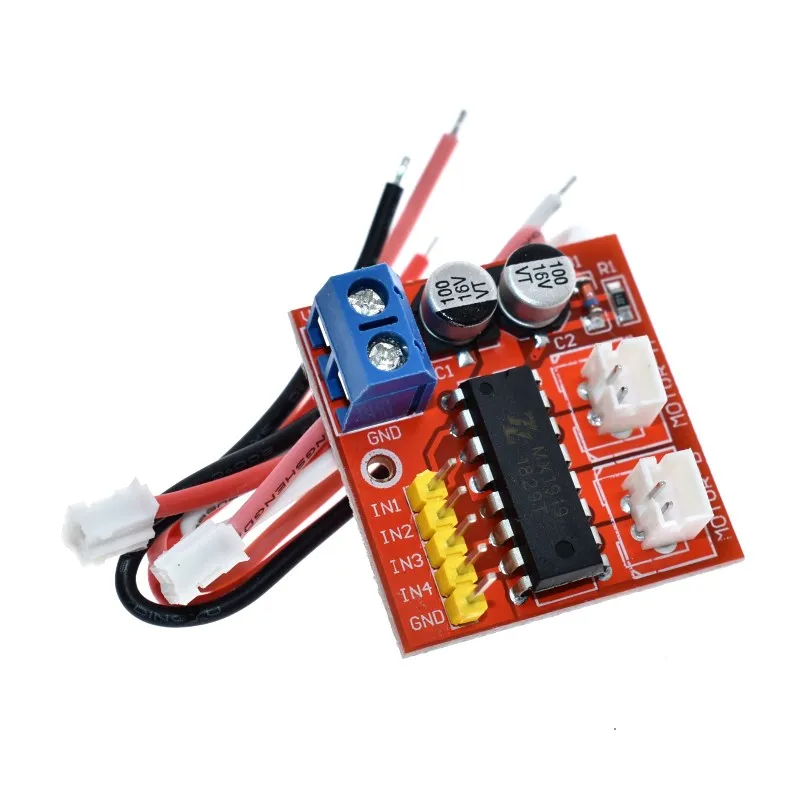
MX1919 Dual Channel DC Motor Driver Module – 2.5A
₹135.70 incl. GST (₹115.00 + GST)
MX1919 Based Motor Driver Module is a compact dual H-bridge controller supporting up to 2.5A peak current, 2–10V DC operation, and 1.8V/3.3V/5V logic compatibility. It can control two DC motors or one 4-wire stepper motor, making it ideal for Arduino, ESP32, Raspberry Pi, micro-mouse, line-following, robotic, and DIY projects.
MX1919 Based Motor Driver Module – Dual H-Bridge 2.5A DC Motor Driver
Product Description
The MX1919 Based Motor Driver Module is a compact and high-current dual-channel motor driver designed for controlling DC motors and small stepper motors in robotics, automation, and embedded electronics projects.
Based on the MX1919 / MX1515 motor driver IC, the module provides two independent H-bridge channels, allowing users to control two DC motors independently or one 4-wire stepper motor. It supports forward, reverse, braking, and PWM speed control, making it suitable for applications requiring precise motor movement.
The module operates from 2V to 10V DC, making it suitable for low-voltage battery-powered systems using Li-ion, NiMH, and other compatible power sources. Its logic inputs are compatible with 1.8V, 3.3V, and 5V controllers, allowing easy integration with Arduino, ESP32, Raspberry Pi, and other microcontroller platforms.
With a compact size of approximately 28 × 28mm and a weight of only around 5g, the module is suitable for space-constrained robotic platforms, line-following robots, micro-mouse robots, robotic arms, and other lightweight applications.
Features
- Compact dual-channel motor driver
- Based on MX1919 / MX1515 IC
- Dual H-bridge configuration
- Controls two DC motors independently
- Can control one 4-wire stepper motor
- Supports forward and reverse motor operation
- Supports braking functionality
- PWM speed control
- Operating voltage from 2V to 10V DC
- Peak output current up to 2.5A
- Compatible with 1.8V, 3.3V, and 5V logic
- Suitable for Arduino, ESP32, and Raspberry Pi
- Lightweight 5g design
- Compact 28 × 28mm PCB
- Suitable for battery-powered applications
Specifications
| Parameter | Specification |
|---|---|
| Product Type | Dual H-Bridge Motor Driver Module |
| Driver IC | MX1919 / MX1515 |
| Operating Voltage | 2V – 10V DC |
| Maximum Output Current | 2.5A |
| Control Channels | 2 Channels |
| Motor Support | 2 DC Motors / 1 Four-Wire Stepper Motor |
| Logic Input | 1.8V / 3.3V / 5V Compatible |
| Dimensions | 28 × 28 × 10mm |
| Weight | Approximately 5g |
| Control Method | Digital / PWM |
| Driver Type | Dual H-Bridge |
Working Principle
The module uses two H-bridge motor-control circuits to control the direction and speed of connected motors.
By changing the logic states of the input pins, the controller can command each motor to:
- Rotate forward
- Rotate reverse
- Stop
- Brake
PWM signals can also be applied to the control inputs to regulate motor speed.
The two H-bridge channels can be operated independently, allowing differential-drive robots and other two-motor systems to perform turning and directional movement.
DC Motor Control
The module can independently control two DC motors. This makes it particularly useful for two-wheel robotic platforms where each motor can be controlled separately.
For example:
- Both motors forward → Robot moves forward
- Both motors reverse → Robot moves backward
- One motor slower → Robot turns
- One motor forward and one reverse → Robot can rotate in place
Actual motor performance depends on the motor specifications, supply voltage, load, and thermal conditions.
Stepper Motor Support
The two H-bridge channels can also be used to control a compatible 4-wire bipolar stepper motor.
A suitable control sequence must be generated by the connected microcontroller to energize the motor windings in the required order.
Logic Compatibility
The input control pins are designed to work with common digital logic levels, including:
- 1.8V
- 3.3V
- 5V
This provides convenient compatibility with development platforms such as Arduino, ESP32, Raspberry Pi, STM32, and other microcontrollers.
PWM Speed Control
PWM can be used to control the effective motor power and adjust DC motor speed.
By changing the PWM duty cycle, the user can vary motor speed according to the requirements of the application.
The actual usable PWM frequency and motor response depend on the motor, controller, supply voltage, and application.
Typical Application Scenarios
Micro-Mouse Robots
The compact size and high current capability make the module suitable for high-speed micro-mouse and compact competitive robots.
Line-Following Robots
PWM speed control allows independent adjustment of left and right motors for precise navigation and turning.
Robotic Arms
The small form factor makes the module suitable for controlling compact DC motors in robotic joints and mechanisms.
DIY Mobile Robots
It can be used in two-wheel and four-wheel robotic platforms requiring compact motor-control electronics.
LED and Inductive Loads
The H-bridge outputs can also be used for suitable inductive or PWM-controlled loads within the module’s electrical limits.
Applications
- Micro-mouse robots
- Line-following robots
- 2WD robot cars
- Small 4WD robots
- Arduino robotics
- ESP32 robotics
- Raspberry Pi robotics
- Robotic arms
- Small DC motor control
- Stepper motor control
- Autonomous robots
- Educational robotics
- Battery-powered robots
- DIY automation
- Embedded motor control
- Compact mechatronics projects
- High-current LED control
- Prototype development
Package Includes
- 1 × MX1919 Based Motor Driver Module – 2.5A
Product Disclaimer
Product images are shown for illustrative and representational purposes only. The actual module may vary slightly in PCB colour, component placement, IC marking, terminal arrangement, dimensions, or other visual details depending on the manufacturing batch.
The module may be supplied with either MX1919 or MX1515 IC, depending on stock availability. Both variants are stated to have the same electrical characteristics, pinout, and performance specifications.
Motors, Arduino boards, ESP32 boards, Raspberry Pi boards, batteries, jumper wires, and other accessories shown in product images are not included unless specifically mentioned in the package contents.
Actual output current capability depends on operating voltage, motor load, PCB temperature, airflow, and duration of operation. The maximum current should not be assumed to be continuously available without appropriate thermal management.
Important Notes
Power Supply
Use a suitable DC supply within the specified 2V–10V range. Ensure the power source can provide the required motor current.
Motor Current
Motors can draw significantly higher current during startup, acceleration, stall conditions, or sudden load changes. Ensure the motor driver and power supply are appropriately rated.
Thermal Management
When operating at higher current levels, provide sufficient airflow and heat dissipation to prevent excessive temperature rise.
Logic Ground
Connect the controller ground and motor-driver ground correctly to provide a common reference for the control signals.
Recommended Related Products
Explore relevant alternatives and complementary products selected from the full Robosap catalogue.
Frequently Asked Questions
1. What is the MX1919 motor driver module?
It is a compact dual H-bridge motor driver used to control DC motors and compatible 4-wire stepper motors.
2. How many DC motors can it control?
It can independently control two DC motors.
3. Can it control a stepper motor?
Yes. It can be used to control one compatible 4-wire bipolar stepper motor.
4. What is the operating voltage?
The specified motor supply range is 2V to 10V DC.
5. What is the maximum output current?
The module is specified for up to 2.5A peak output current.
6. Is PWM speed control supported?
Yes. PWM can be used to control the speed of suitable DC motors.
7. What logic voltage does it support?
The input logic is compatible with 1.8V, 3.3V, and 5V systems.
8. Can I use it with Arduino?
Yes. It can be controlled by Arduino using the digital input pins and PWM outputs.
9. Can I use it with ESP32?
Yes. The 3.3V logic of the ESP32 is compatible with the specified logic input range.
10. Can I use it with Raspberry Pi?
Yes. It can be controlled from suitable Raspberry Pi GPIO outputs, provided the wiring and power supply are correctly configured.
11. Can it control a robot car?
Yes. It is suitable for small two-motor and similar robotic vehicles.
12. Does it support forward and reverse?
Yes. The H-bridge configuration allows forward and reverse motor operation.
13. Can the motors be controlled independently?
Yes. The two H-bridge channels can be controlled independently.
14. Does it require a separate motor power supply?
The motor supply must be provided within the module's specified range and should be capable of delivering the required motor current. The controller and motor supply arrangement depends on the project design.
15. Which IC will I receive?
Depending on stock availability, the module may use MX1919 or MX1515. The supplied product information states that both variants share the same electrical characteristics, pinout, and performance specifications.
16. Are the motors included?
No. The package contains only the MX1919 Based Motor Driver Module.
Only logged in customers who have purchased this product may leave a review.



Reviews
There are no reviews yet