
Capacitive Soil Moisture Sensor V2.0 Module For Arduino/ Raspberry Pi
₹66.08 incl. GST (₹56.00 + GST)
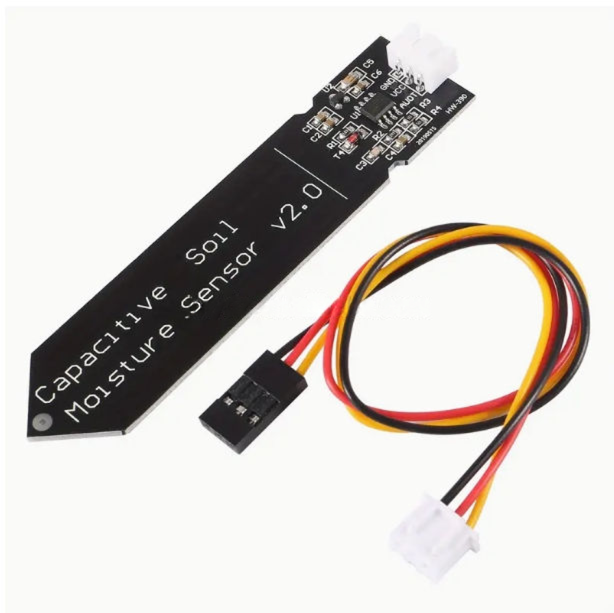
The Capacitive Soil Moisture Sensor V2.0 is a durable sensor that measures soil moisture using capacitive sensing technology, offering better corrosion resistance than traditional resistive sensors. It provides an analog voltage output and operates from 3.3V to 5V DC, making it compatible with Arduino, ESP32, Raspberry Pi with suitable ADC, and other microcontrollers. With a -10°C to +60°C working temperature range, it is ideal for smart irrigation, agriculture automation, plant monitoring, and DIY projects.
Capacitive Soil Moisture Sensor V2.0
Product Description
The Capacitive Soil Moisture Sensor V2.0 is a durable and reliable sensor designed to measure soil moisture levels using capacitive sensing technology. Unlike traditional resistive soil moisture sensors, it does not rely on exposed conductive electrodes, helping provide improved corrosion resistance and longer service life in soil-monitoring applications.
The sensor provides a simple analog voltage output that can be read directly by a compatible analog input or ADC. This makes it easy to monitor changes in soil moisture and use the readings for plant care, smart irrigation, agriculture automation, and IoT projects.
With an operating voltage of 3.3V to 5V DC and a working temperature range of -10°C to +60°C, the sensor is suitable for use with popular development platforms such as Arduino, ESP32, Raspberry Pi with a suitable ADC, and other microcontrollers.
Features
- Capacitive soil moisture sensing technology
- V2.0 sensor design
- Analog voltage output
- Better corrosion resistance than resistive sensors
- Corrosion-resistant PCB coating
- Operates from 3.3V to 5V DC
- Simple 3-pin interface
- Easy to insert into soil
- Suitable for long-term moisture monitoring
- Compatible with popular microcontroller platforms
- Suitable for smart irrigation and agriculture automation
Specifications
| Parameter | Specification |
|---|---|
| Sensor Type | Capacitive Soil Moisture Sensor |
| Model | V2.0 |
| Output Type | Analog Voltage |
| Operating Voltage | 3.3V – 5V DC |
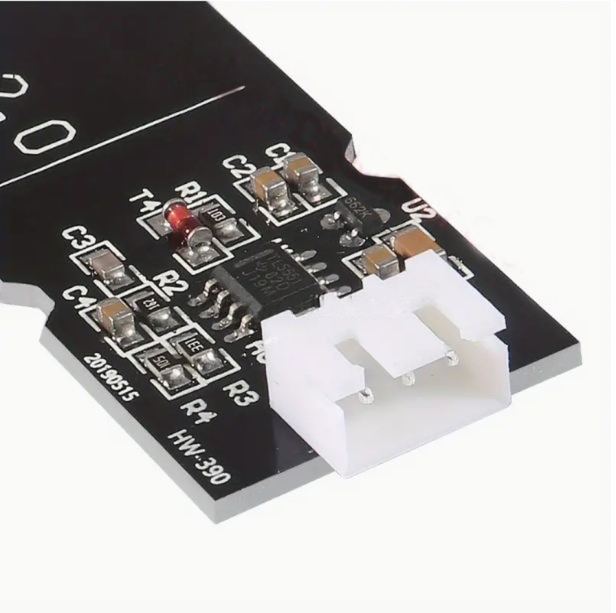
| Interface | VCC, GND, Analog Output |
| Detection Method | Capacitive Soil Moisture Detection |
| Material | Corrosion-Resistant PCB Coating |
| Working Temperature | -10°C to +60°C |
| Application | Soil Moisture Monitoring, Smart Irrigation, Agriculture Automation |
| Compatible Boards | Arduino, ESP32, Raspberry Pi, Microcontrollers |
Pin Configuration
| Pin | Function |
|---|---|
| VCC | 3.3V – 5V DC Power Input |
| GND | Ground |
| Analog Output | Soil Moisture Analog Signal |
Design and Construction
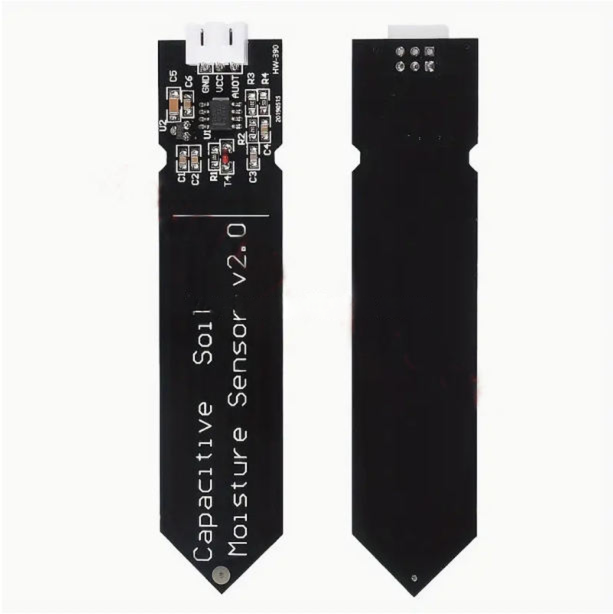
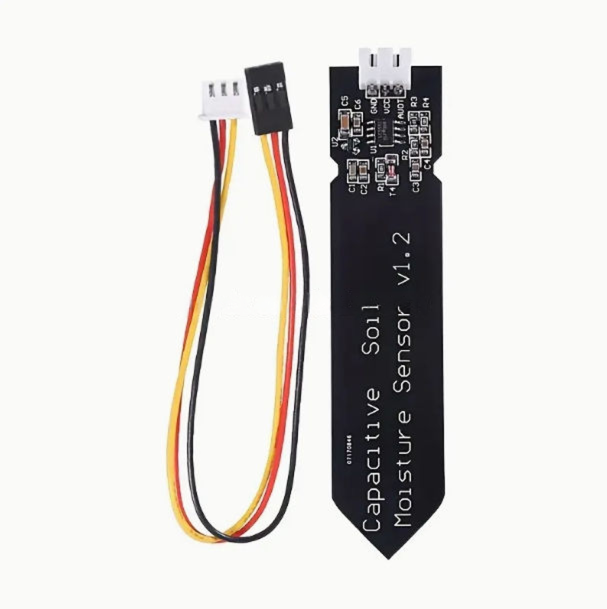
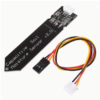
The Capacitive Soil Moisture Sensor V2.0 features a compact sensing board with a corrosion-resistant PCB coating for improved durability in soil environments. Its capacitive sensing structure allows moisture to be detected without depending on exposed metal electrodes.
The simple three-pin interface makes the sensor easy to connect to development boards and microcontrollers. Its compact construction allows it to be inserted into soil near plant roots for convenient moisture monitoring.
Working Principle
The sensor works by detecting changes in the capacitance of the soil as its moisture content changes. Water in the soil affects the dielectric properties surrounding the sensing area, causing a corresponding change in capacitance.
The sensor converts this change into an analog voltage output. A connected microcontroller or ADC can read this signal and use the measured value to determine relative soil moisture conditions.
The analog readings can be calibrated according to the soil type and application to establish suitable dry, moist, and wet ranges.
Applications
- Soil moisture monitoring
- Smart irrigation systems
- Automatic plant watering
- Smart gardening
- Agriculture automation
- Smart farming
- Greenhouse monitoring
- Plant care systems
- Arduino projects
- ESP32 projects
- IoT agriculture
- Soil data logging
- DIY electronics
- Educational projects
How to Use
- Connect VCC to a suitable 3.3V or 5V supply.
- Connect GND to the common ground.
- Connect the Analog Output to a suitable analog input or ADC.
- Insert the sensing portion into the soil near the plant.
- Read the analog value using the microcontroller.
- Calibrate the readings according to the soil conditions and application requirements.
Compatible Platforms
- Arduino Uno, Nano, Mega and compatible boards
- ESP32
- ESP8266
- STM32
- Raspberry Pi with a suitable ADC
- Other 3.3V/5V microcontrollers with analog input
Package Includes
- 1 × Capacitive Soil Moisture Sensor V2.0
Product Disclaimer
The sensor provides an analog indication of soil moisture and may require calibration because readings can vary depending on soil composition, temperature, sensor depth, and environmental conditions.
The sensor is intended for soil moisture monitoring and does not directly operate a water pump. An appropriate relay, MOSFET, or motor driver is required for automatic irrigation applications.
Product images are for representation only. The actual product may differ slightly in appearance, colour, dimensions, PCB markings, or component placement depending on the manufacturing batch.
FAQs – Capacitive Soil Moisture Sensor V2.0
1. What is the Capacitive Soil Moisture Sensor V2.0?
It is a soil moisture sensor that uses capacitive sensing technology to measure changes in soil moisture and provide an analog output.2. What type of output does the sensor provide?
The sensor provides an analog voltage output that can be read using a microcontroller's ADC or analog input.3. What is the operating voltage?
It operates from 3.3V to 5V DC.4. What are the sensor pins?
The sensor has three connections: VCC, GND, and Analog Output.5. How does the sensor detect moisture?
It detects changes in the capacitance of the surrounding soil as the moisture content changes and converts this change into an analog signal.6. Is the sensor corrosion resistant?
Yes. Its capacitive sensing design and corrosion-resistant PCB coating provide better durability than traditional resistive soil moisture sensors.7. Can it be used with Arduino?
Yes. It can be connected to Arduino boards such as Uno, Nano, Mega, and other compatible boards.8. Can it be used with ESP32?
Yes. The sensor is suitable for ESP32 and other 3.3V microcontrollers.9. Can it be used with Raspberry Pi?
Yes, but Raspberry Pi boards generally require an external ADC because they do not have built-in analog inputs.10. What is the working temperature range?
The specified working temperature range is -10°C to +60°C.11. Can the sensor be used for automatic irrigation?
Yes. Its analog output can be read by a controller and used to activate a suitable relay, MOSFET, or pump driver for automatic irrigation.12. Can it directly control a water pump?
No. The sensor only provides a moisture reading. A suitable control or driver circuit is required to operate a pump.13. Does the sensor require calibration?
Calibration is recommended because analog readings can vary depending on soil type, moisture conditions, sensor depth, and environmental factors.14. What are the main applications?
It is suitable for smart gardening, plant monitoring, smart irrigation, agriculture automation, greenhouse systems, IoT projects, and DIY electronics.15. What is included in the package?
The package includes 1 × Capacitive Soil Moisture Sensor V2.0.16. Is this sensor better than a resistive soil moisture sensor?
Capacitive sensing generally provides better resistance to corrosion and longer-term durability compared with exposed-electrode resistive sensors.17. Can the sensor be used for long-term soil monitoring?
Yes. Its capacitive sensing method and corrosion-resistant construction make it suitable for long-term soil moisture monitoring.18. Does the sensor provide a digital output?
No. This version provides an analog output only.19. Can the analog reading indicate whether soil is dry or wet?
Yes. The analog value can be calibrated to establish suitable dry, moist, and wet thresholds for a particular soil and application.20. Is the sensor suitable for DIY projects?
Yes. Its simple three-pin interface and analog output make it suitable for Arduino, ESP32, IoT, agriculture, and educational projects.Only logged in customers who have purchased this product may leave a review.



Reviews
There are no reviews yet