
Product Description
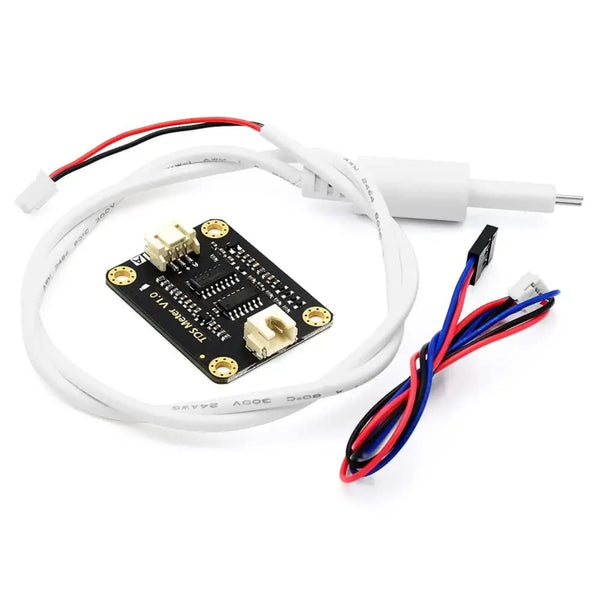
The Arduino-Compatible TDS Sensor / Meter Kit is an easy-to-use water quality testing module designed to measure the Total Dissolved Solids (TDS) present in water. TDS represents the total amount of dissolved organic and inorganic substances in water and is commonly expressed in ppm (parts per million) or mg/L.
This TDS sensor kit provides an affordable solution for integrating water quality monitoring into Arduino and other microcontroller-based projects. Unlike handheld TDS pens, which are mainly designed for manual measurement, this module provides an analog voltage output that can be read by a controller for online monitoring, data logging, display, and automated water-quality analysis.
The signal transmitter board accepts an input voltage of 3.3–5.5 V and provides a 0–2.3 V analog output, making it compatible with both 3.3 V and 5 V controller systems. Its low working current of approximately 3–6 mA makes it suitable for embedded and portable applications.
The module uses an AC excitation source to help reduce electrode polarization during measurement. The included TDS probe is designed for water-quality applications and can be used for domestic water, hydroponics, and other suitable water-testing applications.
With a measurement range of approximately 0–1000 ppm and specified accuracy of ±10% F.S. at 25°C, this module is suitable for educational projects, DIY water-quality monitors, IoT systems, and Arduino-compatible applications.
Features
- Arduino-compatible TDS water quality sensor
- Measures Total Dissolved Solids (TDS) in water
- TDS measurement range of 0–1000 ppm
- 0–2.3 V analog signal output
- Compatible with 3.3 V and 5 V controllers
- Input voltage range of 3.3–5.5 V
- Low working current of approximately 3–6 mA
- AC excitation source helps reduce probe polarization
- Waterproof TDS probe
- Easy plug-and-play connection
- No soldering required for basic connection
- Suitable for Arduino and other microcontrollers
- Useful for online water quality monitoring
- Compact transmitter board
- Suitable for domestic water testing
- Suitable for hydroponic applications
- Affordable alternative for DIY water-quality monitoring
Specifications
| Parameter | Specification |
|---|---|
| Product Type | TDS Sensor / Meter Kit |
| Application | Water Quality Measurement |
| Measurement Parameter | Total Dissolved Solids (TDS) |
| TDS Measurement Range | 0–1000 ppm |
| Input Voltage | 3.3–5.5 V |
| Analog Output Voltage | 0–2.3 V |
| Working Current | 3–6 mA |
| Measurement Accuracy | ±10% F.S. at 25°C |
| Excitation Method | AC Excitation |
| Probe Type | Waterproof TDS Probe |
| Signal Interface | PH2.0-3P |
| Electrode Interface | XH2.54-2P |
| Board Size | Approximately 42 × 32 mm |
| Controller Compatibility | 3.3 V / 5 V Controllers |
| Connection Type | Plug and Play |
What is TDS?
TDS (Total Dissolved Solids) refers to the total concentration of dissolved substances present in water. These substances can include various dissolved salts, minerals, metals, and other organic or inorganic materials.
TDS is generally expressed in ppm or mg/L. A higher TDS value indicates a greater concentration of dissolved substances in the water.
TDS can be used as one of the reference parameters for assessing water quality, but TDS alone does not identify which substances are dissolved in the water and should not be considered a complete measure of water safety or purity.
Working Principle
The TDS probe is placed in the water being tested. The sensor generates an electrical measurement related to the dissolved ionic content of the water.
The transmitter board processes the probe signal and produces a corresponding analog voltage between 0 and 2.3 V. A connected Arduino or other microcontroller can read this analog voltage through an ADC input and calculate or display the corresponding TDS value.
The module uses an AC excitation signal rather than continuous DC excitation, which helps reduce electrode polarization and supports more stable measurement.
For improved measurement results, temperature compensation and suitable calibration should be applied according to the application and water conditions.
Analog Output
The sensor provides a 0–2.3 V analog output that can be directly read by a compatible analog input.
This allows the module to be integrated into systems for:
- Real-time TDS display
- Water-quality monitoring
- Data logging
- IoT applications
- Automatic water-quality analysis
- Microcontroller-based measurement systems
The analog output makes the module more suitable for automated monitoring than a basic handheld TDS pen.
Controller Compatibility
The transmitter board operates from 3.3–5.5 V and provides a maximum analog output of approximately 2.3 V. This makes it suitable for use with many Arduino-compatible 5 V controllers as well as 3.3 V microcontrollers, provided the analog input specifications of the controller are observed.
It can be integrated with suitable development boards for displaying, recording, or transmitting TDS measurements.
Probe and Connections
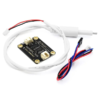
The module uses a dedicated electrode connection through an XH2.54-2P interface. The signal transmitter board provides a PH2.0-3P interface for connection to the controller/system.
The included probe is designed for water measurement and should be used according to the recommended operating conditions.
Applications
- Arduino water quality monitoring
- Domestic water testing
- Hydroponics
- Water purification projects
- DIY TDS meters
- IoT water monitoring
- Water-quality data logging
- Aquarium-related monitoring projects
- Educational electronics projects
- Microcontroller-based water testing
- Smart water monitoring systems
- Laboratory prototypes
- Embedded water-quality systems
- Automated water-quality analysis
- Portable water testing projects
Package Includes
- 1 × V1.0 TDS Sensor / Meter Development Board, approximately 42 × 32 mm
- 1 × TDS Water Quality Probe
Product Disclaimer
The TDS measurement is an indication of the total dissolved solids present in water and does not identify individual dissolved substances or determine whether water is safe for drinking. TDS should be used as one of several parameters when evaluating water quality.
The specified accuracy of ±10% F.S. at 25°C is provided as a product specification. Actual readings may vary depending on water temperature, probe condition, calibration, water composition, installation, electrical noise, and measurement conditions.
For reliable measurements, proper calibration and temperature compensation are recommended where required. The probe should be cleaned and maintained according to the application.
Product images are shown for illustrative and representational purposes only. The actual product colour, dimensions, connector design, component placement, and appearance may vary slightly depending on the manufacturing batch.
Frequently Asked Questions
1. What does this sensor measure?
The module measures Total Dissolved Solids (TDS) in water.
2. What is TDS?
TDS represents the total amount of dissolved organic and inorganic substances present in water and is generally expressed in ppm or mg/L.
3. What is the measurement range?
The specified measurement range is 0–1000 ppm.
4. What type of output does the module provide?
It provides an analog output of approximately 0–2.3 V.
5. What input voltage does the board require?
The signal transmitter board operates from 3.3–5.5 V.
6. Can I use this sensor with Arduino?
Yes. It is designed for use with Arduino-compatible controllers and other suitable microcontrollers with an analog input.
7. Can I use it with a 3.3 V controller?
Yes. The module supports 3.3 V systems, provided the controller's analog input is compatible with the sensor's output range.
8. What is the specified measurement accuracy?
The specified accuracy is ±10% F.S. at 25°C.
9. Does the module include a probe?
Yes. The kit includes a waterproof TDS probe.
10. Is the probe waterproof?
Yes. The supplied TDS probe is designed for water measurement and waterproof operation.
11. What is the purpose of the AC excitation source?
The AC excitation source helps reduce electrode polarization, which can improve the stability and reliability of the measurement.
12. Can this module be used for hydroponics?
Yes. It can be used for hydroponic water monitoring and other suitable water-quality applications.
13. Can it be used for domestic water testing?
Yes. It can be used as a reference measurement tool for monitoring TDS levels in domestic water.
14. Can TDS indicate whether water is safe to drink?
No. TDS is only one water-quality parameter. It does not identify the specific dissolved substances or determine whether water is microbiologically or chemically safe to drink.
15. Can the sensor transmit TDS data to a controller?
Yes. The analog output allows a connected microcontroller to read and process the TDS measurement for online monitoring and data logging.
16. What is the difference between this and a TDS pen?
A TDS pen is generally intended for standalone manual measurements. This module provides an analog electrical output, allowing it to be integrated into Arduino, IoT, automation, and data-logging systems.
17. Does the module require soldering?
The module is designed for easy plug-and-play connection using its provided interfaces, so basic use does not require soldering.
18. What is the size of the transmitter board?
The V1.0 development board is approximately 42 × 32 mm.
19. What is the working current?
The specified working current is approximately 3–6 mA.
20. Does temperature affect TDS measurement?
Yes. TDS measurements can vary with water temperature. For applications requiring improved accuracy, suitable temperature compensation should be applied.
21. Does the sensor require calibration?
Calibration is recommended when accurate and repeatable measurements are required. The calibration method should be selected according to the controller software and intended application.
22. Can this sensor be used with ESP32?
Yes. It can be interfaced with an ESP32 through an appropriate ADC input, while observing the ESP32's analog-input voltage limitations.
23. Can I use this sensor for aquarium monitoring?
It can be used for monitoring TDS in suitable aquarium or aquatic applications, but TDS alone should not be treated as a complete measure of aquarium water quality.
24. Does a higher TDS value always mean the water is unsafe?
No. A higher TDS value means that more dissolved substances are present, but TDS does not indicate which substances are responsible for the reading. Additional water-quality testing may be required.
Only logged in customers who have purchased this product may leave a review.



Reviews
There are no reviews yet