
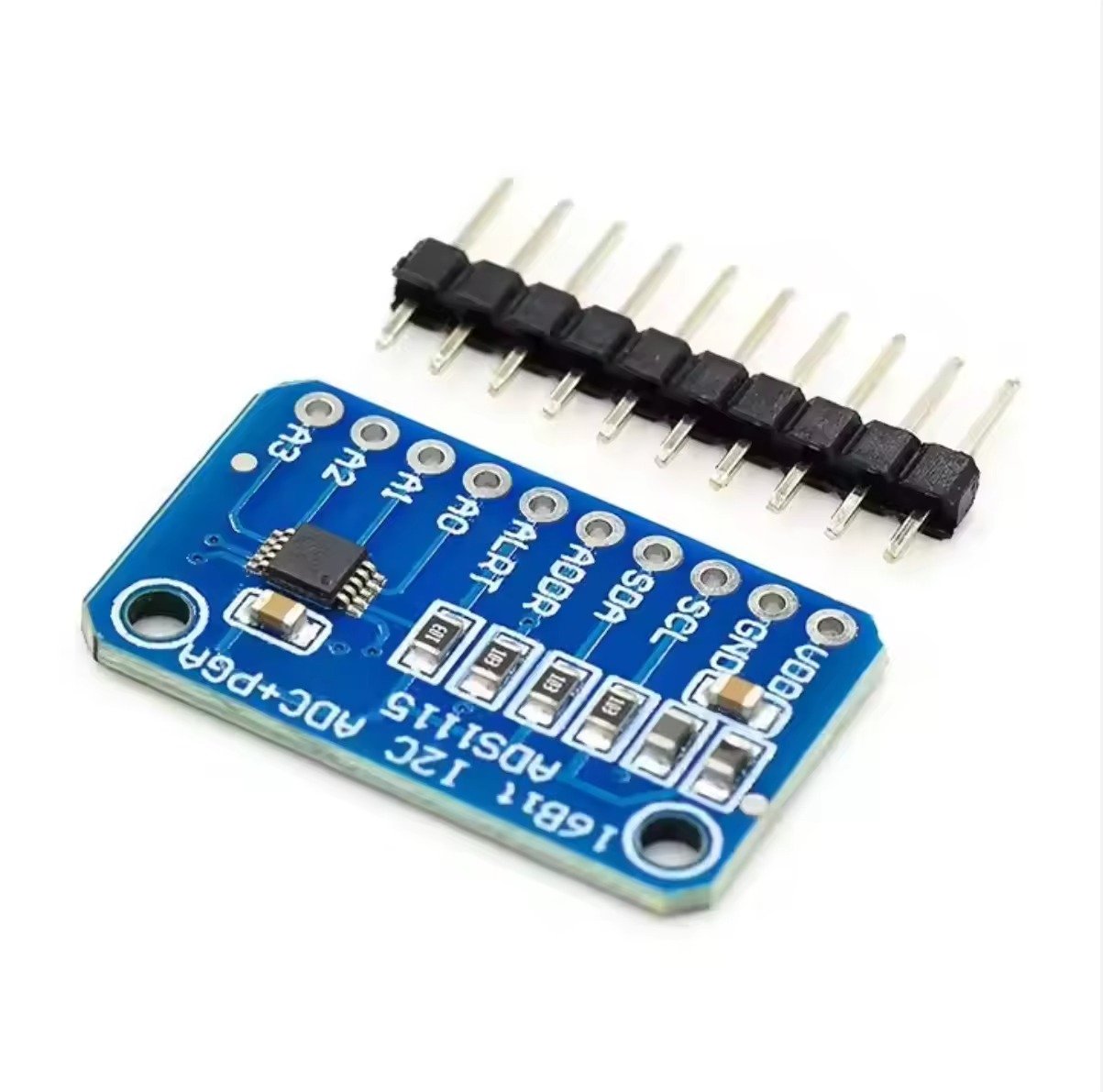
ADS1115 16 Bit ADC Module Board
₹147.50 incl. GST (₹125.00 + GST)
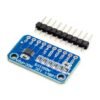
The ADS1115 16-Bit Precision ADC Module is a high-resolution analog-to-digital converter designed for accurate sensor and analog signal measurement. It provides four single-ended or two differential input channels, supports a wide 2.0V–5.5V supply range, and offers programmable data rates from 8 SPS to 860 SPS. With an integrated PGA, internal voltage reference, oscillator, and I²C interface, it is ideal for Arduino, ESP32, Raspberry Pi, robotics, IoT, and precision data-acquisition projects. PCB colour may be blue or purple and will be supplied randomly; images are for representation only.
The ADS1115 Precision Analog-to-Digital Converter (ADC) Module is a high-resolution, low-power ADC designed for accurately measuring analog signals in microcontroller and embedded-system applications. Based on the ADS1115 16-bit ADC, the module provides significantly higher measurement resolution than the built-in ADCs commonly found on many development boards, making it useful for precision sensor and data-acquisition projects.
The module operates from a wide 2.0V to 5.5V supply range and communicates with a microcontroller through an I²C-compatible serial interface. It provides four single-ended analog inputs or two differential inputs, allowing multiple analog sensors or signal sources to be connected.
An integrated programmable gain amplifier (PGA) allows the input range to be adjusted according to the signal being measured. The module also supports programmable data rates from 8 SPS to 860 SPS, providing flexibility between measurement speed and application requirements.
The ADS1115 includes an internal voltage reference and oscillator, reducing the need for additional external components. Its low-power design supports both continuous and single-shot measurement modes, making it suitable for battery-powered and energy-conscious applications.
Features
- High-resolution 16-bit analog-to-digital converter
- Based on the ADS1115 ADC
- Four single-ended analog inputs
- Two differential input configurations
- Wide supply voltage range of 2.0V to 5.5V
- Low current consumption
- Continuous conversion mode
- Single-shot conversion mode with automatic power-down
- Programmable data rate from 8 SPS to 860 SPS
- Integrated programmable gain amplifier (PGA)
- Internal voltage reference
- Internal oscillator
- I²C-compatible serial interface
- Four selectable I²C slave addresses
- Suitable for precision analog measurements
- Compact and low-power design
- Suitable for Arduino, ESP32, Raspberry Pi, and other microcontroller projects
Specifications
| Parameter | Specification |
|---|---|
| Product Type | Precision Analog-to-Digital Converter Module |
| ADC IC | ADS1115 |
| Resolution | 16-Bit |
| Number of Channels | 4 Single-Ended / 2 Differential |
| Supply Voltage | 2.0V – 5.5V |
| Data Rate | 8 SPS – 860 SPS |
| Interface | I²C-Compatible |
| I²C Addresses | 4 Selectable Addresses |
| Gain Control | Programmable Gain Amplifier (PGA) |
| Reference | Internal Voltage Reference |
| Oscillator | Internal |
| Conversion Modes | Continuous / Single-Shot |
| Comparator | Programmable |
| Operating Temperature | -40°C to +140°C* |
*Refer to the specific ADS1115 IC/module manufacturer’s specifications for the exact operating limits of the supplied module.
Design and Construction
The ADS1115 module is designed as a compact precision ADC interface for systems that require higher-resolution analog measurement. The onboard ADS1115 integrates the ADC, programmable gain amplifier, voltage reference, oscillator, and digital interface into a single solution.
The module provides multiple analog input channels, allowing several sensors or analog sources to be connected without requiring a separate ADC for each signal. The I²C interface minimizes the number of microcontroller pins required for communication.
Its wide 2.0V–5.5V supply range allows the module to be integrated into a variety of embedded systems. The compact design makes it suitable for prototyping, sensor interfaces, data acquisition, and precision measurement applications.
Working Principle
The ADS1115 converts an analog voltage applied to its input channels into a 16-bit digital value. The connected microcontroller communicates with the ADC through the I²C interface and reads the converted digital measurement.
The programmable gain amplifier (PGA) allows the input range to be adjusted so that smaller analog signals can be measured with greater resolution. Depending on the application, the ADC can operate using single-ended or differential measurements.
In continuous mode, the ADC continuously performs conversions at the selected data rate. In single-shot mode, it performs one conversion and automatically enters a low-power state, helping reduce energy consumption.
The onboard reference and oscillator simplify the design by reducing the need for additional external components.
Input Configuration
The ADS1115 provides flexible analog input configurations:
- Four single-ended inputs: AIN0, AIN1, AIN2, and AIN3
- Differential measurements: Two analog inputs can be compared to measure the voltage difference between them
This flexibility makes the module suitable for both individual sensor measurements and differential signal applications.
I²C Communication
The module communicates with a microcontroller using the I²C-compatible serial interface. Multiple address options allow compatible ADS1115 devices to share the same I²C bus when configured appropriately.
Typical connections include:
- VCC – Power supply
- GND – Ground
- SDA – I²C data
- SCL – I²C clock
- AIN0–AIN3 – Analog input channels
Always verify the module’s pin labels and voltage requirements before connecting it to a development board.
Power and Operating Modes
The ADS1115 supports a wide 2.0V to 5.5V supply range, making it compatible with many embedded platforms.
It supports:
- Continuous conversion mode for repeated measurements
- Single-shot mode for on-demand measurements with automatic power-down
The single-shot mode can be particularly useful in battery-powered systems where the ADC does not need to remain continuously active.
Applications
- Precision sensor measurement
- Analog voltage measurement
- Temperature sensing
- Pressure sensors
- Light sensors
- Current and voltage monitoring
- Battery monitoring
- Strain gauge applications
- Industrial data acquisition
- Analog signal measurement
- Audio and signal-processing experiments
- Arduino projects
- ESP32 projects
- Raspberry Pi projects
- Raspberry Pi Pico projects
- IoT sensor systems
- Robotics projects
- Embedded instrumentation
- Laboratory measurement systems
- DIY electronics projects
- High-resolution analog data acquisition
Compatibility
The ADS1115 module can be interfaced with many development platforms that support I²C communication, including:
- Arduino boards
- ESP32
- ESP8266
- Raspberry Pi
- Raspberry Pi Pico
- STM32 boards
- Other I²C-compatible microcontrollers
Software libraries and programming requirements may vary depending on the development platform.
Package Includes
- 1 × ADS1115 16-Bit Precision ADC Module
Product Disclaimer
Product images are for illustrative and representational purposes only. The actual product may vary slightly in colour, PCB finish, component placement, markings, dimensions, or overall appearance depending on the manufacturing batch.
The module may be supplied with either a blue or purple PCB, and the PCB colour will be sent randomly.
Additional cables, sensors, microcontrollers, jumper wires, and other components shown in product images are not included unless specifically mentioned in the package contents.
For reliable operation, ensure that the applied supply voltage and analog input signals remain within the applicable limits of the ADS1115 and the connected system. Always verify the module pinout before making connections.
Frequently Asked Questions (FAQs)
1. What is the ADS1115 module used for?
The ADS1115 is a high-resolution ADC module used to accurately measure analog signals from sensors and other analog devices.
2. What is the resolution of the ADS1115?
It provides 16-bit analog-to-digital conversion, allowing high-resolution analog measurements.
3. How many analog input channels does it have?
It provides 4 single-ended inputs or 2 differential input configurations.
4. What is the operating voltage range?
The module supports a wide supply voltage range of 2.0V to 5.5V.
5. What communication interface does it use?
The ADS1115 communicates with microcontrollers through an I²C-compatible interface.
6. What are the main I²C pins?
The main I²C connections are SDA (data) and SCL (clock), along with VCC and GND.
7. What is the programmable gain amplifier (PGA)?
The integrated PGA allows the input measurement range to be adjusted, making the ADC suitable for measuring both relatively larger and smaller analog signals.
8. What data rates does the ADS1115 support?
It supports programmable data rates from 8 SPS to 860 SPS.
9. Does the module support differential measurements?
Yes. The ADS1115 can measure the voltage difference between two analog inputs using differential mode.
10. Does it support single-ended measurements?
Yes. It provides four single-ended analog input channels: AIN0, AIN1, AIN2, and AIN3.
11. Does the ADS1115 have an internal voltage reference?
Yes. It includes an internal voltage reference, reducing the need for an external reference in typical applications.
12. Does it have an internal oscillator?
Yes. The ADC includes an internal oscillator for its conversion operation.
13. What operating modes are available?
The ADS1115 supports continuous conversion mode and single-shot conversion mode.
14. What is single-shot mode?
In single-shot mode, the ADC performs one conversion and then automatically enters a low-power state, which can help reduce power consumption.
15. Is the ADS1115 suitable for battery-powered projects?
Yes. Its low-power operating modes make it suitable for battery-powered and energy-efficient applications.
16. Can I use the ADS1115 with Arduino?
Yes. It can be connected to Arduino boards through the I²C interface using compatible libraries.
17. Can I use it with ESP32?
Yes. The ADS1115 can be interfaced with the ESP32 using its I²C communication interface.
18. Can I use it with Raspberry Pi?
Yes. It can be used with Raspberry Pi boards through I²C for high-resolution analog measurements.
19. What sensors can be connected to the ADS1115?
It can be used with compatible temperature, pressure, light, voltage, current, strain, and other analog sensors.
20. Why use ADS1115 instead of a microcontroller's built-in ADC?
The ADS1115 provides 16-bit resolution, configurable gain, multiple input channels, and differential measurement, which can be useful when higher-resolution analog measurements are required.
21. Can the ADS1115 measure voltage?
Yes. It can measure analog voltage signals within the applicable input range and configured PGA limits.
22. Can it be used for battery monitoring?
Yes. With a suitable voltage-divider circuit and proper input limits, it can be used for battery voltage monitoring.
23. Can it be used for current measurement?
Yes. When paired with an appropriate current-sensing or shunt circuit, it can measure the resulting analog voltage for current monitoring.
24. How many ADS1115 modules can be used on one I²C bus?
The ADS1115 provides four selectable I²C addresses, allowing multiple devices to share an I²C bus when configured with different addresses.
25. What is the programmable comparator used for?
The comparator can be configured to monitor ADC measurements and provide an alert when a programmed threshold condition is reached.
26. Is the module suitable for robotics projects?
Yes. It can be used for sensor measurement, battery monitoring, analog feedback, and other precision measurement tasks in robotics.
27. Is it suitable for IoT projects?
Yes. It is useful when an IoT controller needs accurate analog measurements from sensors.
28. What is included in the package?
The package includes 1 × ADS1115 16-Bit Precision ADC Module.
29. What PCB colour will I receive?
The module may have either a blue or purple PCB. The PCB colour is supplied randomly.
30. Is the actual product exactly the same as shown in the images?
No. Images are for representation only. The actual product may vary slightly in PCB colour, markings, component placement, or overall appearance depending on the manufacturing batch.
Only logged in customers who have purchased this product may leave a review.


Reviews
There are no reviews yet