
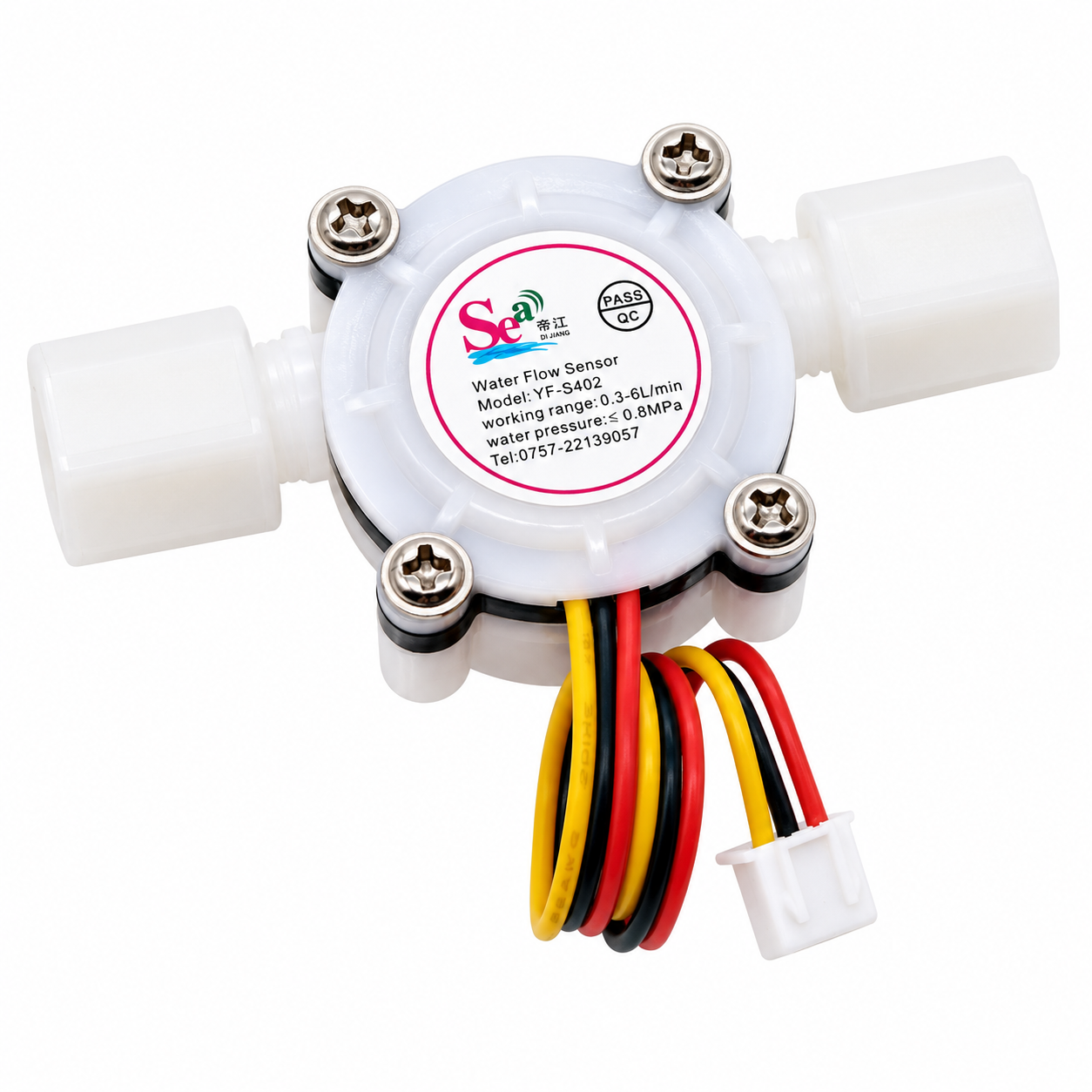
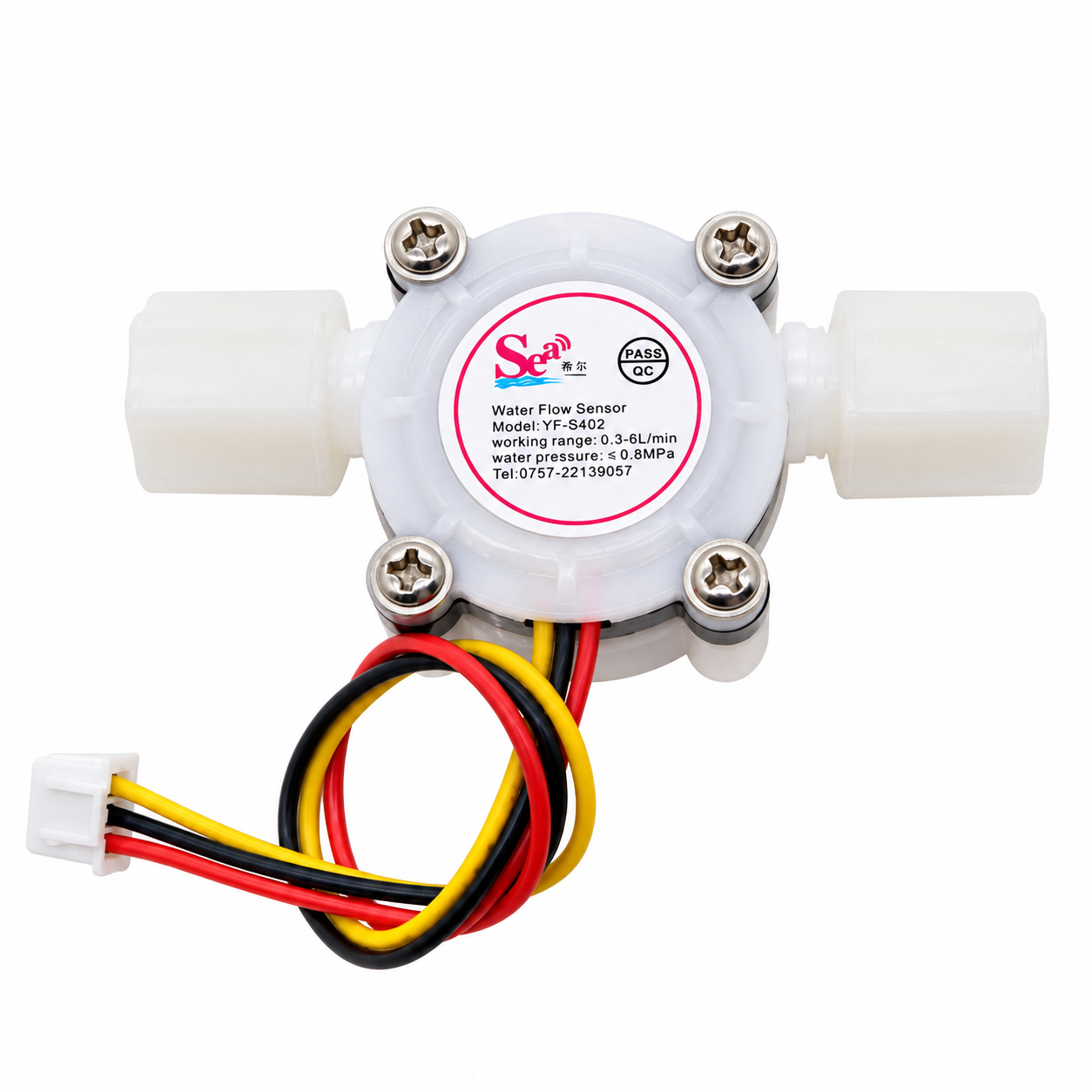
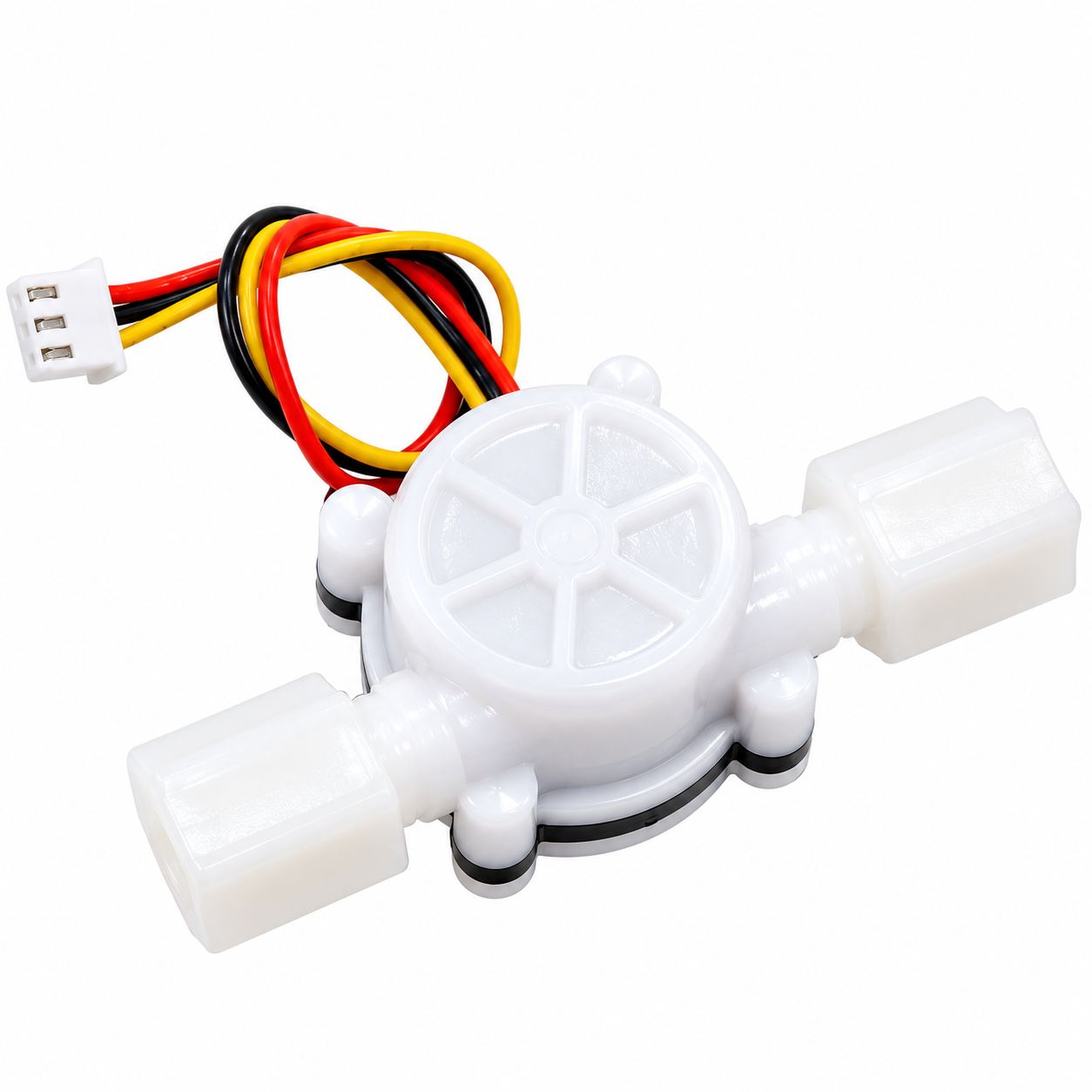
YF-S402 Water Flow Sensor – Digital Water Flow Rate Measurement Module
₹312.70 incl. GST (₹265.00 + GST)
The YF-S402 Water Flow Sensor is a compact digital sensor designed to measure water flow using a turbine rotor and Hall effect sensing technology. Operating at 5V–24V DC, it supports a stated flow range of 0.3–6 L/min and generates digital pulses proportional to flow rate. It can be interfaced with compatible Arduino, ESP32, and other microcontroller-based systems for irrigation, water dispensers, coffee machines, plumbing monitoring, and smart water management projects.
1. Product Description
The YF-S402 Water Flow Sensor is a compact and lightweight sensor designed to measure the flow rate of water in pipes and fluid-handling systems. It uses a turbine-type rotor and a Hall effect sensor to detect water movement and generate digital pulses corresponding to the flow rate.
When water passes through the sensor, the internal magnetic rotor spins. The Hall effect sensor detects this rotation and produces a pulse signal whose frequency varies with the flow rate. By connecting the sensor to a microcontroller such as an Arduino, ESP32, or other compatible controller, users can monitor water flow, estimate water consumption, and develop automated water management systems.
Operating with a supply voltage of 5V to 24V DC and supporting a stated flow range of 0.3 to 6 litres per minute, the YF-S402 is suitable for smart irrigation, water dispensers, coffee machines, plumbing projects, and water monitoring applications.
2. Features
-
Digital Pulse Output: Generates pulses proportional to the water flow rate.
-
Hall Effect Sensing: Detects the rotation of the internal magnetic rotor.
-
Wide Operating Voltage: Supports a supply voltage of 5V to 24V DC.
-
Flow Measurement: Designed for flow rates from 0.3 to 6 litres per minute.
-
Compact and Lightweight: Easy to integrate into water monitoring systems.
-
Sealed Construction: Includes a sealing ring to help prevent leakage when properly installed.
-
Stainless Steel Axis: Provides durability and abrasion resistance.
-
Microcontroller Compatibility: Can be interfaced with compatible digital input pins.
-
Versatile Applications: Suitable for irrigation, plumbing, water dispensers, coffee machines, and automation projects.
-
RoHS Compliance: Listed as RoHS compliant; verify the manufacturer’s documentation if certification is required.
3. Specifications
| Parameter | Details |
|---|---|
| Product Name | YF-S402 Water Flow Sensor |
| Sensor Type | Turbine-type water flow sensor |
| Sensing Technology | Hall effect sensor |
| Output Type | Digital pulse signal |
| Operating Voltage | 5V–24V DC |
| Flow Rate Range | 0.3–6 L/min |
| Output Frequency | 0–100 Hz, as specified |
| Pipe Connection Dimensions | Inner diameter: 8.5 mm; outer diameter: 11 mm |
| Rotor Type | Magnetic turbine rotor |
| Shaft Material | Stainless steel |
| Body Material | Plastic, as specified |
| Sealing | Sealing ring |
| Compatibility | Compatible microcontrollers and digital input systems |
| Compliance | RoHS compliant, as stated |
Note: The supplied information does not specify the exact pulse-to-volume calibration factor, measurement accuracy, maximum water pressure, or output voltage levels. These should be confirmed before designing a measurement system.
4. Design and Construction
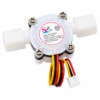
The YF-S402 consists of a plastic valve body, an internal turbine rotor with a magnet, a Hall effect sensing element, and a sealing ring. The water flows through the sensor body and rotates the internal rotor.
A stainless steel axis supports the rotor and helps provide wear resistance. The compact construction makes the sensor suitable for integration into small water pipes and equipment where space is limited.
The pipe connection dimensions are specified as an inner diameter of 8.5 mm and an outer diameter of 11 mm. Check the physical dimensions and connection compatibility before installation.
5. Working Principle
The YF-S402 measures water flow by converting the rotation of an internal turbine into electrical pulses.
-
Water Flow: Water enters the sensor and passes through the internal turbine.
-
Rotor Rotation: The flowing water causes the magnetic rotor to spin.
-
Magnetic Detection: The Hall effect sensor detects the rotating magnetic field.
-
Pulse Generation: The sensor generates a digital pulse signal.
-
Flow Calculation: A microcontroller counts the pulses over time and uses the sensor’s calibration factor to estimate flow rate and total water volume.
The pulse frequency generally increases as the flow rate increases. However, the precise relationship between pulse frequency and litres per minute depends on the sensor’s calibration.
6. Applications
-
Agriculture and Irrigation: Monitor water flow in irrigation and automated watering systems.
-
HVAC Systems: Measure water movement in compatible heating, ventilation, and air-conditioning systems.
-
Plumbing Systems: Monitor water flow in residential and commercial installations.
-
Water Treatment: Track water flow through compatible treatment equipment.
-
Smart Home Automation: Monitor water usage and support leak-detection projects.
-
Automatic Water Dispensers: Measure water delivery in dispensing equipment.
-
Coffee Machines: Monitor water flow during brewing.
-
DIY Electronics: Build water flow monitoring and control projects using Arduino or ESP32.
-
Water Management Systems: Estimate consumption and automate compatible pumps or valves.
7. Interfacing with Microcontrollers
The YF-S402 can be connected to a compatible microcontroller through its power, ground, and pulse-output connections. The microcontroller counts the digital pulses to calculate the flow rate.
When interfacing with an Arduino, ESP32, or another controller:
-
Supply the sensor with a voltage within its specified operating range.
-
Connect the sensor ground and controller ground together.
-
Connect the pulse output to a compatible digital input.
-
Confirm the sensor’s output voltage before connecting it directly to a microcontroller input. An ESP32 uses 3.3V logic and its GPIO pins are not 5V tolerant.
-
Use the correct calibration factor to calculate flow rate and total volume.
-
Ensure all pipe connections are secure and leak-free before operating the system.
8. Package Includes
– 1 × YF-S402 Water Flow Sensor
9. Product Disclaimer
-
The specified flow range and pulse frequency are based on the supplied product information. Actual performance may vary depending on water pressure, installation, flow conditions, and sensor calibration.
-
The exact pulse calibration factor and measurement accuracy are not provided. Calibration may be required for reliable flow measurement.
-
Confirm the sensor’s connection dimensions, output voltage, maximum operating pressure, and compatibility with the intended liquid before installation.
-
The sensor is described for water flow measurement. Compatibility with other liquids should not be assumed without checking the manufacturer’s specifications.
-
Use suitable pipe fittings and sealing methods to prevent leakage. Keep electronic connections protected from moisture.
-
Product images are for illustration and representation purposes only. The actual product may slightly differ in appearance, colour, design, or component placement due to manufacturing variations and production batches.
Frequently Asked Questions (FAQs)
1. What is the YF-S402 Water Flow Sensor?
The YF-S402 is a digital water flow sensor that measures the movement of water through a pipe using a rotating turbine and a Hall effect sensor.2. What is the operating voltage of the YF-S402?
The specified operating voltage is 5V to 24V DC.3. What is the flow rate range of this sensor?
The stated measurement range is 0.3 to 6 litres per minute (L/min).4. What type of output does the sensor provide?
It provides a digital pulse output. The pulse frequency changes according to the water flow rate.5. How does the YF-S402 measure water flow?
Water rotates an internal magnetic turbine. The Hall effect sensor detects the rotation and generates electrical pulses that can be counted by a microcontroller.6. Can I use the YF-S402 with Arduino?
Yes. It can be interfaced with an Arduino using a compatible digital input and suitable power supply.7. Can I use this sensor with an ESP32?
Yes. However, confirm the pulse output voltage before connecting it to an ESP32 GPIO because ESP32 pins are not 5V tolerant. Use an appropriate level-shifting circuit if required.8. Can I use it with an ESP8266?
Yes, provided the supply and pulse-output levels are compatible with the ESP8266's electrical requirements.9. What is the output frequency of the sensor?
The supplied specifications state an output frequency range of 0–100 Hz. Actual frequency depends on the flow conditions and sensor characteristics.10. Is the output analog or digital?
The sensor provides a digital pulse output rather than a continuously varying analog voltage.11. Can the sensor measure total water consumption?
Yes. A microcontroller can count the pulses over time and convert them into an estimated water volume using the sensor's calibration factor.12. Can I calculate litres per minute using this sensor?
Yes. The microcontroller measures the pulse frequency and applies a suitable calibration formula to estimate the flow rate in litres per minute.13. Is the calibration factor provided?
The supplied product information does not specify an exact pulse-per-litre or frequency-to-flow calibration factor. Check the manufacturer's documentation or calibrate the sensor experimentally.14. Can the YF-S402 detect whether water is flowing?
Yes. A controller can detect pulse activity to determine whether flow is occurring, within the sensor's operating range and response characteristics.15. Can I use it for automatic water pump control?
Yes. It can provide flow feedback to a controller that operates a suitable pump driver or relay. Appropriate electrical protection and control logic are required.16. Is it suitable for smart irrigation systems?
Yes. It can monitor water flow in compatible irrigation systems and support automated watering or water-consumption monitoring.17. Can I use it in a coffee machine?
Yes. The sensor is suitable for compatible coffee-machine projects that require water flow monitoring, provided the flow rate, pressure, materials, and temperature requirements are met.18. Can it be used in water dispensers?
Yes. It can be integrated into compatible automatic water dispensers to monitor the volume or flow of dispensed water.19. What is the body material?
The supplied information describes a plastic valve body.20. Does the sensor have a stainless steel shaft?
Yes. A stainless steel axis is specified for the internal rotor assembly.21. Does the sensor include a sealing ring?
Yes. The supplied description states that a sealing ring is included to help prevent water leakage when properly installed.22. What are the connection dimensions?
The supplied dimensions are an 8.5 mm inner diameter and an 11 mm outer diameter. Verify these measurements against your pipe and fittings before installation.23. Is the sensor easy to install?
It is compact and designed for integration into water-flow systems. Proper installation still requires compatible fittings, correct flow direction where indicated, and leak-free connections.24. Can I use this sensor for liquids other than water?
The supplied description specifies water flow measurement. Other liquids may affect the sensor's materials, rotor operation, sealing, or calibration, so compatibility must be confirmed first.25. Can the sensor measure very low flow rates?
The specified lower flow limit is 0.3 L/min. Measurements below this level may not be reliable or may not be detected consistently.26. Can it measure flow rates above 6 L/min?
The stated upper flow limit is 6 L/min. Operation beyond this range is not guaranteed and should be avoided unless supported by the manufacturer's specifications.27. Does it provide highly accurate measurements?
The product is described as a high-precision sensor, but no numerical accuracy specification is provided. Calibration and testing are recommended when measurement accuracy is important.28. Can it be used for water leak detection?
Yes. When integrated with a controller, it can help detect unexpected flow or continuous water movement. It cannot independently identify the location or cause of a leak.29. Is the sensor waterproof?
The sensor is designed for installation in a water-flow path, but the supplied information does not provide an enclosure protection rating for its electrical components. Protect the wiring and electronics from moisture.30. Can I connect the sensor directly to a microcontroller?
The pulse output can connect to a compatible digital input, but first verify its voltage level and electrical characteristics. Level shifting may be needed for 3.3V controllers.31. Does the sensor require programming?
The sensor itself generates pulses without requiring programming. Programming is needed if you want a microcontroller to calculate flow rate, display readings, log consumption, or control equipment.32. Can I display flow readings on an LCD or OLED?
Yes. A compatible microcontroller can process the pulses and display estimated flow rate or total water volume on an LCD or OLED.33. Can I connect it to an IoT system?
Yes. With a compatible controller such as an ESP32 or ESP8266, readings can be transmitted to an IoT dashboard or monitoring platform.34. Does the sensor require an external power supply?
Yes. It needs a suitable DC supply within the specified 5V–24V range.35. Is the sensor RoHS compliant?
The supplied product description lists it as RoHS compliant. Request the relevant manufacturer documentation if formal verification is required.36. What is included in the package?
The package includes one YF-S402 Water Flow Sensor. A microcontroller, display, power supply, wiring, and pipe fittings are not listed as included.37. Can the sensor be used in residential plumbing?
It can be used in compatible plumbing monitoring projects, provided its flow range, connection dimensions, pressure rating, and installation requirements are suitable.38. Does water pressure affect the readings?
Yes. Flow conditions, pressure, pipe configuration, and installation can affect rotor behaviour and measurement performance.39. Does the sensor have a specified maximum water pressure?
A maximum pressure rating was not included in the supplied specifications. Confirm this value with the manufacturer before installing it in a pressurised system.40. How can I improve measurement reliability?
Use a suitable installation, maintain secure and leak-free connections, verify the output voltage, apply the correct calibration factor, and compare readings against a known volume or reference flow meter.Only logged in customers who have purchased this product may leave a review.


Reviews
There are no reviews yet