
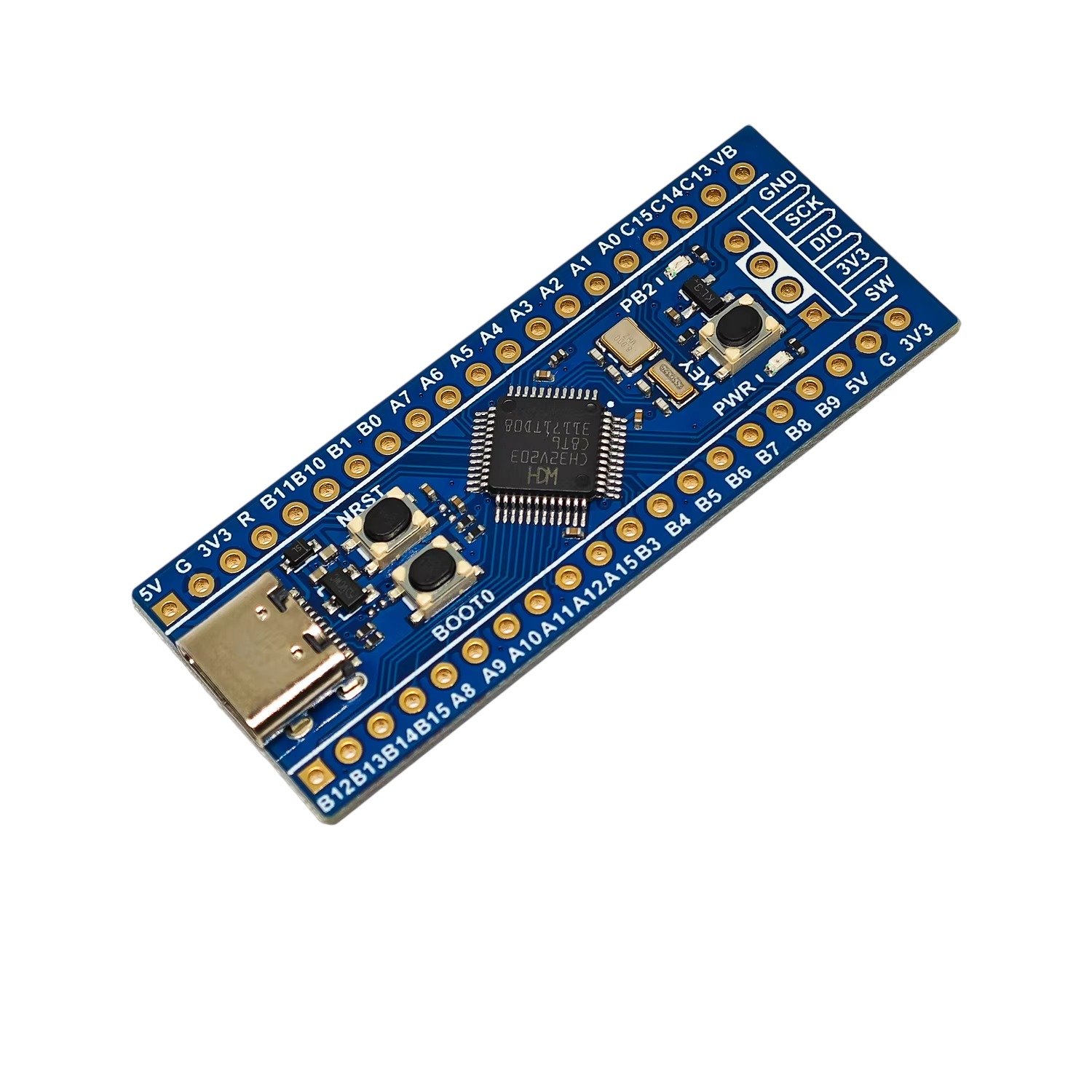
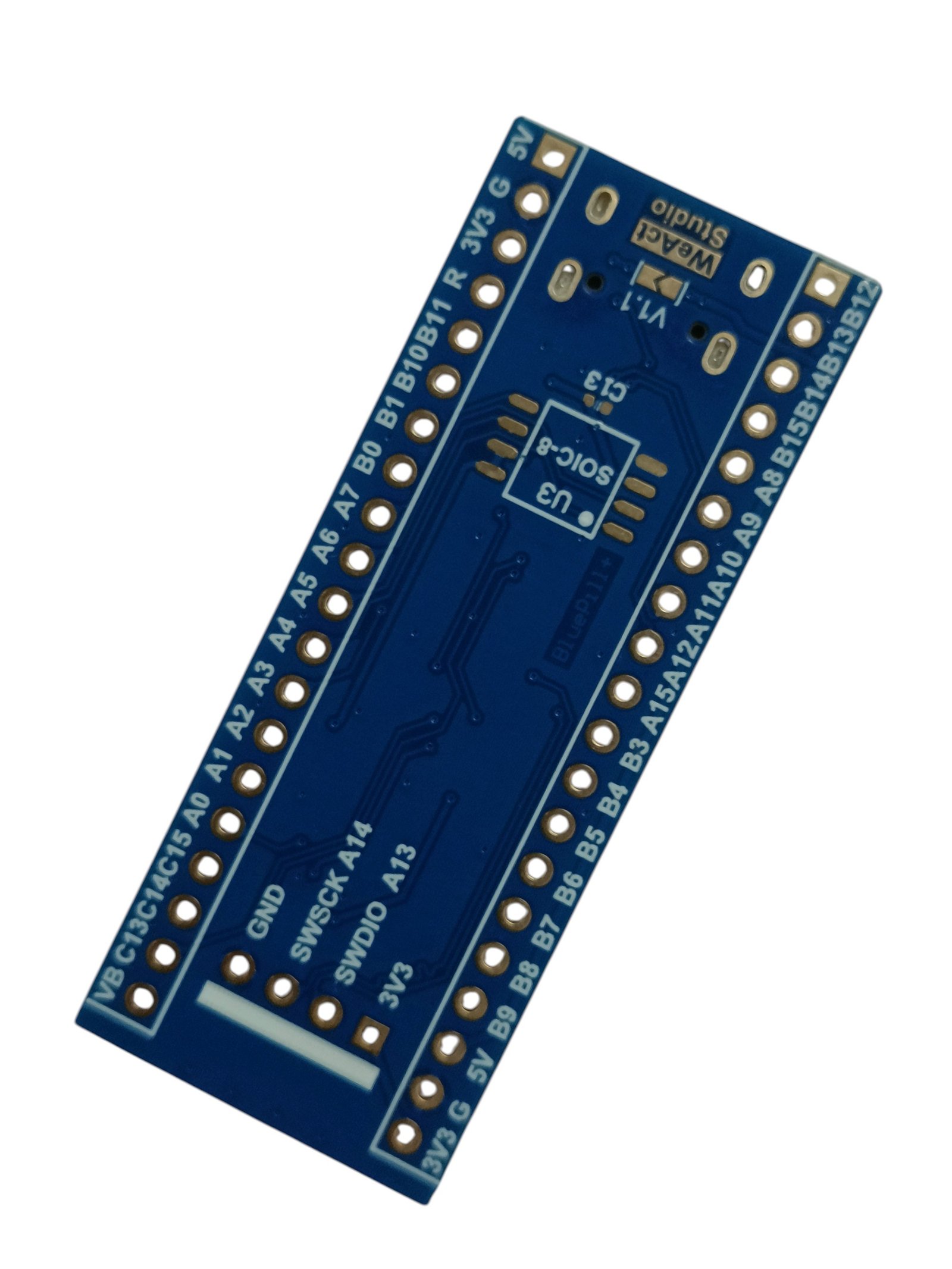
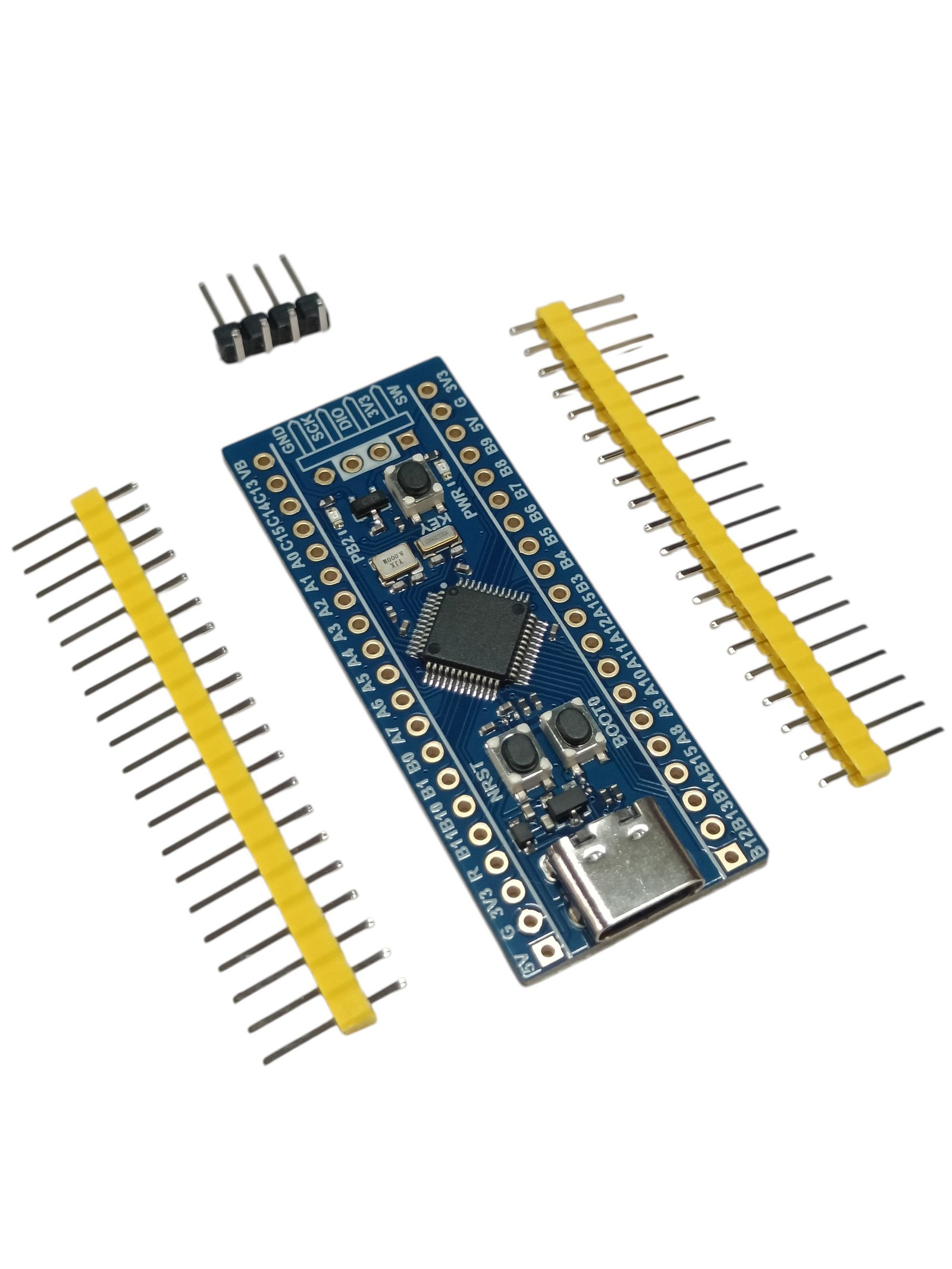
WeAct Studio CH32V203C8T6 RISC-V Low Power Core Demo Board
₹311.52 incl. GST (₹264.00 + GST)
The WeAct Studio CH32V203C8T6 Demo Board is a high-performance, low-power RISC-V development board powered by the QingKe V4B processor with a clock speed of up to 144MHz. It features 20KB SRAM, 64KB Flash, 3.3V operation, and multiple low-power modes for energy-efficient applications. With USB 2.0, UART, CAN, IIC, SPI, 12-bit ADC, TouchKey, DMA, timers, and 2-wire debugging, it offers versatile connectivity for embedded projects. Ideal for IoT, robotics, automation, sensor systems, and RISC-V development.
The WeAct Studio CH32V203C8T6 Demo Board is a compact and powerful development platform based on the QingKe V4B RISC-V processor, designed for high-performance and low-power embedded applications. With a system clock frequency of up to 144MHz, the board provides fast processing performance for a wide range of embedded development, control, automation, and IoT projects.
The board features 20KB SRAM and 64KB Flash memory, providing sufficient resources for program execution and data storage. It operates with a 3.3V supply voltage, while the GPIO unit is independently powered to provide greater flexibility when interfacing with external devices and peripherals.
Designed with power efficiency in mind, the CH32V203C8T6 supports multiple low-power operating modes, including Sleep, Stop, and Standby. Its low power consumption makes it suitable for battery-powered and energy-conscious embedded applications.
The development board also provides a wide range of integrated peripherals, including USB 2.0 Host/Device, UART, CAN, IIC, SPI, DMA, ADC, TouchKey, amplifiers, timers, CRC calculation, and a 2-wire serial debug interface. These features make it a versatile platform for learning, prototyping, and developing advanced RISC-V-based embedded systems.
Features
- Based on the QingKe V4B RISC-V processor
- Maximum system clock frequency up to 144MHz
- 20KB SRAM
- 64KB Flash memory
- 3.3V operating supply
- Independently powered GPIO unit
- Supports Sleep, Stop, and Standby low-power modes
- Ultra-low power consumption
- 18-channel general DMA controllers
- 12-bit ADC with TouchKey support
- 10-channel ADC functionality
- 10-channel TouchKey functionality
- 2 integrated amplifiers
- Multiple hardware timers
- USB 2.0 Host/Device interface
- Multiple UART interfaces
- CAN interface
- IIC interface
- SPI interface
- CRC calculation unit
- 96-bit unique device ID
- Serial 2-wire debug interface
- Power-on/Power-down Reset (POR/PDR)
- Programmable Voltage Detector (PVD)
- Suitable for low-power embedded applications
- Ideal for RISC-V development and prototyping
Specifications
| Parameter | Specification |
|---|---|
| Product Type | RISC-V Low Power Core Demo Board |
| Processor | QingKe V4B |
| Architecture | RISC-V |
| Maximum Clock Frequency | Up to 144MHz |
| SRAM | 20KB |
| Flash Memory | 64KB |
| Operating Voltage | 3.3V |
| GPIO Supply | Independently Powered |
| Low-Power Modes | Sleep / Stop / Standby |
| DMA | 18-Channel General DMA |
| ADC | 12-bit ADC |
| ADC Channels | Up to 10 Channels |
| TouchKey | 10 Channels |
| Amplifiers | 2 |
| USB | USB 2.0 Host/Device |
| UART | Multiple UART Interfaces |
| CAN | Supported |
| IIC | Supported |
| SPI | Supported |
| Debug Interface | Serial 2-Wire |
| Unique ID | 96-bit |
| Reset | POR/PDR |
| Voltage Detection | Programmable Voltage Detector |
| CRC | Hardware CRC Calculation |
Design and Construction
The WeAct Studio CH32V203C8T6 demo board is designed as a compact development platform for applications requiring a combination of high processing performance, low power consumption, and extensive peripheral connectivity.
The QingKe V4B processor provides a maximum system clock frequency of 144MHz, allowing the board to handle demanding embedded control and data-processing tasks. The 20KB SRAM and 64KB Flash provide memory resources for application programs and runtime data.
The board operates at 3.3V, with an independently powered GPIO unit that provides additional flexibility when connecting external sensors, modules, displays, communication interfaces, and other peripherals.
Working Principle
The board operates around the QingKe V4B RISC-V processor, which executes the application firmware stored in its internal Flash memory. The SRAM is used during program execution for temporary variables, buffers, and runtime data.
The processor communicates with external hardware through its integrated peripheral interfaces, including UART, SPI, IIC, CAN, and USB 2.0. Analog signals can be processed using the integrated 12-bit ADC, while TouchKey functionality can be used for compatible capacitive-touch applications.
The integrated DMA controllers allow data to be transferred between peripherals and memory with reduced processor intervention, improving overall system efficiency.
For energy-efficient applications, the board can enter Sleep, Stop, or Standby modes to reduce power consumption when full processing performance is not required.
Power Consumption
The CH32V203C8T6 is designed for low-power embedded applications. Its stated power consumption includes approximately:
- Run Mode: 44.65µA/MHz
- Sleep Mode: 17.90µA/MHz
Actual power consumption may vary depending on the operating frequency, enabled peripherals, connected external components, and application conditions.
Peripheral and Interface Support
The board provides a wide range of integrated peripherals for embedded development:
- USB 2.0 Host/Device for USB-based applications
- UART interfaces for serial communication
- CAN interface for industrial and automotive communication applications
- IIC interface for sensors, displays, memory devices, and peripherals
- SPI interface for high-speed peripheral communication
- 12-bit ADC for analog signal measurement
- TouchKey support for capacitive touch applications
- DMA controllers for efficient data transfers
- Timers for timing, control, PWM, and other applications
- CRC unit for hardware-assisted data integrity calculations
- 2-wire serial debug interface for development and debugging
Applications
- RISC-V embedded development
- Low-power embedded systems
- IoT devices
- Battery-powered applications
- Robotics projects
- Industrial automation
- Sensor-based systems
- Data acquisition systems
- USB-based embedded applications
- CAN communication projects
- UART communication projects
- SPI and IIC peripheral projects
- Touch-sensitive interfaces
- Motor and actuator control
- Embedded control systems
- Educational RISC-V projects
- Hardware prototyping
- Custom development boards
- Smart electronic devices
- Low-power IoT prototypes
Package Includes
- 1 × WeAct Studio CH32V203C8T6 RISC-V Low Power Core Demo Board
Product Disclaimer
Product images are for illustrative and representational purposes only. The actual product may vary slightly in colour, PCB markings, component placement, dimensions, connector configuration, or overall appearance depending on the manufacturing batch.
Additional cables, programmers, sensors, displays, modules, and other accessories are not included unless specifically mentioned in the package contents.
The stated electrical specifications and power consumption values are provided for reference. Actual performance and power consumption may vary depending on firmware, operating conditions, peripheral usage, supply conditions, and connected external components.
Frequently Asked Questions (FAQs)
1. What is the WeAct Studio CH32V203C8T6 Demo Board?
It is a compact RISC-V development board based on the QingKe V4B processor, designed for embedded development, prototyping, IoT, robotics, and low-power applications.
2. What processor does the board use?
The board uses the QingKe V4B RISC-V processor.
3. What is the maximum clock speed?
The processor supports a system clock frequency of up to 144MHz.
4. How much Flash memory is available?
The board provides 64KB of Flash memory for program storage.
5. How much SRAM does it have?
It features 20KB of SRAM for program execution and temporary data storage.
6. What is the operating voltage?
The board operates at a 3.3V supply voltage.
7. Does the board support low-power modes?
Yes. It supports Sleep, Stop, and Standby modes for low-power applications.
8. What is the power consumption?
The stated power consumption is approximately 44.65µA/MHz in Run mode and 17.90µA/MHz in Sleep mode. Actual consumption depends on the application and enabled peripherals.
9. What communication interfaces are available?
The board supports USB 2.0, UART, CAN, IIC, and SPI interfaces.
10. Does it support USB?
Yes. It supports a USB 2.0 Host/Device interface for compatible USB applications.
11. Does the board support CAN communication?
Yes. An integrated CAN interface is available for compatible communication applications.
12. Does it have an ADC?
Yes. It includes a 12-bit ADC with up to 10 channels according to the provided specifications.
13. Does it support capacitive touch sensing?
Yes. The processor provides 10-channel TouchKey support for capacitive touch applications.
14. Does it have DMA?
Yes. It includes 18-channel general DMA controllers for efficient data transfer with reduced CPU involvement.
15. Does the board include timers?
Yes. The processor provides integrated timer peripherals that can be used for timing, control, PWM, and other embedded applications.
16. Does it have built-in amplifiers?
Yes. The provided specifications indicate 2 integrated amplifiers.
17. What debugging interface does it use?
The board supports a serial 2-wire debug interface for programming and debugging.
18. Does the processor have a unique identification number?
Yes. It includes a 96-bit unique ID that can be used for device identification.
19. Does it include voltage monitoring features?
Yes. It includes Power-on/Power-down Reset (POR/PDR) and a Programmable Voltage Detector (PVD).
20. Can this board be used for IoT projects?
Yes. Its processing capability, communication interfaces, and low-power modes make it suitable for various IoT and connected embedded applications.
21. Is it suitable for robotics projects?
Yes. It can be used for robot controllers, sensor interfaces, communication systems, motor-control applications, and embedded robotic prototypes.
22. Can it be used with sensors?
Yes. The ADC, IIC, SPI, UART, and other interfaces allow the board to communicate with many compatible sensors and peripheral modules.
23. Is it suitable for low-power applications?
Yes. Its Sleep, Stop, and Standby modes make it suitable for battery-powered and energy-efficient embedded systems.
24. What can the 12-bit ADC be used for?
The ADC can be used to measure analog signals from compatible sensors, potentiometers, voltage sources, and other analog devices.
25. What can the IIC and SPI interfaces be used for?
They can be used to connect compatible sensors, displays, memory chips, communication modules, and other peripheral devices.
26. Can it be used for USB-based projects?
Yes. The integrated USB 2.0 Host/Device functionality supports compatible USB applications.
27. Is this board suitable for embedded-system development?
Yes. It is designed for embedded development and provides processing power, memory, communication interfaces, debugging, analog functions, and low-power features.
28. What applications can this board be used for?
It can be used for IoT devices, robotics, automation, sensor systems, USB projects, CAN applications, data acquisition, touch interfaces, and RISC-V development.
29. What is included in the package?
The package includes 1 × WeAct Studio CH32V203C8T6 RISC-V Low Power Core Demo Board.
30. Are cables and other accessories included?
No. Additional cables, programmers, sensors, displays, and other accessories are not included unless specifically mentioned in the package contents.
31. Is the actual board exactly the same as shown in the images?
Product images are for representation purposes only. The actual board may vary slightly in PCB markings, component placement, colour, connector configuration, or appearance depending on the manufacturing batch.
Only logged in customers who have purchased this product may leave a review.




Reviews
There are no reviews yet