
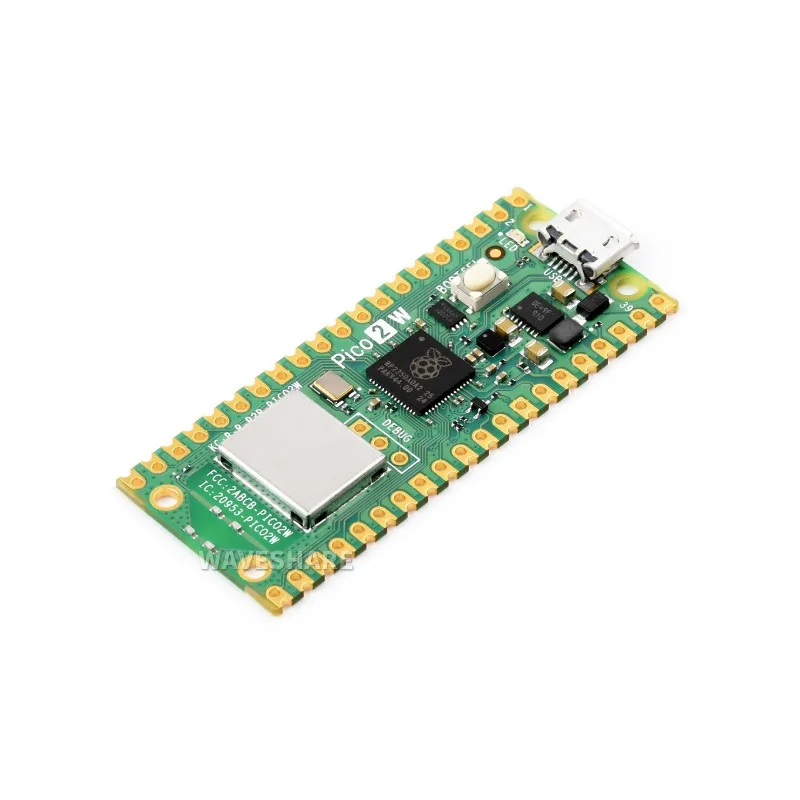
Raspberry Pi Pico 2 W – Dual-Core RP2350 with WiFi & Bluetooth
₹731.60 incl. GST (₹620.00 + GST)
Raspberry Pi Pico 2 W is a powerful wireless microcontroller board featuring the RP2350A, 150MHz dual-core processor, 520KB SRAM, 4MB Flash, 2.4GHz Wi-Fi, and Bluetooth 5.2. With 26 GPIO pins and advanced security features, it is ideal for IoT, robotics, automation, edge computing, smart home, and embedded projects.
Raspberry Pi Pico 2 W – RP2350 Dual-Core Wi-Fi & Bluetooth Microcontroller Development Board
Product Description
The Raspberry Pi Pico 2 W is a powerful and wireless-enabled microcontroller development board designed for modern embedded systems, IoT, robotics, automation, education, and low-power electronics projects.
Powered by the RP2350A microcontroller, the Pico 2 W provides a significant performance improvement over the original Raspberry Pi Pico. It features a dual-core architecture with support for either Arm Cortex-M33 or RISC-V Hazard3 processor cores and operates at up to 150 MHz.
The board includes 520KB SRAM and 4MB external Flash memory, providing additional resources for larger programs, data processing, wireless applications, graphical interfaces, and advanced embedded projects.
Wireless connectivity is provided by the integrated CYW43439 wireless chip, supporting 2.4GHz Wi-Fi 802.11n and Bluetooth 5.2. This makes the Pico 2 W suitable for connected IoT devices, remote monitoring, smart home systems, wireless controllers, and cloud-connected applications.
The Pico 2 W also provides enhanced security features including Arm TrustZone, secure boot capabilities, hardware-accelerated cryptography, SHA-256 support, and a True Random Number Generator (TRNG), making it suitable for applications where secure communication and data protection are important.
With 26 multifunction GPIO pins, programmable I/O, USB connectivity, and a compact 40-pin form factor, the Raspberry Pi Pico 2 W provides a flexible platform for both beginner projects and advanced embedded development.
Features
- Raspberry Pi RP2350A microcontroller
- Dual-core processor architecture
- Dual Arm Cortex-M33 or dual RISC-V Hazard3 cores
- Clock speed up to 150 MHz
- 520KB SRAM
- 4MB external Flash memory
- Integrated 2.4GHz Wi-Fi 802.11n
- Bluetooth 5.2
- 26 multifunction GPIO pins
- Programmable I/O support
- USB connectivity
- Arm TrustZone security
- Secure boot support
- Hardware cryptographic acceleration
- SHA-256 support
- TRNG support
- Low-power operating capabilities
- 40-pin DIP-compatible form factor
- Suitable for breadboard prototyping
- Designed for IoT, robotics, automation, and embedded applications
Specifications
| Parameter | Specification |
|---|---|
| Product Type | Wireless Microcontroller Development Board |
| Microcontroller | Raspberry Pi RP2350A |
| Processor | Dual Arm Cortex-M33 or Dual RISC-V Hazard3 |
| Clock Speed | Up to 150 MHz |
| SRAM | 520 KB |
| Flash Memory | 4 MB |
| Wireless | 2.4GHz Wi-Fi & Bluetooth 5.2 |
| GPIO | 26 Multifunction GPIO Pins |
| USB | USB Interface |
| Security | Arm TrustZone, SHA-256, TRNG |
| Operating Voltage | 1.8V – 5.5V DC* |
| Form Factor | 40-Pin DIP-Compatible |
| Application | IoT, Robotics, Automation, Embedded Systems |
*Refer to the official Raspberry Pi documentation for exact power-input and GPIO operating requirements.
Design and Construction
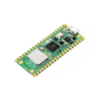
The Raspberry Pi Pico 2 W maintains the compact design and 40-pin DIP footprint associated with the Pico family, making it convenient for breadboards, prototyping boards, custom carrier boards, and embedded installations.
The board provides access to 26 multifunction GPIO pins, allowing users to connect a wide variety of external sensors, displays, motors, relays, communication modules, and other peripherals.
Its compact size and wireless capabilities make it suitable for applications where both processing performance and low power consumption are important.
Working Principle
The RP2350A acts as the main processing controller of the Pico 2 W. Users can program the board to read sensors, control actuators, process data, and communicate with other devices.
Depending on the software and application, developers can make use of the supported Arm Cortex-M33 or RISC-V Hazard3 architecture.
The onboard wireless hardware provides Wi-Fi and Bluetooth connectivity, allowing the board to communicate with local networks, smartphones, computers, cloud services, and other connected devices.
The programmable I/O capabilities also allow the board to perform precise timing and custom communication tasks without placing all of the processing burden on the CPU.
Wireless Connectivity
The integrated wireless system supports:
2.4GHz Wi-Fi
Suitable for:
- IoT cloud connectivity
- Wireless sensor networks
- Web servers
- Remote monitoring
- Smart home devices
- Wireless automation
Bluetooth 5.2
Suitable for:
- Smartphone communication
- Wireless controllers
- BLE sensors
- Wearable devices
- Local device configuration
- Short-range communication
Security Features
The Pico 2 W includes several hardware-assisted security features designed for modern connected applications.
These include:
- Arm TrustZone
- Secure boot support
- Hardware cryptographic acceleration
- SHA-256
- True Random Number Generator (TRNG)
- OTP-based security features
These capabilities can help developers build more secure IoT and embedded systems.
Memory and Performance
The RP2350A provides 520KB SRAM, almost double the memory of the original Pico platform, along with 4MB external Flash.
The increased memory and processing performance make the Pico 2 W suitable for applications involving:
- Larger firmware
- Wireless communication
- Data logging
- Sensor processing
- Graphics
- User interfaces
- Embedded AI and ML experiments
- Advanced automation
Typical Application Scenarios
Advanced IoT Nodes
Suitable for wireless sensor nodes, cloud-connected controllers, smart monitoring systems, and secure IoT devices.
Edge Computing
The increased processing resources and memory make the board suitable for lightweight local data processing, signal analysis, and selected embedded AI/ML applications.
Industrial Automation
Useful for motor control, sensor monitoring, machine interfaces, real-time control, and wireless automation prototypes.
Handheld and Interactive Devices
The board can be used for custom controllers, portable devices, educational game systems, and interactive embedded electronics.
Robotics
Its wireless connectivity, GPIO, processing power, and compact size make it suitable for robots, autonomous vehicles, remote-control systems, and sensor platforms.
Applications
- IoT projects
- Wireless sensor nodes
- Smart home automation
- Robotics
- Industrial automation
- Embedded systems
- Wireless controllers
- Bluetooth projects
- Wi-Fi projects
- Data logging
- Remote monitoring
- Sensor networks
- Educational electronics
- STEM projects
- Portable electronics
- Custom control systems
- Embedded AI/ML experiments
- Automation prototypes
- Research and development
- Secure IoT devices
Package Includes
- 1 × Raspberry Pi Pico 2 W
Product Disclaimer
Product images are shown for illustrative and representational purposes only. The actual board may vary slightly in PCB colour, component placement, connector arrangement, antenna design, chip marking, or other visual details depending on the manufacturing batch.
USB cable, sensors, displays, breadboards, jumper wires, batteries, and other accessories shown in product images are not included unless specifically mentioned in the package contents.
Software support, available SDK features, architecture selection, wireless functionality, and library compatibility depend on the software framework and versions being used.
Important Notes
Backward Compatibility
The Pico 2 W maintains the same general 40-pin DIP form factor as the original Pico family, making it mechanically suitable for many existing Pico-based projects.
However, applications originally designed for the RP2040 may require updated software libraries, SDKs, firmware, or architecture-specific binaries to ensure compatibility with the RP2350.
Power Supply
Use an appropriate power source within the board’s supported electrical requirements. Do not apply voltages directly to GPIO pins that exceed their specified logic limits.
Wireless Performance
Wi-Fi and Bluetooth performance can vary depending on antenna orientation, enclosure materials, environmental interference, and surrounding wireless networks.
Recommended Related Products
Explore relevant alternatives and complementary products selected from the full Robosap catalogue.
- RP2040 + ESP32-C3 Dual-MCU Board – WiFi, Bluetooth & Dual-Core
- RP2040 Raspberry Pi Pico W Compatible Board with ESP8285 Wifi USBC
- Raspberry Pi Pico Compatible Development Board USB C with Headers (Soldered Version)
- Raspberry Pi Pico Compatible Development Board USB C
- Ultimate Pico RP2040 128Mbit 16MB Microcontroller Development Board
Frequently Asked Questions
1. What is the Raspberry Pi Pico 2 W?
The Pico 2 W is a wireless microcontroller development board based on the RP2350A, designed for embedded, IoT, robotics, automation, and educational applications.
2. What processor does it use?
It uses the RP2350A with support for dual Arm Cortex-M33 or dual RISC-V Hazard3 cores.
3. What is the maximum clock speed?
The processor can operate at up to 150 MHz.
4. How much SRAM does it have?
The board provides 520KB SRAM.
5. How much Flash memory does it have?
The board includes 4MB external Flash memory.
6. Does it support Wi-Fi?
Yes. It supports 2.4GHz Wi-Fi 802.11n.
7. Does it support Bluetooth?
Yes. It supports Bluetooth 5.2.
8. How many GPIO pins are available?
The board provides 26 multifunction GPIO pins.
9. What security features are included?
It supports features including Arm TrustZone, secure boot, SHA-256, hardware cryptography, and TRNG.
10. Can I use the Pico 2 W for IoT projects?
Yes. Its Wi-Fi, Bluetooth, processing power, memory, and low-power capabilities make it well suited for IoT development.
11. Can I use it for robotics?
Yes. It can control sensors, motors, servos, displays, and wireless communication modules in robotic systems.
12. Is it compatible with the original Raspberry Pi Pico footprint?
It maintains the same general 40-pin form factor, but software and firmware compatibility should be checked because the Pico 2 W uses the newer RP2350 architecture.
13. Can it be used with battery-powered projects?
Yes. The board is designed for low-power embedded applications and can be used in suitable battery-powered systems.
14. Is the USB cable included?
No. The package includes only the Raspberry Pi Pico 2 W unless otherwise specified.Only logged in customers who have purchased this product may leave a review.




Reviews
There are no reviews yet