
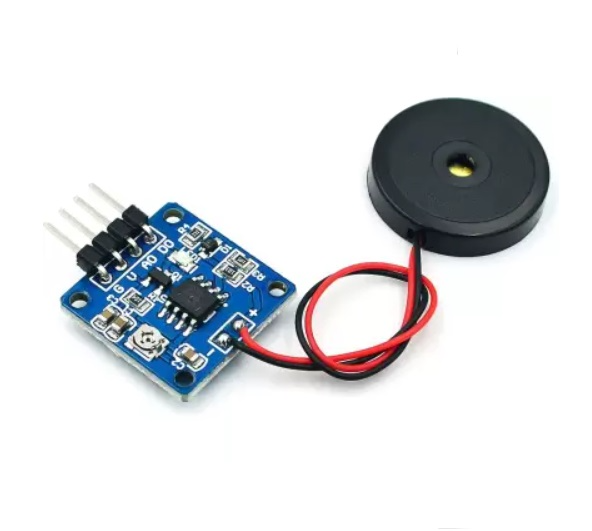
Piezoelectric Knock Vibration Sensor Switch Module
₹76.70 incl. GST (₹65.00 + GST)
The Piezoelectric Knock Vibration Sensor Switch Module detects knocks, taps, vibrations, and impacts with adjustable sensitivity. It provides both digital TTL and analog outputs for easy integration with Arduino, ESP32, Raspberry Pi, and other microcontrollers. Featuring an onboard LED indicator and compact design, it is ideal for security systems, alarms, automation, robotics, and DIY electronics projects.
Piezoelectric Knock Vibration Sensor Switch Module
The Piezoelectric Knock Vibration Sensor Switch Module is a compact and versatile sensor module designed to detect knocks, taps, vibrations, shocks, and mechanical impacts. It uses a piezoelectric sensing element to respond to physical movement and vibration, making it suitable for a wide range of DIY electronics, automation, robotics, and security applications.
The module provides both digital TTL and analog signal outputs, giving users flexibility depending on their project requirements. The digital output can be used as a simple vibration-triggered ON/OFF signal, while the analog output can provide a varying signal that can be monitored by a suitable analog input.
With an adjustable sensitivity potentiometer and onboard LED indicator, the module is easy to configure and use with popular development platforms such as Arduino, ESP32, Raspberry Pi, and other microcontrollers.
Dual Output Design
One of the main advantages of this module is its ability to provide both digital and analog outputs.
Digital TTL Output
The digital output provides a HIGH/LOW signal when the detected vibration reaches the configured sensitivity threshold. This makes it useful for triggering an action when a knock, tap, or impact is detected.
For example, a microcontroller can use the signal to:
- Trigger an alarm
- Turn on an LED
- Activate a buzzer
- Start or stop a motor
- Count knocks or impacts
- Initiate an automation sequence
Analog Output
The analog output provides a variable signal related to the vibration detected by the piezoelectric element. This allows a microcontroller with an analog input to monitor changes in vibration intensity rather than simply detecting whether a threshold has been exceeded.
This can be useful for experimental projects where users want to analyze vibration levels or distinguish between different types of impacts.
Adjustable Sensitivity
The module includes an onboard potentiometer for sensitivity adjustment. Users can rotate the potentiometer to change the detection threshold according to the requirements of their application.
This makes it possible to configure the module for different environments, from detecting relatively light taps to responding to stronger impacts.
Sensitivity may need to be adjusted depending on mounting conditions, surrounding vibration, sensor placement, and the type of impact being detected.
Onboard LED Indicator
An integrated LED indicator provides visual feedback when the module detects a vibration or knock according to its configured threshold.
This is particularly useful during development because users can test the sensor without immediately connecting it to a microcontroller.
The LED can also make the module useful for simple interactive demonstrations and educational projects.
Piezoelectric Vibration Detection
The sensor uses the electrical properties of a piezoelectric sensing element to detect mechanical vibration and impact.
When the sensing element experiences physical deformation or vibration, it generates an electrical signal that can be processed by the module’s circuitry.
This allows the module to respond to events such as:
- Tapping
- Knocking
- Shaking
- Vibration
- Mechanical impact
- Sudden movement or shock
Easy Microcontroller Integration
The module is designed for simple integration with development boards and microcontrollers.
It can be used with platforms such as:
- Arduino
- ESP32
- Raspberry Pi
- STM32
- Other compatible microcontrollers
The digital output can be connected to a digital input for event detection, while the analog output can be connected to a suitable analog input for vibration-level monitoring.
When connecting the module to a specific development board, ensure that the module’s output voltage and power requirements are compatible with the controller’s input specifications.
Compact Design
The compact module can be easily installed in DIY electronics and embedded projects. It can be mounted on a suitable surface or enclosure depending on the application.
For more consistent vibration detection, the sensor should be mounted securely. The mounting method and physical position can significantly influence sensitivity and detection behavior.
Key Features
- Detects knocks, taps, vibrations, and impacts
- Piezoelectric sensing technology
- Digital TTL output
- Analog output
- Adjustable sensitivity using onboard potentiometer
- Onboard LED detection indicator
- Compact and easy-to-integrate design
- Suitable for Arduino and other microcontrollers
- Useful for security and automation systems
- Suitable for educational and DIY electronics projects
Specifications
| Specification | Details |
|---|---|
| Product Type | Piezoelectric Knock Vibration Sensor Module |
| Sensor Type | Piezoelectric |
| Operating Voltage | 5V DC |
| Outputs | TTL Digital + Analog |
| Digital Output | HIGH/LOW trigger signal |
| Analog Output | Variable vibration signal |
| Sensitivity | Adjustable |
| Sensitivity Adjustment | Onboard Potentiometer |
| Indicator | Onboard LED |
| Detection | Knock, Tap, Vibration, Shock, Impact |
| Maximum Output Current | Up to 1A* |
| Application | Vibration and Impact Detection |
*The stated output-current capability should be treated according to the specific module version and circuit implementation. For higher-current loads, use an appropriate transistor, MOSFET, relay, or driver rather than connecting a high-current load directly to a microcontroller.
Applications
The Piezoelectric Knock Vibration Sensor Module can be used in:
- Vibration detection systems
- Knock and tap detection
- Shock and impact monitoring
- Motion-triggered alarms
- Anti-theft systems
- Security devices
- Machine vibration monitoring
- Interactive electronics
- Smart switches
- DIY automation
- Arduino projects
- ESP32 projects
- Raspberry Pi projects
- Robotics experiments
- STEM education
- Interactive art installations
Security and Alarm Applications
The module can be used as a basic vibration trigger in security and anti-tamper projects. For example, it can detect vibration caused by an impact on a protected enclosure and send a trigger signal to a microcontroller.
The microcontroller can then activate an alarm, send a notification, or perform another programmed action.
Actual security performance depends on sensor placement, sensitivity settings, environmental vibration, and the software used to process the sensor signal.
DIY and Educational Projects
The module is also useful for learning about sensors, analog signals, digital signals, thresholds, and microcontroller inputs.
Students can experiment with different sensitivity settings and observe how the analog and digital outputs respond to various vibrations.
It provides a simple way to demonstrate how a physical event such as a knock can be converted into an electrical signal.
Installation and Usage Tips
For reliable detection:
- Mount the sensor securely to the surface being monitored.
- Adjust the potentiometer gradually to achieve the desired sensitivity.
- Avoid mounting it close to unnecessary sources of vibration.
- Test the sensor under actual operating conditions.
- Use the analog output when vibration intensity information is required.
- Use the digital output when a simple trigger signal is sufficient.
- Use a suitable driver circuit for loads requiring significant current.
Package Includes
- 1 × Piezoelectric Knock Vibration Sensor Switch Module
Important Notes
- The module is designed for 5V DC operation.
- Detection sensitivity depends on the mounting method, vibration source, sensor position, and potentiometer setting.
- The analog output should be connected to an input capable of safely reading the module’s signal.
- Always verify voltage compatibility when connecting the module to 3.3V microcontrollers such as ESP32 or Raspberry Pi.
- The stated 1A maximum output current should not be assumed to mean that a microcontroller GPIO can safely supply 1A. Use an appropriate external driver for high-current loads.
- The module is intended for general vibration and impact detection and should not be considered a certified safety or security device.
- Product appearance and PCB markings may vary slightly between production batches.
Why Choose the Piezoelectric Knock Vibration Sensor Module?
The Piezoelectric Knock Vibration Sensor Switch Module provides an easy and flexible way to add vibration and impact detection to electronic projects. With dual analog and digital outputs, adjustable sensitivity, and an onboard LED indicator, it can be configured for simple knock detection or more advanced vibration-monitoring applications.
Its compact design and compatibility with popular microcontrollers make it a useful choice for DIY electronics, robotics, automation, security experiments, STEM education, and interactive projects.
Related Products and Categories
Explore relevant products and category pages available from Robosap.
FAQs
1. What does this sensor detect? It detects knocks, taps, vibrations, shocks, and impacts.
2. What type of sensor is used? It uses a piezoelectric sensing element.
3. What outputs are available? It provides both digital TTL and analog outputs.
4. Can the sensitivity be adjusted? Yes. An onboard potentiometer allows sensitivity adjustment.
5. What is the operating voltage? The module operates at 5V DC.
6. Does it have an LED indicator? Yes. The onboard LED indicates vibration detection.
7. Can it be used with Arduino? Yes. It can be easily integrated with Arduino and compatible microcontrollers.
8. Is it compatible with ESP32? Yes, but ensure the module's output voltage is compatible with the ESP32's 3.3V input levels.
9. Can it be used with Raspberry Pi? Yes, with appropriate voltage-level consideration and interface circuitry where required.
10. What is the digital output used for? It provides a HIGH/LOW trigger when vibration reaches the configured threshold.
11. What is the analog output used for? It can be used to monitor changes in the detected vibration signal.
12. Can it detect light taps? Yes. Sensitivity can be adjusted to detect light taps or stronger impacts.
13. What are common applications? It can be used for alarms, anti-tamper systems, vibration detection, automation, robotics, and DIY projects.
14. Is the sensor suitable for high-current loads? For high-current loads, use a suitable transistor, MOSFET, relay, or driver circuit rather than connecting the load directly to a microcontroller.
15. What is included in the package? The package includes 1 × Piezoelectric Knock Vibration Sensor Switch Module.Only logged in customers who have purchased this product may leave a review.



Reviews
There are no reviews yet