
Infrared Obstacle Avoidance TSOP Sensor Module
₹61.36 incl. GST (₹52.00 + GST)
Product Description
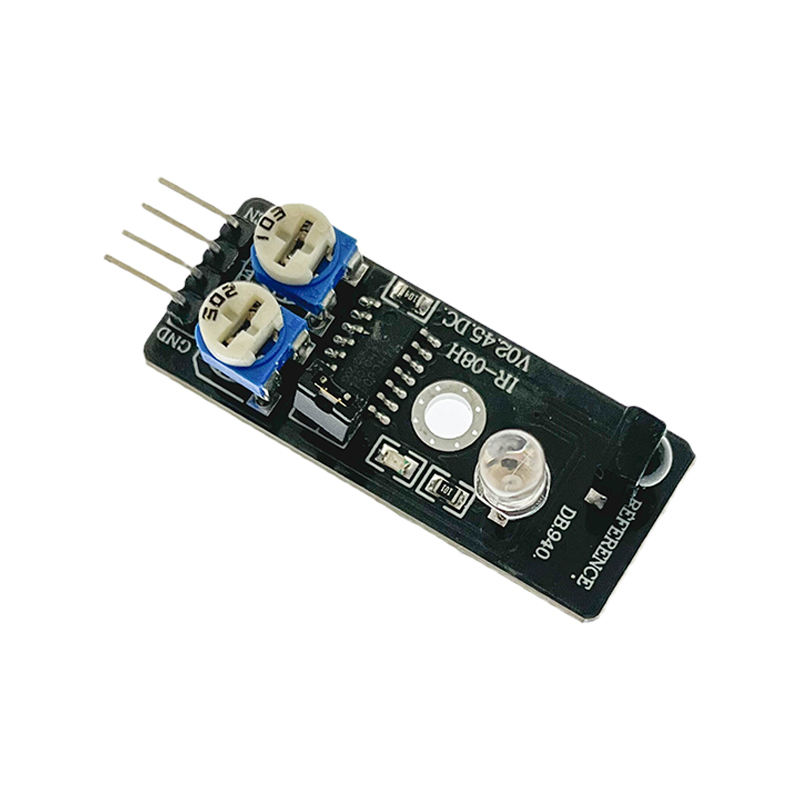
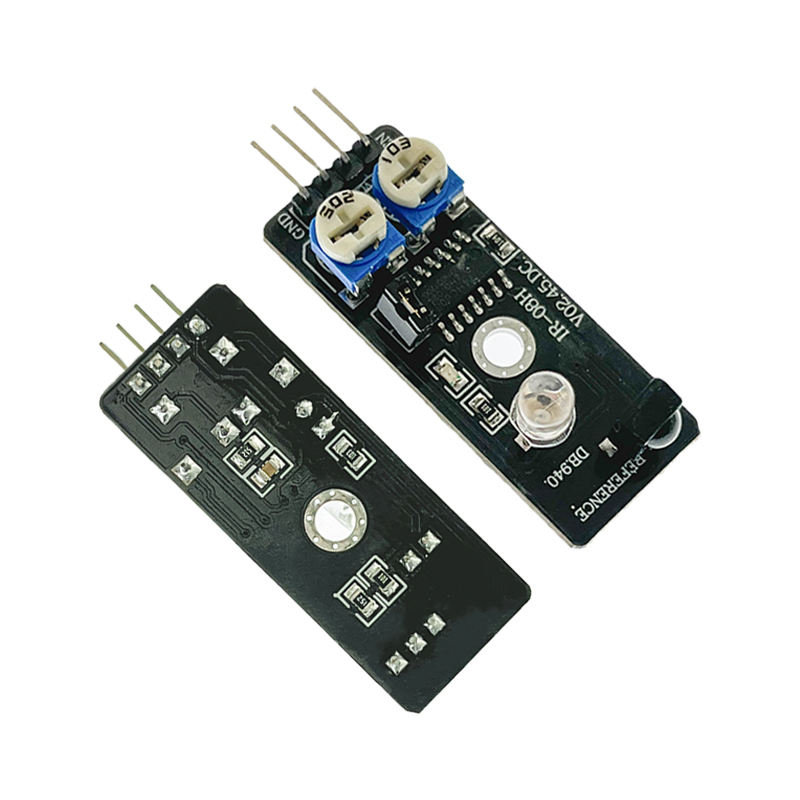
The Infrared Obstacle Avoidance Sensor Module is a cost-effective and easy-to-use infrared detection module designed for obstacle avoidance, proximity sensing, robotics, and electronic projects. It uses an infrared transmitter and receiver system to detect objects based on reflected IR signals.
The module features a 38 kHz infrared detection system and comes pre-assembled with a 555 timer-based oscillator circuit. It provides a simple 4-pin interface consisting of +5V, GND, OUT, and EN (Enable), making it easy to connect with Arduino, Raspberry Pi, and other microcontroller platforms.
The sensor provides an active-low digital output and includes an onboard status LED for visual indication. The EN pin allows the sensor to be enabled or disabled externally, providing additional control when required.
Two onboard potentiometers are provided for adjusting the operating frequency and infrared intensity. The module is factory-configured for approximately 38 kHz operation, and it is generally recommended to leave the potentiometers at their default settings for stable performance.
In practical testing, the module can provide a reliable detection range of approximately 30–40 cm, depending on the size, colour, texture, and reflectivity of the object. White and reflective surfaces generally provide better detection than dark, rough, or IR-absorbing surfaces.
Features
- Infrared-based obstacle detection
- Cost-effective proximity detection solution
- Pre-assembled and ready to use
- 38 kHz IR detection system
- 555 timer-based oscillator circuit
- Active-low digital output
- Onboard obstacle/status indicator LED
- 4-pin interface
- Includes Enable (EN) control pin
- Enable or disable sensor using external control
- Two onboard potentiometers for adjustment
- Suitable for Arduino and other microcontrollers
- Compatible with Raspberry Pi with suitable voltage configuration
- Easy to install and interface
- Suitable for robotics and automation projects
Specifications
| Parameter | Specification |
|---|---|
| Module Type | Infrared Obstacle Avoidance Sensor |
| Detection Method | Infrared Reflection |
| Operating Frequency | Approximately 38 kHz |
| Output Type | Digital |
| Output Logic | Active Low |
| Interface | 4-Pin |
| Pins | +5V, GND, OUT, EN |
| Operating Voltage | Approximately 3–6 V |
| Recommended Raspberry Pi VCC | 3 V |
| Oscillator | 555 Timer Based |
| Enable Control | EN Pin |
| Detection Range | Approximately 30–40 cm Typical |
| Adjustment | Frequency and Intensity Potentiometers |
| Indicator | Onboard Status LED |
| Sensor Type | IR Transmitter and Receiver |
Pin Configuration
| Pin | Function | Description |
|---|---|---|
| +5V / VCC | Power | Supply voltage |
| GND | Ground | Power and signal ground |
| OUT | Output | Active-low obstacle detection signal |
| EN | Enable | LOW = Enabled, HIGH = Disabled |
Working Principle
The module uses an infrared transmitter to emit IR light at approximately 38 kHz. When the emitted infrared signal encounters a nearby object, part of the signal is reflected back toward the receiver.
The receiver detects the reflected infrared signal and the onboard circuit processes it to determine whether an obstacle is present. When an obstacle is detected, the OUT pin produces a LOW-level signal, allowing a connected microcontroller to identify the obstacle.
The onboard LED provides a visual indication of the detection status.
Enable Function
The EN (Enable) pin allows the sensor to be externally enabled or disabled.
- EN connected to GND (LOW): Sensor enabled
- EN connected to VCC (HIGH): Sensor disabled
An onboard jumper can be used to configure the enable function. The jumper may be left open when external enable/disable control is required.
Potentiometer Adjustment
The module includes two onboard potentiometers:
- Frequency adjustment: Used to adjust the IR operating frequency around the 38 kHz range.
- Intensity adjustment: Used to adjust the infrared signal intensity.
Although adjusting these potentiometers may affect the detection range or sensitivity, the module is generally recommended to be used with the factory/default settings for stable operation.
Detection Range
The practical detection range is approximately 30–40 cm, but the actual range depends on the target object and environmental conditions.
Objects with white, smooth, or reflective surfaces generally provide stronger infrared reflections and better detection. Dark, rough, transparent, or infrared-absorbing materials may result in reduced detection distance or less reliable sensing.
Interfacing
The module can be connected to Arduino and other microcontrollers using the VCC, GND, and OUT pins. The EN pin can optionally be connected to a digital control pin when software-based sensor enable/disable functionality is required.
For Raspberry Pi applications, the module can be used with an appropriate 3 V supply configuration, while ensuring that the output voltage presented to the Raspberry Pi GPIO remains within safe limits.
Applications
- Robot obstacle avoidance
- Autonomous robots
- Smart car projects
- Proximity detection
- Object detection
- Arduino projects
- Raspberry Pi projects
- Embedded systems
- Automation systems
- Electronic control systems
- DIY robotics
- Line and object detection experiments
- Educational electronics projects
- Sensor-based switching systems
- Prototype development
Package Includes
- 1 × Infrared Obstacle Avoidance Sensor Module
Product Disclaimer
The stated detection range is approximate and may vary depending on the target object’s colour, size, shape, surface texture, reflectivity, ambient light, sensor alignment, and installation conditions.
The module is designed for proximity and obstacle detection rather than precision distance measurement.
When connecting the module to a Raspberry Pi or other 3.3 V logic device, ensure that the supply and output signal levels are suitable for the controller’s GPIO requirements.
Product images are shown for illustrative and representational purposes only. The actual product colour, dimensions, component placement, potentiometer position, jumper configuration, and appearance may vary slightly depending on the manufacturing batch.
Frequently Asked Questions
1. What is this infrared sensor module used for?
It is primarily used for obstacle avoidance, proximity detection, and object detection in robotics and electronic projects.
2. What operating frequency does the module use?
The module is designed around a 38 kHz infrared operating frequency.
3. What type of output does it provide?
It provides a digital active-low output. The output goes LOW when an obstacle is detected.
4. How many pins does the module have?
The module has four pins: VCC, GND, OUT, and EN.
5. What is the function of the EN pin?
The EN pin controls whether the sensor is enabled or disabled. LOW enables the module, while HIGH disables it.
6. Can I use this module with Arduino?
Yes. It can be easily connected to an Arduino digital input for obstacle detection.
7. Can I use it with Raspberry Pi?
Yes. It can be used with Raspberry Pi when operated with a suitable supply voltage and compatible GPIO signal levels.
8. What is the typical detection range?
The practical detection range is approximately 30–40 cm, depending on the target surface and environmental conditions.
9. Does the colour of the object affect detection?
Yes. White and reflective objects generally provide better IR reflection and detection than black, rough, or IR-absorbing surfaces.
10. Does the module have an indicator LED?
Yes. An onboard LED provides a visual indication of the sensor's detection status.
11. Can the detection range be adjusted?
The module includes potentiometers for adjusting frequency and IR intensity, which can influence detection performance.
12. Should I adjust the onboard potentiometers?
For normal operation, it is recommended to leave them at their default settings. Adjustments may affect the sensor's range and sensitivity.
13. What circuit is used for the oscillator?
The onboard oscillator circuit is based on a 555 timer and is configured for approximately 38 kHz operation.
14. Can this sensor measure exact distance?
No. It is primarily an obstacle/proximity detection sensor, not a precision distance-measuring sensor. Its detection range varies with the target and environment.
15. Can it be used in an obstacle-avoiding robot?
Yes. The active-low digital output makes it suitable for detecting obstacles and controlling motors through a microcontroller and suitable motor driver.
16. Is the sensor ready to use?
Yes. The module comes pre-assembled and can be connected directly to a suitable power supply and controller.
17. Does the package include connecting wires?
No. The package includes the sensor module only, unless connecting wires are specifically mentioned in the package contents.
Only logged in customers who have purchased this product may leave a review.

Reviews
There are no reviews yet