
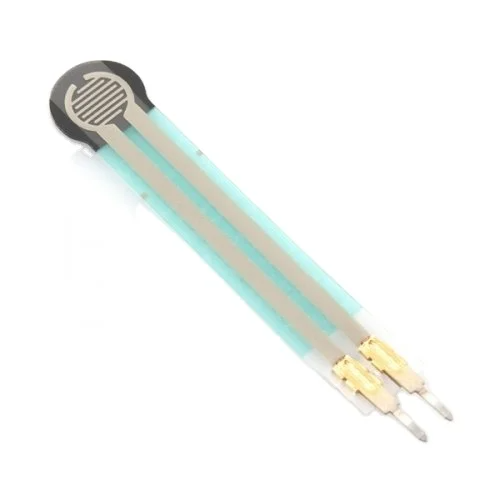
FSR 400 FORCE SMALL 5.08MM SENSOR CAPACTIVE
₹246.62 incl. GST (₹209.00 + GST)
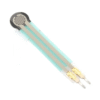
The FSR-400 Small Force Sensing Resistor is a compact pressure-sensitive sensor with a 5.08mm sensing area. Its resistance changes with applied force, making it ideal for touch detection, pressure sensing, robotics, automation, Arduino projects, and compact DIY electronics applications.
FSR-400 Small Force Sensing Resistor – 5.08mm Force Sensor
The FSR-400 Small Force Sensing Resistor is a compact, pressure-sensitive resistor designed to detect force applied to its small 5.08mm sensing area. Its compact size makes it suitable for applications where space is limited and a small force-sensitive element is required.
The resistance of the FSR changes according to the amount of force applied to its sensing surface. As the applied force increases, the electrical resistance generally decreases. This change can be measured using a suitable electronic circuit, allowing the sensor to be used for touch detection, pressure sensing, force detection, and interactive control applications.
The small sensing area makes the FSR-400 particularly useful for detecting pressure at a specific point rather than across a large surface. It can be integrated into robotic mechanisms, switches, control interfaces, wearable prototypes, and other compact sensing systems.
The FSR-400 is a passive resistive sensor, so it does not generate a digital signal by itself. Instead, an external measurement circuit can convert the resistance change into a voltage signal that can be read by a microcontroller or other electronic system.
Its simple operating principle and compact form factor make it convenient for Arduino, robotics, automation, DIY electronics, research, and prototype development.
Features
- Compact force sensing resistor
- Small 5.08mm sensing area
- Resistance changes with applied force
- Resistance generally decreases as force increases
- Thin and compact sensing element
- Suitable for point-pressure detection
- Simple resistive sensing principle
- Passive sensor design
- Easy to integrate into custom electronic circuits
- Suitable for microcontroller-based projects
- Useful for Arduino projects
- Suitable for robotics and automation
- Ideal for touch and pressure detection
- Useful for compact and space-limited applications
- Suitable for DIY electronics and prototyping
Specifications
| Parameter | Specification |
|---|---|
| Product Type | Small Force Sensing Resistor |
| Model | FSR-400 |
| Sensor Type | Force Sensitive Resistor (FSR) |
| Sensing Area | 5.08mm |
| Output | Variable Resistance |
| Response | Resistance Changes with Applied Force |
| Sensor Type | Passive |
| Application | Force, Pressure and Touch Detection |
| Suitable Platforms | Arduino, Microcontrollers and Embedded Systems |
Design and Construction
The FSR-400 is designed as a small force-sensitive resistive element with a compact sensing area of approximately 5.08mm. Its small footprint makes it suitable for integrating force detection into mechanisms and assemblies where a larger sensor would be difficult to install.
The sensor responds to mechanical pressure applied to its active sensing area. Rather than providing a conventional digital ON/OFF output, the FSR produces a variable resistance that changes according to the applied force.
This allows the sensor to be incorporated into custom measurement circuits and control systems. A microcontroller can monitor the resulting electrical signal and use it to detect touch, pressure, or changes in applied force.
Its compact construction makes the sensor particularly useful for applications requiring localized force detection.
Working Principle
The FSR-400 works by changing its electrical resistance when mechanical force is applied to the sensing area.
With little or no force applied, the sensor has a relatively high resistance. When pressure is applied, the resistance decreases. The amount of resistance change depends on factors such as applied force, contact area, sensor placement, and operating conditions.
A common method of reading an FSR is to connect it to a voltage-divider circuit. The resulting voltage changes as the sensor resistance changes.
A microcontroller such as an Arduino can then read this changing voltage through an analog input and use the information to determine whether pressure is being applied or to estimate relative changes in force.
The sensor is therefore suitable for applications where relative force or pressure detection is required.
Interfacing with a Microcontroller
The FSR-400 can be integrated with a microcontroller using a simple resistor network.
A typical voltage-divider circuit consists of:
- FSR-400 sensor
- Fixed resistor
- Microcontroller analog input
- Power supply
As the resistance of the FSR changes, the voltage at the analog input also changes. The microcontroller can monitor this voltage and respond according to the programmed force or pressure thresholds.
This makes the sensor convenient for projects using platforms such as Arduino and other compatible microcontrollers.
The exact resistor value and circuit configuration should be selected according to the desired sensing range and application requirements.
Touch and Pressure Detection
The small 5.08mm sensing area allows the FSR-400 to detect pressure at a localized point. This makes it useful for custom buttons, touch-sensitive mechanisms, robotic contact detection, and interactive controls.
For example, the sensor can be positioned beneath a mechanical surface so that pressing the surface applies force directly to the sensing area.
The resulting resistance change can then be detected by the control system.
Applications
- Robotics
- Robotic contact sensing
- Automation systems
- Touch-sensitive controls
- Pressure-sensitive switches
- Force detection
- Human-machine interfaces
- Arduino projects
- Microcontroller projects
- DIY electronics
- Interactive electronic systems
- Compact control interfaces
- Robotic mechanisms
- Grip and contact detection
- Wearable electronics prototypes
- Embedded sensing systems
- Educational electronics
- Research projects
- Experimental force sensing
- Mechanical prototypes
- Custom pressure detection systems
Important Considerations
The FSR-400 is intended primarily for force and pressure detection, rather than precision weighing or laboratory-grade force measurement.
The resistance response can vary depending on the force applied, contact area, mounting arrangement, environmental conditions, and sensor characteristics. For applications requiring accurate force measurement, appropriate calibration and application-specific testing are recommended.
Avoid applying excessive mechanical force beyond the sensor’s intended operating conditions, as improper handling can damage the sensing element.
Package Includes
- 1 × FSR-400 Small Force Sensing Resistor
Product Disclaimer
Product images are shown for illustrative and representational purposes only. The actual product may vary slightly in appearance, dimensions, markings, connector arrangement, or construction depending on the manufacturing batch.
The 5.08mm sensing area refers to the specified sensing region of the FSR-400. Actual sensing performance may vary depending on mounting conditions, contact area, applied force, and the measurement circuit.
This product is a passive sensing component and does not include a microcontroller, resistor, wiring, power supply, or other electronic components unless specifically mentioned in the package contents.
The FSR-400 is not intended to be used as a calibrated precision weighing sensor without appropriate calibration and application-specific compensation.
Recommended Related Products
Explore relevant force-sensing and pressure-sensing products available from Robosap.
Frequently Asked Questions (FAQs)
1. What is the FSR-400?
The FSR-400 is a compact Force Sensing Resistor (FSR) designed to detect pressure or force applied to its sensing area. Its small size makes it suitable for compact electronic and robotic applications.2. What is the sensing area of the FSR-400?
The FSR-400 has a small 5.08mm sensing area, making it suitable for localized force and pressure detection.3. How does the FSR-400 work?
The sensor changes its electrical resistance when force is applied. Generally, the resistance decreases as the applied force increases.4. Does the FSR-400 provide a digital output?
No. The FSR-400 is a variable-resistance sensor. Its resistance change can be converted into a voltage signal using a suitable circuit and read by a microcontroller.5. Can I use the FSR-400 with Arduino?
Yes. The FSR-400 can be connected to an Arduino analog input, typically using a simple voltage-divider circuit.6. Does the FSR-400 require a separate power supply?
The sensor itself is passive and does not require a dedicated power supply. However, an external circuit and power source are required to measure its resistance change.7. What can the FSR-400 detect?
It can detect touch, pressure, applied force, contact, and relative changes in force.8. Is the FSR-400 suitable for robotics?
Yes. Its compact sensing area makes it useful for robotic contact detection, robotic mechanisms, grippers, pressure-sensitive controls, and automation projects.9. Can this sensor be used as a button?
Yes. The FSR-400 can be incorporated into a custom circuit to detect when pressure is applied, making it suitable for pressure-sensitive buttons and switches.10. Can the FSR-400 measure exact weight?
It is not intended as a precision weighing sensor. It is better suited for detecting relative force or pressure. Accurate force measurement requires appropriate calibration and application-specific testing.11. Can the sensor detect different pressure levels?
Yes. Since the resistance changes with applied force, a microcontroller can monitor the changing signal and distinguish between different relative pressure levels.12. What circuit is commonly used to read the FSR-400?
A voltage-divider circuit is commonly used. The FSR is connected with a fixed resistor, and the changing voltage can be measured using an analog input.13. Is the FSR-400 suitable for compact projects?
Yes. Its small 5.08mm sensing area makes it particularly useful where installation space is limited or force needs to be detected at a specific point.14. What are the common applications of the FSR-400?
Common applications include robotics, automation, touch sensing, pressure-sensitive switches, Arduino projects, interactive controls, human-machine interfaces, DIY electronics, and research prototypes.15. Is the FSR-400 a passive sensor?
Yes. The FSR-400 is a passive resistive sensing component and does not contain an active digital controller.16. Does the resistance change linearly with force?
Not necessarily. FSR response is generally non-linear, so it should not be assumed that a specific resistance value corresponds directly to a precise force value without calibration.17. What affects the sensor's readings?
Readings can be affected by applied force, contact area, mounting arrangement, mechanical pressure distribution, environmental conditions, and the measurement circuit.18. Can the FSR-400 be used for touch detection?
Yes. Applying pressure to the sensing area changes its resistance, allowing it to be used for touch and contact detection.19. What is included in the package?
The package includes:- 1 × FSR-400 Small Force Sensing Resistor
20. What should I check before using the FSR-400?
Check the sensing area, mounting arrangement, expected force range, measurement circuit, and application requirements before integrating the sensor into your project.Only logged in customers who have purchased this product may leave a review.


Reviews
There are no reviews yet