
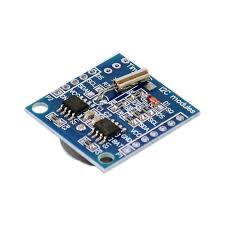
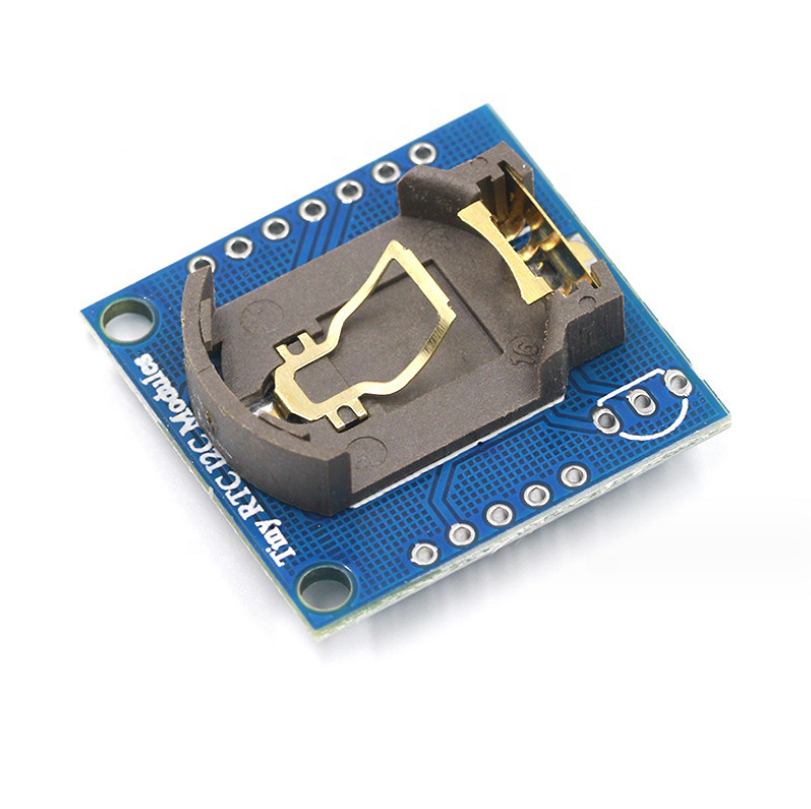
DS1307 Real Time Clock RTC Module
₹46.02 incl. GST (₹39.00 + GST)
The DS1307 RTC Module is a reliable real-time clock module for accurate time and date tracking in Arduino, ESP32, Raspberry Pi, STM32, and other embedded projects. It uses the I²C interface, includes an AT24C32 4KB EEPROM for data storage, and provides a 1Hz output signal for timing applications. A CR2032 backup battery holder maintains time during power loss; the battery is not included.
The DS1307 RTC Module is a reliable real-time clock module designed to provide accurate and continuous timekeeping for Arduino, ESP32, Raspberry Pi, STM32, and other embedded systems. It keeps track of seconds, minutes, hours, day, date, month, and year, making it suitable for applications that require precise time and date information.
The module communicates with a host microcontroller through the I²C two-wire serial interface, which simplifies connection and requires only a small number of communication pins. The DS1307 automatically handles month-end dates and leap-year adjustments, allowing the system to maintain the correct calendar information without requiring complex time-management code.
An onboard AT24C32 EEPROM provides 32Kbit (4KB) of non-volatile storage, allowing users to store configuration values, event information, settings, counters, or other small amounts of data that need to remain available even after the main power supply is removed.
The module includes a CR2032 coin-cell battery holder for backup timekeeping. When a suitable CR2032 battery is installed, the RTC can continue maintaining the time when the main system power is disconnected. The battery is not included with the module.
The DS1307 module also provides a 1Hz output signal, which can be used for timing and pulse-generation applications. Its compact design makes it suitable for embedded systems, data loggers, clocks, automation projects, IoT devices, and educational electronics applications.
Features
- Real-time clock module based on the DS1307 IC
- Tracks seconds, minutes, hours, day, date, month, and year
- Automatic leap-year adjustment
- Automatic month-end date adjustment
- I²C two-wire serial communication interface
- Compatible with Arduino, ESP32, ESP8266, Raspberry Pi, STM32, AVR, PIC, and other suitable controllers
- Onboard AT24C32 32Kbit (4KB) EEPROM
- Provides non-volatile memory for data storage
- CR2032 backup battery holder
- Maintains time during main power interruption when a battery is installed
- 1Hz square-wave output
- Low power consumption
- Compact module design
- Suitable for time-stamping applications
- Useful for data logging and automation
- Suitable for IoT and embedded systems
- Easy to integrate into microcontroller projects
Specifications
| Parameter | Specification |
|---|---|
| Product Type | Real Time Clock Module |
| RTC IC | DS1307 |
| Communication Interface | I²C / Two-Wire Serial |
| Backup Battery | CR2032 Coin Cell |
| Battery Included | No |
| EEPROM IC | AT24C32 |
| EEPROM Capacity | 32Kbit / 4KB |
| RTC User Memory | 56 Bytes |
| Output Signal | 1Hz Square Wave |
| Operating Voltage | 3.3V–5V |
| Dimensions | Approximately 27mm × 28mm × 8.4mm |
| Operating Temperature | 0°C to +70°C |
| Compatible Platforms | Arduino, ESP32, ESP8266, Raspberry Pi, STM32, AVR, PIC |
| Application | Timekeeping, Data Logging, Automation & IoT |
Design and Construction
The DS1307 RTC module is built around the DS1307 real-time clock IC and includes the supporting circuitry required for timekeeping and microcontroller communication. Its compact PCB design makes it convenient to integrate into breadboard prototypes, embedded systems, control panels, and custom electronic devices.
The module includes an onboard CR2032 battery holder, allowing a backup coin-cell battery to be installed so that the RTC can continue maintaining time when the primary system power is disconnected. The CR2032 battery itself is not included.
An AT24C32 EEPROM is also provided on the module, offering additional non-volatile storage for project data. Information stored in the EEPROM can remain available even after the main power supply is removed.
The module provides an I²C interface for communication with the host microcontroller. This two-wire interface simplifies wiring and allows the RTC and EEPROM to be accessed from compatible microcontroller platforms.
The board also provides a 1Hz output signal, which can be used by external circuitry or a microcontroller for timing-related applications.
DS1307 RTC Module reference image
Working Principle
The DS1307 maintains the current time and calendar information using its internal real-time clock circuitry. It continuously keeps track of seconds, minutes, hours, day, date, month, and year.
The connected microcontroller communicates with the RTC through the I²C interface to read the current time and date or update the clock settings. The microcontroller can use this information to perform time-based operations, display the current time, or add timestamps to stored data.
When the main power supply is available, the module operates from the system power. When the main power is removed and a suitable CR2032 backup battery is installed, the RTC can continue maintaining the time.
The DS1307 automatically handles calendar functions such as month-end date changes and leap-year adjustments, reducing the amount of calendar-processing work required from the microcontroller.
The onboard AT24C32 EEPROM operates as additional non-volatile memory. The microcontroller can use it to store small amounts of information such as configuration settings, event records, counters, or other data that should remain stored after power loss.
The 1Hz output pin generates a square-wave timing signal that can be used for timing, synchronization, or pulse-generation applications.
Applications
- Real-time clock systems
- Arduino clock projects
- Digital clock projects
- Time and date display systems
- Time-stamped data logging
- Environmental data loggers
- IoT devices
- Time-based automation systems
- Alarm clock projects
- Event scheduling systems
- Access control systems
- Attendance systems
- Industrial automation
- Embedded control systems
- Smart home projects
- Energy monitoring systems
- Temperature data logging
- Sensor data logging
- Electronic timers
- Calendar-based automation
- Microcontroller projects
- Educational electronics projects
- Raspberry Pi timekeeping projects
- ESP32 and ESP8266 IoT projects
- Battery-backed timekeeping applications
Package Includes
- 1 × DS1307 RTC Module with CR2032 Battery Holder
Note: CR2032 backup battery is not included.
Product Disclaimer
Product images are shown for illustrative and representational purposes only. The actual product may vary slightly in colour, dimensions, PCB layout, component placement, connector arrangement, or appearance depending on the manufacturing batch.
CR2032 battery, Arduino boards, ESP32 boards, Raspberry Pi boards, connecting wires, breadboards, displays, sensors, power supplies, and other components shown in product images are not included unless specifically mentioned in the package contents.
The backup battery is not included. Install a suitable CR2032 coin-cell battery in the holder if backup timekeeping is required.
Timekeeping accuracy can vary depending on the RTC characteristics, ambient temperature, battery condition, power supply, and operating environment.
The module should be operated within its specified voltage and temperature ranges. Verify the wiring and I²C connections before powering the module.
Related Products and Categories
Explore relevant products and category pages available from Robosap.
FAQs
1. What is the DS1307 RTC Module used for?
The DS1307 RTC Module is used to provide real-time clock and calendar information to microcontrollers and embedded systems. It can keep track of seconds, minutes, hours, day, date, month, and year, making it useful for clocks, data loggers, automation systems, alarms, attendance systems, and time-based applications.
2. What does RTC mean?
RTC stands for Real-Time Clock. An RTC is a dedicated electronic circuit that keeps track of the current time and date even when the main microcontroller is busy performing other tasks.
3. Which IC is used in this RTC module?
The module is based on the DS1307 Real-Time Clock IC, which is designed specifically for maintaining time and calendar information in electronic systems.
4. What communication interface does the DS1307 use?
The DS1307 communicates with a microcontroller through the I²C two-wire serial interface. This requires only the appropriate clock and data connections along with power and ground.
5. Which microcontrollers are compatible with the DS1307 module?
The module can be used with popular platforms such as Arduino, ESP32, ESP8266, Raspberry Pi, STM32, AVR, PIC, and other microcontrollers that support compatible I²C communication.
6. What information can the DS1307 track?
The DS1307 can track seconds, minutes, hours, day of the week, date, month, and year. It also automatically handles calendar changes such as month-end dates and leap-year adjustments.
7. Does the DS1307 require a backup battery?
The module can operate from the main power supply without a backup battery, but a CR2032 battery is recommended when continuous timekeeping during power loss is required. The module includes a CR2032 battery holder, but the battery is not included.
8. What happens when the main power is disconnected?
When a suitable CR2032 battery is installed, the RTC can continue maintaining the current time while the main system power is disconnected. This allows the system to recover the correct time when power is restored.
9. Is the CR2032 battery included with the module?
No. The module includes a CR2032 battery holder, but the CR2032 coin-cell battery must be purchased separately.
10. Does the module include EEPROM memory?
Yes. The module includes an AT24C32 EEPROM with a capacity of 32Kbit (4KB). This additional non-volatile memory can be used to store project data even when the main power is removed.
11. What can be stored in the AT24C32 EEPROM?
The EEPROM can store information such as configuration settings, counters, event records, calibration values, user settings, sensor data, and other small amounts of information that need to remain available after power loss.
12. What is the 1Hz output on the DS1307 module used for?
The module provides a 1Hz square-wave output, which generates one pulse per second. It can be used for timing, synchronization, pulse generation, and other applications requiring a periodic timing signal.
13. What is the operating voltage of the module?
The module is specified for an operating voltage of approximately 3.3V to 5V, making it suitable for many commonly used microcontroller development platforms.
14. Can the DS1307 be used with Arduino?
Yes. The DS1307 is commonly used with Arduino boards for digital clocks, timers, data logging, alarms, attendance systems, and other projects requiring accurate time and date information.
15. Can the DS1307 be used with ESP32 and ESP8266?
Yes. The module can be connected to ESP32 and ESP8266 through their I²C interface. It can be used in IoT projects where accurate timestamps are required for sensor readings, events, or data logging.
16. Can the DS1307 be used with Raspberry Pi?
Yes. The module can be connected to a Raspberry Pi through I²C when the appropriate hardware configuration and software support are used.
17. Can the DS1307 be used for data logging?
Yes. The RTC can provide accurate time and date information that can be added to sensor or system records. For example, a data logger can store a sensor reading together with the exact date and time at which it was recorded.
18. Can the DS1307 be used for an alarm clock project?
Yes. A microcontroller can read the time from the DS1307 and compare it with a programmed alarm time. When the specified time is reached, the controller can activate a buzzer, relay, display, or other output device.
19. Can the DS1307 be used in automation projects?
Yes. It can be used for time-based automation, such as switching lights, pumps, fans, appliances, or other devices at scheduled times.
20. Does the DS1307 automatically handle leap years?
Yes. The DS1307 includes calendar functionality that automatically handles leap-year adjustments and month-end date changes, reducing the need for the microcontroller to calculate these changes manually.
21. Does the RTC lose the time when the Arduino is restarted?
Normally, restarting the Arduino does not reset the RTC time. If the RTC has a suitable backup battery installed, it can continue keeping time even when the Arduino's main power is disconnected.
22. Does the DS1307 store the current time permanently?
The current time is maintained by the RTC circuitry while power is available. When main power is removed, a suitable backup CR2032 battery can keep the RTC running. The actual timekeeping duration depends on battery condition and operating conditions.
23. What is the purpose of the AT24C32 EEPROM on the module?
The AT24C32 provides non-volatile data storage separate from the RTC's timekeeping function. It can store information that should remain available after the system is powered off.
24. Can the RTC and EEPROM be used together?
Yes. The DS1307 RTC and AT24C32 EEPROM can be integrated into the same project. For example, a data logger can use the RTC to generate timestamps while using the EEPROM to store configuration or other project information.
25. Is the DS1307 suitable for IoT projects?
Yes. The module is useful in IoT systems that require local timekeeping and timestamps, especially when the system needs a hardware clock independent of network connectivity.
26. What are the common applications of the DS1307 module?
Common applications include digital clocks, alarm clocks, data loggers, attendance systems, access-control systems, event scheduling, IoT devices, time-based automation, sensor monitoring, embedded systems, and educational electronics projects.
27. Is the DS1307 module suitable for beginners?
Yes. Its simple I²C interface and compatibility with popular development boards make it suitable for students, hobbyists, makers, and beginners learning about real-time clocks and embedded systems.
28. Does the DS1307 provide a digital output?
Yes. The time and date information is transferred digitally through the I²C interface, and the module also provides a dedicated 1Hz square-wave output.
29. What is the operating temperature range of the module?
The specified operating temperature range is approximately 0°C to +70°C. Applications requiring operation outside this range should use an RTC designed for the required environmental conditions.
30. What should be checked before using the DS1307 module?
Check the power-supply voltage, I²C connections, backup battery installation, and microcontroller compatibility before use. If backup timekeeping is required, install a suitable CR2032 battery in the provided holder.
31. What is included with the DS1307 RTC Module?
The package includes 1 × DS1307 RTC Module with CR2032 battery holder. The CR2032 battery is not included, and connecting wires, microcontrollers, displays, breadboards, and other accessories are not included unless specifically mentioned.
Only logged in customers who have purchased this product may leave a review.




Reviews
There are no reviews yet