
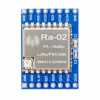
SX1278 LoRa RA-02 Long-Range Wireless Transceiver Module with Breakout Board
₹377.60 incl. GST (₹320.00 + GST)
The SX1278 LoRa RA-02 Long-Range Wireless Transceiver Module with Breakout Board is a 433MHz wireless communication module designed for long-range IoT and embedded applications. It supports SPI communication, up to +20dBm (100mW) RF output power, receiver sensitivity down to -148dBm, and communication ranges up to 10km under suitable conditions. Operating at a typical 3.3V supply, it supports LoRa, FSK, GFSK, and other modulation modes, making it suitable for Arduino, ESP32, smart agriculture, remote monitoring, wireless sensor networks, and smart home projects.
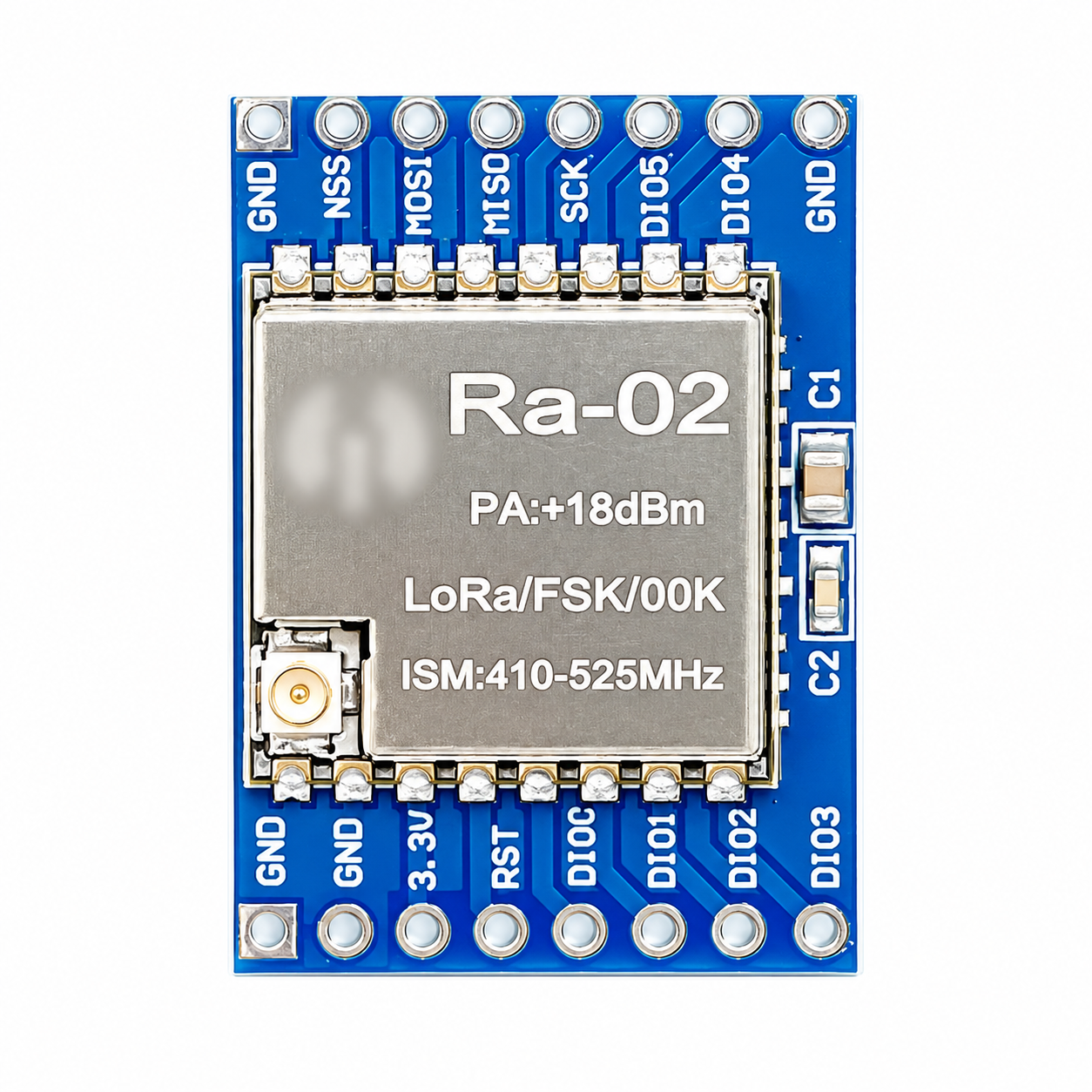
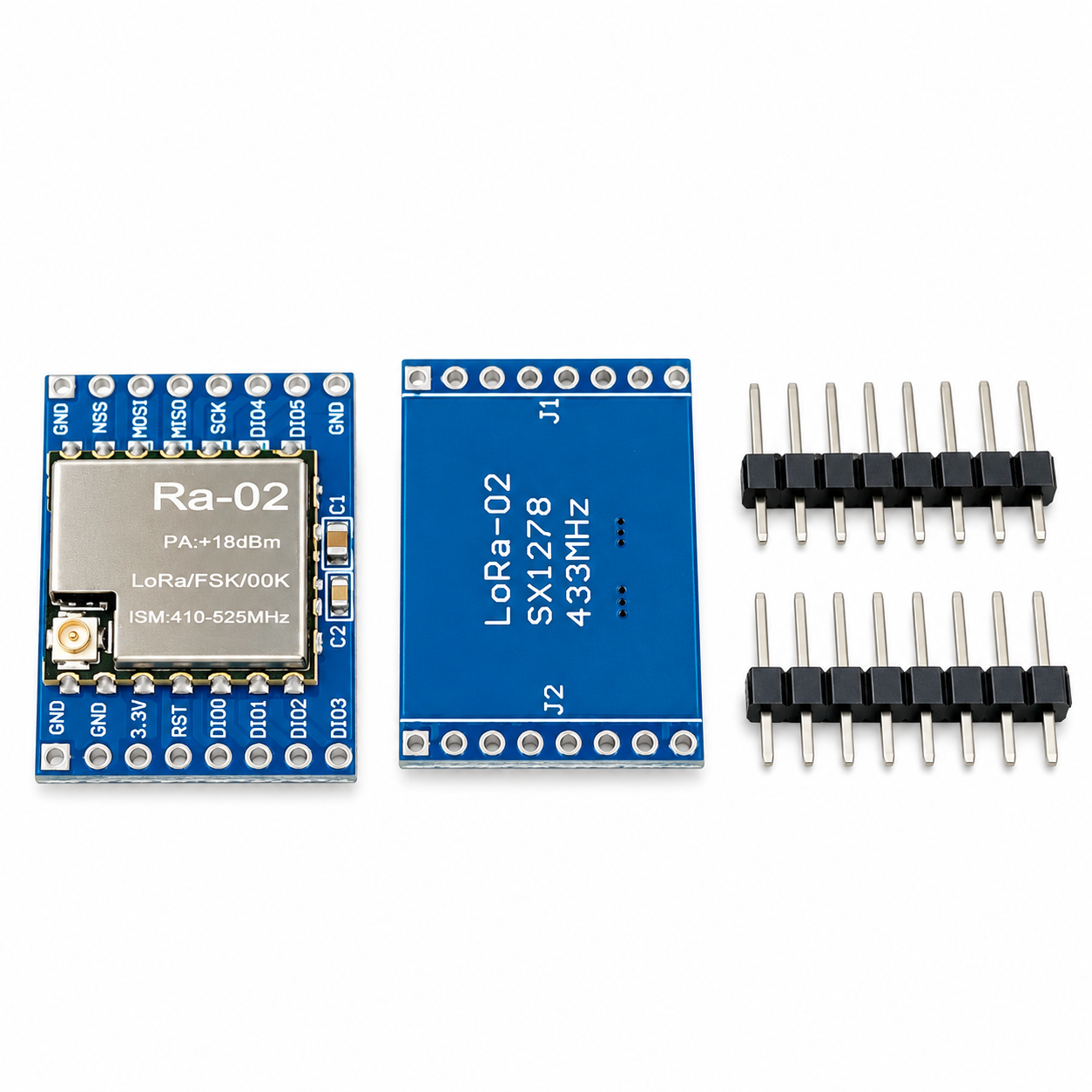
Ra-02 is based on SX1278 wireless transparent transmission module (transceiver one), with IPEX socket it can connect external antenna. Using advanced LoRa spread spectrum technology, communication distance is10000 meters, super error correction, anti-interference ability, with the air wake-up function (ultra-low power consumption). It can be used in the enviroment with thousands of people,especially for meter reading, smart home, burglar alarm and other equipment. Feature: LoRa Spread Spectrum Modulation Technology +20dBm-100mW Constant RF power output when voltage changes High sensitivity: low to -148dBm Half-duplex SPI communication Programmable bit rates up to 300kbps Supports FSK, GFSK, MSK, GMSK, LoRa and OOK modulation modes 127dB RSSI dynamic range Automatic RF signal detection, CAD mode and ultra-high-speed AFC With CRC, up to 256 bytes of packet engine Small volume dual-row stamp-hole patch package With shielding shell Spring antenna (Ra-01) or IPEX external antenna (Ra-02) Wireless standard 433MHz Frequency range: 420 ~ 450MHz Interface: SPI GPIO Voltage:1.8 ~ 3.7V, the typical value is 3.3V Current: Receiver:? 10.8mA (LnaBoost off, band 1) Transimit: ? 120mA (+ 20dBm) Sleep mode: 0.2?A Working temperature: -40 to + 85 ? C Storage temperature: normal
Please Note: Images are for representation only. The actual Product may diffe
1. Product Description
The SX1278 LoRa RA-02 Long-Range Wireless Transceiver Module with Breakout Board is a compact wireless communication solution designed for long-range, low-power IoT and embedded applications. Based on the SX1278 transceiver, it uses LoRa spread-spectrum modulation technology to provide long-distance communication, high receiver sensitivity, and strong resistance to interference.
Operating in the 433MHz frequency band, the module supports wireless data transmission and reception through an SPI interface. It offers a specified RF output power of up to +20dBm (100mW) and receiver sensitivity as low as -148dBm, making it suitable for applications requiring reliable communication over extended distances. The stated communication range can reach up to 10km under suitable conditions, depending on antenna selection, terrain, obstacles, interference, and radio configuration.
The module supports multiple modulation modes, including LoRa, FSK, GFSK, MSK, GMSK, and OOK. It also incorporates error detection, automatic signal detection, channel activity detection (CAD), and automatic frequency control features to improve communication reliability.
Featuring an IPEX antenna connector, a compact shielded design, and an included breakout board, the module can be integrated into compatible microcontroller platforms such as Arduino and ESP32. It is suitable for remote sensor networks, smart agriculture, wireless monitoring, smart home systems, meter reading, and other long-range IoT applications.
2. Features
-
Based on the SX1278 LoRa transceiver
-
Operates in the 433MHz frequency band
-
Uses LoRa spread-spectrum modulation technology
-
Specified communication range of up to 10km under suitable conditions
-
RF output power up to +20dBm (100mW)
-
High receiver sensitivity of up to -148dBm
-
Half-duplex SPI communication interface
-
Programmable data rates up to 300kbps, depending on modulation mode
-
Supports LoRa, FSK, GFSK, MSK, GMSK, and OOK modulation modes
-
High resistance to interference through appropriate LoRa configuration
-
Automatic RF signal detection
-
Channel Activity Detection (CAD) support
-
Automatic Frequency Control (AFC)
-
CRC error detection support
-
Packet engine supporting packets up to 256 bytes
-
Low-power sleep mode
-
IPEX connector for an external antenna
-
Compact shielded module design
-
Compatible with suitable microcontrollers and breakout-board interfaces
3. Specifications
| Specification | Details |
|---|---|
| Product Type | LoRa Wireless Transceiver Module |
| Module Model | RA-02 |
| Transceiver Chip | SX1278 |
| Wireless Technology | LoRa / Sub-GHz RF |
| Operating Frequency | 433MHz band |
| Frequency Range | 420–450MHz |
| RF Output Power | Up to +20dBm (100mW) |
| Receiver Sensitivity | Up to -148dBm |
| Maximum Stated Range | Up to 10km under suitable conditions |
| Communication Interface | SPI |
| Communication Mode | Half-duplex |
| Supported Modulation | LoRa, FSK, GFSK, MSK, GMSK, OOK |
| Programmable Bit Rate | Up to 300kbps, depending on mode |
| Maximum Packet Length | Up to 256 bytes, as specified |
| Signal Detection | Automatic RF detection and CAD |
| Error Detection | CRC |
| Operating Voltage | 1.8–3.7V |
| Typical Supply Voltage | 3.3V |
| Receiver Current | Approximately 10.8mA, under specified conditions |
| Transmit Current | Approximately 120mA at +20dBm |
| Sleep Current | Approximately 0.2µA, as specified |
| Operating Temperature | -40°C to +85°C |
| Antenna Connector | IPEX |
| Board Type | Module with breakout board |
Note: The maximum data rate depends on the selected modulation and radio configuration. The actual communication range and current consumption vary with antenna, transmit power, spreading factor, bandwidth, supply quality, and operating conditions.
4. Working Principle
The SX1278 transceiver converts digital data from a connected microcontroller into radio-frequency signals for wireless transmission. The receiving module detects the transmitted signals and converts them back into digital data.
The module communicates with the host microcontroller through the SPI interface, which is used to configure radio parameters and transfer data. The microcontroller can set parameters such as frequency, transmit power, spreading factor, bandwidth, and coding rate, depending on the selected communication mode and library.
LoRa modulation spreads the transmitted signal across a wider bandwidth, improving sensitivity and communication robustness under suitable conditions. This makes it useful for low-data-rate applications that need longer range than many conventional short-range wireless technologies.
The module operates in half-duplex mode, meaning it transmits or receives at a given time rather than transmitting and receiving simultaneously.
5. LoRa Wireless Technology
LoRa is a spread-spectrum radio modulation technology designed for long-range communication. It can provide strong receiver sensitivity and useful interference tolerance, depending on the configured radio parameters.
The SX1278 supports LoRa as well as several other modulation modes. Its programmable configuration allows developers to balance range, data rate, airtime, and power consumption for the intended application.
The module is particularly suitable for transmitting small data packets from remote sensors and embedded devices.
6. Interface and Connectivity
The module uses an SPI interface to communicate with a host microcontroller. Depending on the breakout-board design, the connection may expose the following signals:
-
VCC: Power supply
-
GND: Ground
-
SCK: SPI clock
-
MISO: SPI data from module to controller
-
MOSI: SPI data from controller to module
-
NSS/CS: SPI chip select
-
RESET: Module reset
-
DIO pins: Configurable digital signals and interrupt functions
The exact pin labels and number of exposed DIO pins depend on the breakout board. Verify the board pinout before wiring.
7. Power Supply Requirements
The module operates from 1.8V to 3.7V, with 3.3V as the typical supply voltage. Its power supply must provide sufficient current during transmission, particularly when operating at the maximum specified RF output power.
At +20dBm, the supplied specification lists approximately 120mA transmit current. A stable 3.3V supply with adequate current capacity is recommended.
Important: Do not power the module directly from a 5V supply. Ensure that SPI and GPIO signal levels are also compatible with the module’s electrical requirements.
8. Antenna Connection
The RA-02 module uses an IPEX antenna connector for an external antenna.
For effective communication, use an antenna suitable for the 433MHz frequency band and ensure that the connector and antenna are compatible. Antenna placement, orientation, nearby objects, and the surrounding environment can significantly affect communication performance.
The antenna and breakout-board accessories included in the package should be verified with the seller.
9. Applications
The SX1278 LoRa RA-02 module is suitable for:
-
Smart agriculture and farm monitoring
-
Remote environmental sensors
-
Long-range IoT communication
-
Smart home automation
-
Wireless meter reading
-
Remote data acquisition
-
Industrial monitoring
-
Wireless alarm systems
-
Security and monitoring devices
-
Weather station networks
-
Water level monitoring
-
Remote equipment monitoring
-
Arduino and ESP32 wireless projects
-
Low-power sensor networks
10. Package Includes
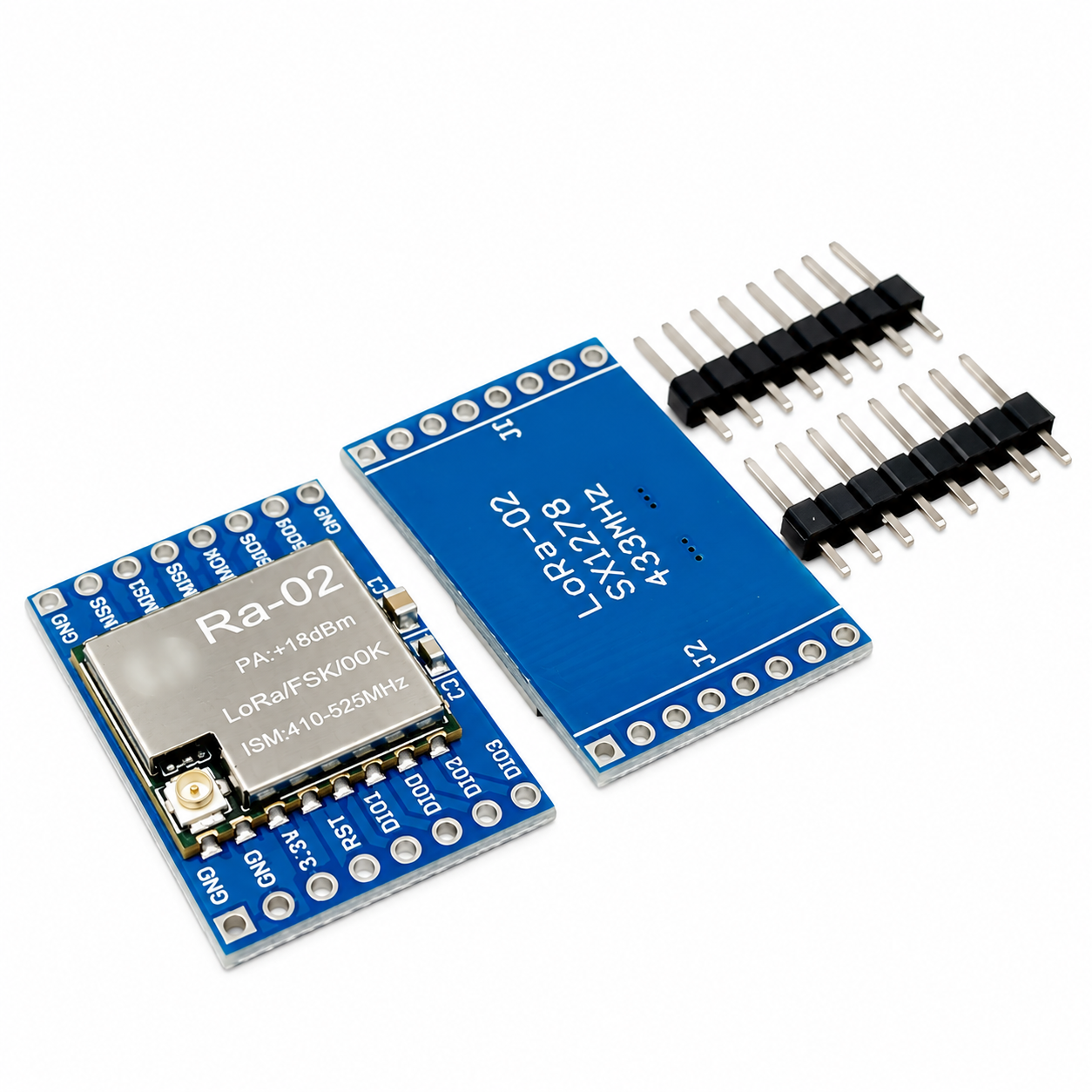
The supplied product title indicates a module with a breakout board, but the exact package contents are not fully specified.
Please confirm whether the package includes:
-
SX1278 RA-02 transceiver module
-
Breakout board
-
433MHz antenna
-
Connecting accessories
Only the items explicitly listed by the seller should be considered included.
11. Product Disclaimer
-
The stated 10km communication range is a maximum claim under suitable conditions and is not guaranteed in every installation.
-
Actual range depends on antenna quality, antenna height, terrain, obstacles, interference, transmit power, and radio settings.
-
The module requires compatible software and an SPI-capable microcontroller.
-
The module uses a 3.3V typical supply and is not intended for direct 5V power input.
-
Ensure that the antenna is suitable for the operating frequency.
-
Verify local radio regulations and permitted transmit-power limits before use.
-
Product images are for illustration and representation purposes only. The actual product may differ slightly in appearance.
r slightly in appearance.
Frequently Asked Questions (FAQs)
1. What is the SX1278 LoRa RA-02 module?
It is a long-range wireless transceiver module based on the SX1278 chip, designed for low-power IoT and embedded communication applications.2. What frequency does the module operate at?
It operates in the 433MHz band, with a specified frequency range of 420–450MHz.3. What is the maximum communication range?
The supplied specification states a range of up to 10km under suitable conditions. Actual range depends on antenna selection, terrain, interference, and radio configuration.4. What is LoRa technology?
LoRa is a spread-spectrum radio modulation technology designed to provide long-range communication with high receiver sensitivity.5. What is the SX1278 chip?
The SX1278 is a sub-GHz wireless transceiver that supports LoRa and several other modulation modes.6. What is the RA-02?
RA-02 is the module designation for this SX1278-based wireless transceiver.7. What interface does the module use?
It uses an SPI interface to communicate with a microcontroller.8. Is the module compatible with Arduino?
Yes. It can be used with compatible Arduino boards that provide SPI communication and suitable 3.3V interfacing.9. Can I use it with ESP32?
Yes. It is suitable for ESP32 projects when the SPI connections, voltage levels, and software configuration are correct.10. Can it be used with ESP8266?
Yes. It can be interfaced with an ESP8266 through SPI, provided the module is powered and connected according to its electrical requirements.11. What is the operating voltage?
The specified operating voltage range is 1.8–3.7V, with 3.3V as the typical supply voltage.12. Can I connect the module directly to 5V?
No. The module is designed for a maximum supply voltage of 3.7V. Use a suitable regulated supply and compatible logic levels.13. What is the maximum RF output power?
The module supports a specified maximum output power of +20dBm, equivalent to 100mW.14. What is the receiver sensitivity?
The supplied specification lists receiver sensitivity as low as -148dBm, depending on the selected radio configuration.15. What is the maximum data rate?
The supplied specifications state programmable bit rates up to 300kbps, depending on the selected modulation mode and configuration.16. Does it support FSK modulation?
Yes. It supports FSK as well as GFSK, MSK, GMSK, LoRa, and OOK modulation modes.17. Does it support LoRa modulation?
Yes. LoRa is one of the main modulation technologies supported by the module.18. Is the communication full-duplex?
No. The module operates in half-duplex mode, transmitting or receiving at a given time.19. What is the maximum packet size?
The supplied specification lists a packet engine supporting packets up to 256 bytes. The actual application payload depends on the selected mode and protocol configuration.20. What is CRC?
CRC stands for Cyclic Redundancy Check. It is used to detect errors in received data packets.21. What is CAD mode?
Channel Activity Detection (CAD) allows the transceiver to detect LoRa activity on a channel before transmission or as part of a channel-monitoring strategy.22. What is RSSI?
RSSI stands for Received Signal Strength Indicator. It provides an indication of the received radio signal strength.23. What is AFC?
Automatic Frequency Control helps compensate for frequency offsets under supported operating modes.24. What is the transmit current?
The supplied specification lists approximately 120mA at +20dBm transmit power.25. What is the receiver current?
The supplied specification lists approximately 10.8mA under the stated receiver conditions.26. What is the sleep current?
The supplied specification lists approximately 0.2µA in sleep mode. Actual system current depends on the breakout board and connected circuitry.27. Does the module support low-power applications?
Yes. It supports a low-power sleep mode and is suitable for battery-powered sensor applications when the complete system is designed for low-power operation.28. What antenna does it use?
The RA-02 uses an IPEX antenna connector for a compatible external antenna.29. Is the antenna included?
The supplied information does not clearly confirm whether an antenna is included. Verify the package contents with the seller.30. Does the module require a microcontroller?
For typical applications, yes. A microcontroller configures the transceiver through SPI and handles the application data.31. Can two SX1278 modules communicate with each other?
Yes. Two compatible modules can communicate when configured with matching frequency, modulation settings, and compatible packet handling.32. Can it communicate with other LoRa modules?
It may communicate with other LoRa devices that use compatible frequency bands, modulation parameters, and packet formats. LoRa compatibility alone does not guarantee interoperability between all products.33. Can it connect to a LoRaWAN network?
The SX1278 provides radio functionality, but LoRaWAN requires suitable protocol software, network configuration, and a compatible network. The module is not a complete LoRaWAN gateway.34. Is it suitable for smart agriculture?
Yes. It can transmit sensor data from remote agricultural locations to a compatible receiver or gateway.35. Can it be used for wireless meter reading?
Yes. It is suitable for transmitting small amounts of data in compatible remote meter-reading systems.36. Can it be used for home automation?
Yes. It can be used in compatible wireless control and monitoring systems, subject to local radio regulations and application requirements.37. Can it be used for remote monitoring?
Yes. It is suitable for remote sensor data collection and equipment monitoring when paired with compatible firmware and a receiving device.38. What is the operating temperature range?
The specified operating temperature range is -40°C to +85°C.39. Does the module include a breakout board?
The product title specifies a module with a breakout board. Confirm the exact board arrangement and included accessories with the seller.40. What is included in the package?
The exact package contents are not fully specified in the supplied description. Confirm whether the antenna, breakout board, and accessories are included before purchase.41. What affects the wireless range?
The range depends on antenna performance, antenna height, obstacles, terrain, interference, radio settings, and permitted transmit power.42. Is the module suitable for long-distance wireless projects?
Yes. Its LoRa capability and high receiver sensitivity make it suitable for long-range wireless communication when configured appropriately.43. Can it be used for industrial monitoring?
Yes. It can be used for suitable wireless sensor networks and remote industrial monitoring applications.44. Does the module require special software?
Yes. A compatible driver or library is generally required to configure the SX1278 and handle transmission and reception through SPI.45. What are the main advantages of this module?
Its main advantages include long-range LoRa communication, high receiver sensitivity, configurable modulation, SPI interfacing, and low-power sleep support, making it useful for remote IoT and sensor networks.Only logged in customers who have purchased this product may leave a review.




Reviews
There are no reviews yet