
TPL0501 100KΩ 256-Position Digital Potentiometer Module
₹566.40 incl. GST (₹480.00 + GST)
The TPL0501 Digital Potentiometer Module is a high-precision, single-channel digital resistor featuring 256 programmable positions and 100KΩ resistance. It uses an SPI-compatible interface and operates from 2.7V to 5.5V, making it suitable for Arduino, STM32, ESP32, and other microcontroller projects. It is ideal for sensor calibration, amplifier gain control, voltage adjustment, electronic trimming, and replacing mechanical potentiometers in programmable circuits.
The TPL0501 Digital Potentiometer Module is a high-precision, single-channel digital resistor designed for electronically controlled resistance adjustment. It provides 256 programmable tap positions across a 100KΩ end-to-end resistance, allowing a microcontroller to adjust resistance digitally without requiring a traditional mechanical potentiometer.
The module uses an SPI-compatible serial interface, making it suitable for integration with Arduino, STM32, ESP32, and other microcontroller-based systems. Resistance can be adjusted through software, making the module useful for applications where automatic calibration, remote adjustment, repeatable settings, or electronic control are required.
With a wide 2.7V to 5.5V operating voltage range, the module can be integrated into many low-voltage embedded systems. Its precision characteristics and low temperature coefficient make it useful for sensor calibration, amplifier gain adjustment, voltage regulation, offset trimming, and programmable analog circuits.
The TPL0501 provides a convenient digital alternative to mechanical potentiometers, particularly in applications where the resistance setting needs to be controlled automatically by a microcontroller.
Features
- Based on the TPL0501 digital potentiometer
- Single-channel digital resistance adjustment
- 256 programmable tap positions
- 100KΩ end-to-end resistance
- SPI-compatible serial interface
- Wide 2.7V–5.5V operating voltage
- Software-controlled resistance adjustment
- Suitable as a digital replacement for mechanical potentiometers
- Resistance tolerance of approximately ±20%
- Low temperature coefficient of approximately 35ppm/°C
- Operating temperature range of -40°C to +125°C
- ESD protection up to 2000V human-body model
- Suitable for calibration and trimming applications
- Compact design for embedded applications
- Compatible with Arduino, STM32, ESP32, and other microcontrollers
Specifications
| Parameter | Specification |
|---|---|
| Product Type | Digital Potentiometer Module |
| IC | TPL0501 |
| Channels | Single Channel |
| Resolution | 256 Positions |
| Resistance | 100KΩ |
| Interface | SPI-Compatible |
| Operating Voltage | 2.7V–5.5V |
| Resistance Tolerance | ±20% |
| Temperature Coefficient | 35ppm/°C |
| Operating Temperature | -40°C to +125°C |
| ESD Protection | Up to 2000V HBM |
| Application | Digital Resistance Adjustment |
Design and Construction
The TPL0501 module provides electronically controlled resistance adjustment through a compact digital potentiometer circuit. Instead of using a physical knob or sliding contact, the resistance value is selected digitally through the SPI-compatible interface.
The 256 tap positions provide multiple selectable resistance levels across the 100KΩ range. This allows a microcontroller to make repeatable and programmable adjustments according to the application’s requirements.
The module’s wide supply range makes it suitable for integration into many 3.3V and 5V embedded systems.
Working Principle
A digital potentiometer works similarly to a conventional potentiometer, but its resistance setting is controlled electronically.
The TPL0501 divides its total resistance into 256 selectable positions. A microcontroller sends digital commands through the SPI-compatible interface to select the required tap position.
Changing the selected tap changes the effective resistance between the potentiometer terminals. This allows the connected circuit to electronically adjust parameters such as voltage, gain, offset, or sensor calibration.
The resistance value can therefore be changed through software without physically turning a potentiometer.
SPI Interface
The module communicates with the host microcontroller through an SPI-compatible serial interface.
A compatible microcontroller can send digital commands to select the desired resistance position. This makes it possible to automate resistance adjustments or change them dynamically during operation.
Typical applications include:
- Programmable gain control
- Automated sensor calibration
- Digital voltage adjustment
- Electronic trimming
- Programmable analog circuits
- Remote parameter adjustment
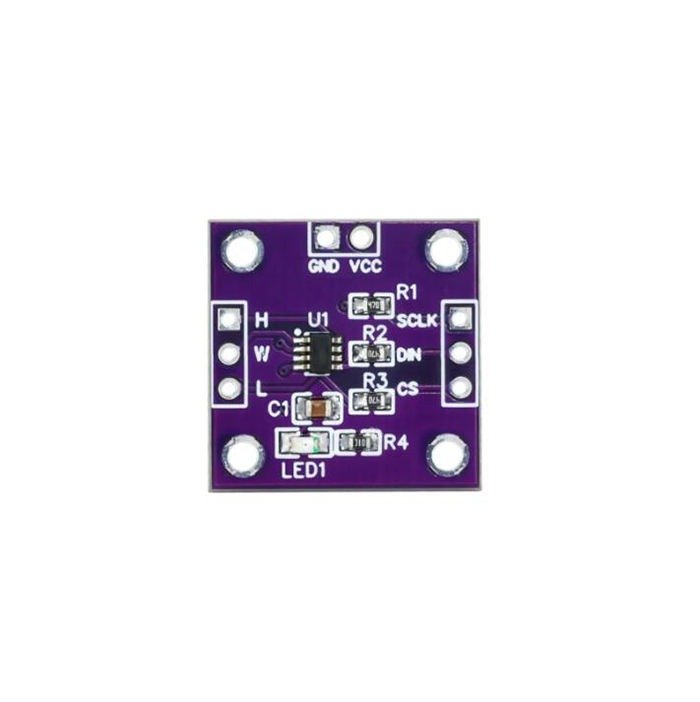
The exact pin configuration should be verified from the markings on the supplied module before connection.
256-Position Resolution
The 256 available tap positions provide fine digital adjustment across the 100KΩ resistance range. The actual resistance at each position depends on the device’s nominal resistance, tolerance, and electrical characteristics.
This resolution makes the module useful when a circuit requires repeatable electronic adjustment rather than manual potentiometer control.
Applications
- Adjustable power supply control
- Sensor calibration
- Sensor fine-tuning
- Digital potentiometer replacement
- Amplifier gain adjustment
- Amplifier offset trimming
- Voltage regulation circuits
- Programmable analog circuits
- Electronic calibration systems
- Arduino projects
- STM32 projects
- ESP32 projects
- Embedded control systems
- Industrial control applications
- Measurement equipment
- DIY electronics projects
- Prototyping and experimentation
Advantages
- Software-controlled resistance adjustment
- No mechanical moving parts
- 256 selectable positions
- 100KΩ nominal resistance
- SPI-compatible communication
- Wide operating voltage range
- Repeatable resistance settings
- Suitable for automated calibration
- Compact and easy to integrate
- Compatible with common microcontroller platforms
Compatibility
The module can be used with microcontroller platforms that provide compatible SPI communication, including:
- Arduino
- STM32
- ESP32
- Other SPI-compatible microcontrollers
The module can also be used in custom analog and embedded circuits where electronically controlled resistance is required.
Package Includes
- 1 × TPL0501 100KΩ 256-Position Digital Potentiometer Module
Product Disclaimer
Product images are for illustrative and representational purposes only. The actual product may vary slightly in colour, PCB layout, component placement, dimensions, markings, or overall appearance depending on the manufacturing batch.
The specified ±20% resistance tolerance means the actual resistance may differ from the nominal 100KΩ value. Actual performance may also vary depending on supply voltage, temperature, connected circuit, and operating conditions.
The TPL0501 is intended for applications within its specified electrical limits. Verify the device’s voltage, current, terminal configuration, and signal requirements before connecting it to a circuit.
Arduino boards, STM32 boards, ESP32 boards, sensors, power supplies, jumper wires, and other components shown in product images are not included unless specifically mentioned in the package contents.
Frequently Asked Questions (FAQs)
1. What is the TPL0501 Digital Potentiometer Module?
It is a digitally controlled potentiometer that allows a microcontroller to adjust resistance electronically without using a mechanical knob.
2. What is the resistance value of the module?
The module has a nominal 100KΩ end-to-end resistance.
3. How many adjustment positions does it have?
It provides 256 programmable tap positions, allowing fine digital resistance adjustment.
4. What communication interface does it use?
The TPL0501 uses an SPI-compatible serial interface for digital control.
5. What is the operating voltage?
It operates from 2.7V to 5.5V, making it suitable for many low-voltage microcontroller systems.
6. Can I use it with Arduino?
Yes. It can be controlled by compatible Arduino boards through the SPI interface.
7. Can it be used with ESP32?
Yes. The ESP32 can communicate with the module using its SPI interface.
8. Can it be used with STM32?
Yes. STM32 microcontrollers with compatible SPI functionality can control the module.
9. What can a digital potentiometer be used for?
It can be used for gain adjustment, voltage control, sensor calibration, offset trimming, and programmable analog circuits.
10. Can it replace a mechanical potentiometer?
Yes. It can serve as a digital replacement for a mechanical potentiometer in circuits that are electrically compatible with the device.
11. Can the resistance be adjusted using software?
Yes. The resistance setting can be changed digitally by sending appropriate commands through the SPI-compatible interface.
12. Does it have multiple channels?
No. The TPL0501 module provides single-channel digital resistance adjustment.
13. What is the resistance tolerance?
The specified resistance tolerance is approximately ±20%.
14. What is the temperature coefficient?
The specified temperature coefficient is approximately 35ppm/°C.
15. What is the operating temperature range?
The specified operating temperature range is approximately -40°C to +125°C.
16. Does the module provide ESD protection?
The specified ESD protection is up to 2000V Human Body Model (HBM).
17. Can it be used for sensor calibration?
Yes. It is suitable for electronically adjusting calibration parameters in compatible sensor circuits.
18. Can it be used for amplifier gain control?
Yes. It can be used in suitable amplifier circuits for programmable gain or offset adjustment.
19. Can it be used for voltage regulation?
It can be used for adjustment or trimming functions in compatible voltage-control circuits. The complete circuit must remain within the potentiometer's electrical limits.
20. Does it work like a normal potentiometer?
Functionally, it can provide adjustable resistance, but the resistance is selected electronically through digital commands rather than by physically turning a knob.
21. Is the resistance exactly 100KΩ at every position?
No. 100KΩ is the nominal end-to-end resistance. Each of the 256 tap positions provides a different effective resistance.
22. Is this module suitable for DIY electronics projects?
Yes. It is useful for Arduino, ESP32, STM32, sensor, audio, calibration, and embedded electronics projects.
23. What should I check before connecting the module?
Check the supply voltage, SPI pin configuration, resistance requirements, signal levels, and electrical limits of the connected circuit.
24. What is included in the package?
The package includes 1 × TPL0501 100KΩ 256-Position Digital Potentiometer Module.
25. Is the actual product exactly the same as shown in the images?
No. Product images are for representation only, and the actual module may vary slightly in PCB colour, layout, component placement, markings, or appearance depending on the manufacturing batch.
Only logged in customers who have purchased this product may leave a review.



Reviews
There are no reviews yet