
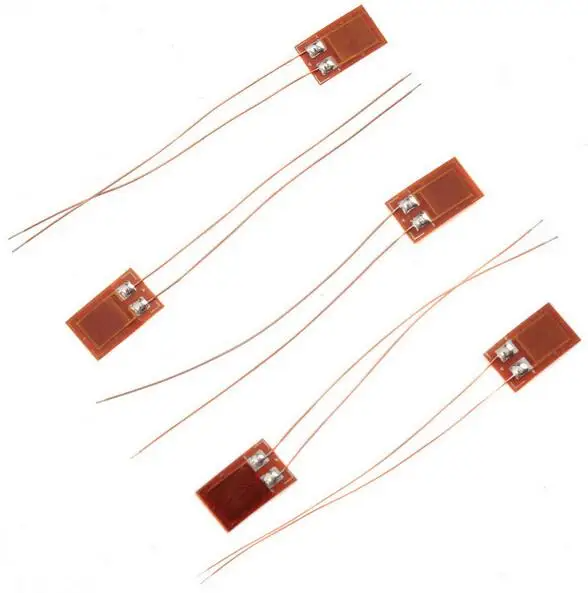
BX120-3AA High Precision Foil Strain Gauge – 120 Ohm Sensor- Pack of 4 Pcs
₹259.60 incl. GST (₹220.00 + GST)
BX120-3AA High Precision Resistance Strain Gauge
Product Description
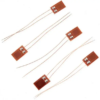
The BX120-3AA High Precision Resistance Strain Gauge is a foil-type resistance sensor designed to measure small mechanical deformations in materials. It is suitable for building custom load cells, weighing sensors, pressure sensors, structural monitoring systems, and robotic force-sensing applications.
When bonded to a surface such as a metal beam, the strain gauge stretches or compresses along with the material. This mechanical deformation causes a small change in electrical resistance, which can be measured using a Wheatstone Bridge circuit to determine strain, force, pressure, or weight.
Precision Strain Measurement
The BX120-3AA features a 120Ω nominal resistance and a sensitivity coefficient of approximately 2.0–2.1, providing measurable resistance changes when the attached material undergoes mechanical strain.
It can be used in quarter-bridge, half-bridge, or full-bridge configurations, depending on the requirements of the sensing application.
Foil Construction
The gauge uses Constantan foil with a phenolic backing, providing a compact and stable sensing element for measuring mechanical deformation.
Its operating temperature range of approximately -30°C to +80°C makes it suitable for a variety of laboratory, educational, industrial, and DIY measurement applications.
Key Features
- High-precision foil resistance strain gauge
- 120Ω nominal resistance
- Sensitivity coefficient of 2.0–2.1
- Constantan foil construction
- Suitable for quarter, half, and full bridge circuits
- Measures static and dynamic mechanical strain
- Suitable for load cell construction
- Useful for force and pressure measurement
- Suitable for structural analysis
- Compact sensing element
Technical Specifications
| Feature | Specification |
|---|---|
| Model | BX120-3AA |
| Type | Foil Resistance Strain Gauge |
| Nominal Resistance | 120Ω |
| Sensitivity Coefficient | 2.0–2.1 |
| Strain Limit | 2% (20,000 µm/m) |
| Accuracy Class | 0.02 Level |
| Material | Constantan Foil / Phenolic Backing |
| Working Temperature | -30°C to +80°C |
Working Principle
A strain gauge measures mechanical deformation by converting changes in physical strain into changes in electrical resistance.
When the BX120-3AA is properly bonded to a test surface, any stretching or compression of that surface causes the foil element to deform. This changes its electrical resistance.
The small resistance change is typically measured using a Wheatstone Bridge circuit and a suitable strain-gauge amplifier. The resulting electrical signal can then be processed to calculate strain, force, pressure, or weight.
Bridge Configurations
Quarter Bridge
A single strain gauge can be used in a quarter-bridge configuration for basic strain measurement applications.
Half Bridge
Two gauges can be combined to improve measurement sensitivity and compensate for certain environmental effects.
Full Bridge
Four strain gauges can be arranged in a full Wheatstone Bridge to provide higher sensitivity and improved measurement performance for load-cell applications.
Typical Application Scenarios
DIY Load Cells
Suitable for building custom weighing systems, digital scales, and force measurement devices.
Structural Analysis
Can be bonded to beams, structures, and mechanical components to study stress and strain distribution.
Pressure Sensors
Can be incorporated into custom diaphragm-based pressure sensing systems.
Robotics
Useful for developing force, tactile, and grip-pressure sensing systems for robotic mechanisms.
Applications
- Custom load cells
- Digital weighing scales
- Force measurement
- Pressure sensing
- Structural analysis
- Stress measurement
- Mechanical testing
- Robotics
- Tactile sensors
- Robotic grippers
- Industrial monitoring
- Educational projects
- DIY measurement systems
- Electronic weighing systems
Package Includes
- 4 × BX120-3AA High Precision Resistance Strain Gauge
Product Disclaimer
Product information provided on our website may not be entirely accurate as specifications can vary between manufacturers, suppliers, and production batches. Please verify the actual product specifications before using the strain gauge in critical measurement applications.
Product images are for illustrative purposes only and may differ from the actual product in colour, size, backing material, or other visual details.
Important Note
Installation
Strain gauges are delicate precision components and require careful installation. The gauge should be properly bonded to a clean, prepared test surface using an appropriate adhesive suitable for strain-gauge installation.
Signal Amplification
The resistance changes produced by a strain gauge are extremely small. A suitable Wheatstone Bridge circuit and strain-gauge amplifier, such as an HX711-based interface, may be required to obtain a usable signal for a microcontroller.
Surface Preparation
Proper surface preparation, alignment, bonding, and wiring are important for obtaining reliable strain measurements.
Recommended Related Products
Explore relevant alternatives and complementary products selected from the full Robosap catalogue.
Frequently Asked Questions
1. What is the BX120-3AA?
The BX120-3AA is a foil resistance strain gauge used to measure mechanical deformation and strain.
2. What is its nominal resistance?
The nominal resistance is 120Ω.
3. What is the sensitivity coefficient?
The specified sensitivity coefficient is approximately 2.0–2.1.
4. What material is the strain gauge made from?
It uses Constantan foil with a phenolic backing.
5. How does a strain gauge work?
It detects mechanical deformation by measuring the small change in electrical resistance caused when the gauge stretches or compresses.
6. Can it be used to build a load cell?
Yes. Multiple gauges can be arranged in a Wheatstone Bridge configuration to build a custom load cell.
7. Can I connect it directly to Arduino?
A strain gauge generally produces a very small resistance change, so it should normally be connected through an appropriate Wheatstone Bridge and amplifier before being read by a microcontroller.
8. Can I use an HX711 with this strain gauge?
Yes. An HX711-based strain-gauge/load-cell interface can be used to amplify and digitize the small bridge signal.
9. What is the operating temperature range?
The specified working temperature range is -30°C to +80°C.
10. How many strain gauges are included?
The package contains 4 BX120-3AA strain gauges.
11. What applications are suitable for this strain gauge?
It can be used for load cells, weighing systems, pressure sensors, structural analysis, robotics, and force measurement.
12. Is installation important?
Yes. Proper surface preparation, alignment, bonding, and wiring are essential for accurate strain measurement.Only logged in customers who have purchased this product may leave a review.

Reviews
There are no reviews yet