
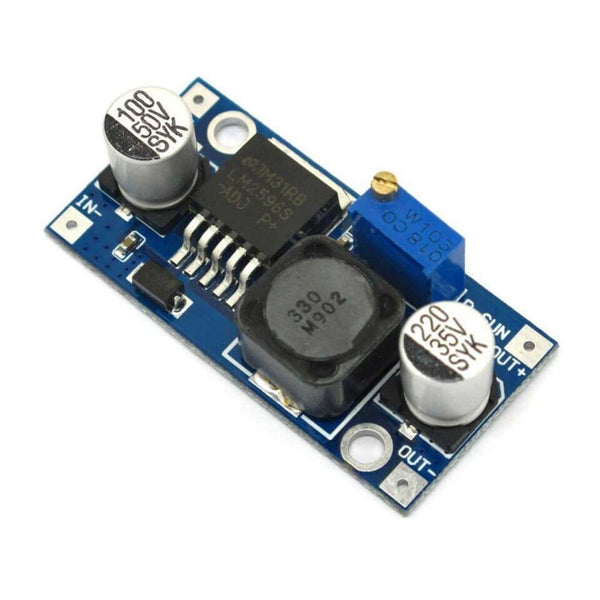
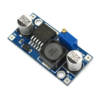
LM2596 DC-DC Buck Converter Step-Down Power Module
₹44.84 incl. GST (₹38.00 + GST)
Product Description
The LM2596S DC-DC Step Down Adjustable Power Supply Module is a compact and efficient non-isolated buck converter designed to reduce a higher DC input voltage to a lower adjustable output voltage. Based on the LM2596S switching regulator, this module provides a practical solution for powering microcontrollers, sensors, development boards, and other electronic circuits requiring a stable lower voltage.
The module accepts a wide 4.5 V to 40 V DC input and provides an adjustable output from approximately 1.5 V to 35 V. The output voltage can be adjusted using the onboard potentiometer, allowing the module to be configured according to the requirements of the connected circuit.
It supports a rated output current of 2 A, while up to 3 A maximum output current can be achieved under suitable thermal conditions. An additional heatsink is recommended when operating close to the maximum current or power rating.
With a switching frequency of 150 kHz and conversion efficiency of up to approximately 92%, the module offers efficient voltage conversion with relatively low power loss. It also incorporates current-limiting short-circuit protection with automatic recovery.
Its compact size of approximately 43 × 20 × 14 mm makes it suitable for integration into DIY electronics projects, embedded systems, battery-powered equipment, and power-management applications.
Features
- LM2596S-based DC-DC step-down converter
- Adjustable buck converter module
- Wide input voltage range
- Input voltage: 4.5–40 V DC
- Adjustable output voltage: 1.5–35 V DC
- Rated output current: 2 A
- Maximum output current: up to 3 A with suitable cooling
- Conversion efficiency up to approximately 92%
- 150 kHz switching frequency
- Non-isolated step-down design
- Non-synchronous rectification
- Adjustable output using onboard potentiometer
- Short-circuit and current-limit protection
- Automatic recovery after short-circuit protection
- Low-cost and compact power solution
- Suitable for embedded and DIY electronics
- Additional heatsink recommended for high-current operation
Specifications
| Parameter | Specification |
|---|---|
| Module Type | DC-DC Step Down Buck Converter |
| Regulator IC | LM2596S |
| Input Voltage | 4.5–40 V DC |
| Output Voltage | Adjustable 1.5–35 V DC |
| Rated Output Current | 2 A |
| Maximum Output Current | Up to 3 A |
| Conversion Efficiency | Up to approximately 92% |
| Switching Frequency | 150 kHz |
| Load Regulation | ±0.5% |
| Voltage Regulation | ±0.5% |
| Dynamic Response | 5% in approximately 200 µs |
| Rectification | Non-Synchronous |
| Isolation | Non-Isolated |
| Protection | Current Limiting / Short Circuit |
| Short-Circuit Recovery | Automatic |
| Full-Load Temperature Rise | Approximately 40°C |
| Operating Temperature | -40°C to +85°C at ≤10 W output |
| Dimensions | Approximately 43 × 20 × 14 mm |
Design and Construction
The module features a compact PCB design containing the LM2596S switching regulator, inductive components, capacitors, protection circuitry, and an adjustable potentiometer for output voltage control.
Its small form factor allows it to be installed inside project enclosures or integrated directly into electronic systems. The module is designed as a non-isolated buck converter, meaning the input and output grounds are electrically common.
For higher-current applications, adequate airflow or an additional heatsink should be provided to manage heat generated by the switching regulator.
Working Principle
The LM2596S converts a higher DC input voltage into a lower adjustable DC output voltage using a high-frequency switching buck-conversion process.
The input voltage is rapidly switched at approximately 150 kHz and passed through the switching, inductive, and filtering components. The regulator continuously adjusts the switching operation to maintain the desired output voltage.
The output voltage can be adjusted using the onboard potentiometer. Because the module is a step-down converter, the output voltage must be configured below the applied input voltage.
Output Voltage Adjustment
Before connecting sensitive electronics, measure the output voltage using a suitable multimeter and adjust the onboard potentiometer to the required voltage.
For example, a higher input voltage can be converted to a lower regulated voltage suitable for compatible electronic circuits.
Important: The module cannot increase the input voltage. The output must remain below the input voltage and within the specified 1.5–35 V output range.
Protection
The module includes current-limiting short-circuit protection. If an output short circuit or excessive current condition occurs, the protection mechanism limits the current and can automatically recover when the fault is removed.
Protection does not eliminate the need to operate the module within its voltage, current, and thermal limits.
Thermal Performance
The module is rated for approximately 2 A continuous output current, while up to 3 A may be possible under suitable conditions. Operation near the maximum current generates additional heat, so an external heatsink and adequate airflow are recommended.
For the stated industrial operating temperature range of -40°C to +85°C, the specified output power condition is 10 W or less.
Actual performance depends on input voltage, output voltage, output current, ambient temperature, ventilation, and heatsinking.
Applications
- Arduino power supply
- ESP32 power supply
- Raspberry Pi peripheral power
- Microcontroller projects
- Sensor power supplies
- LED applications
- Battery-powered electronics
- DIY power supplies
- Embedded systems
- Robotics projects
- Automation systems
- Industrial electronics
- Development boards
- Electronic prototypes
- Voltage conversion
- DC power management
- Automotive electronics projects
- Portable electronic devices
Package Includes
- 1 × LM2596S DC-DC Step Down Adjustable Power Supply Module
Product Disclaimer
This is a non-isolated DC-DC step-down converter. The output voltage must be lower than the input voltage and must remain within the specified operating range.
The 2 A rating is the recommended rated output current, while operation up to approximately 3 A requires suitable thermal management. An additional heatsink and adequate airflow are recommended for high-current or high-power operation.
Do not exceed the specified input voltage, output voltage, current, or power limits. Always verify the output voltage with a multimeter before connecting sensitive electronic components.
Actual efficiency, temperature rise, output current capability, and voltage regulation may vary depending on input/output voltage, load, ambient temperature, wiring, and cooling conditions.
Product images are shown for illustrative and representational purposes only. The actual product colour, dimensions, component placement, terminal arrangement, and appearance may vary slightly depending on the manufacturing batch.
Frequently Asked Questions
1. What is the LM2596S module?
It is an adjustable DC-DC step-down buck converter used to reduce a higher DC voltage to a lower regulated voltage.
2. What is the input voltage range?
The module accepts approximately 4.5 V to 40 V DC.
3. What is the adjustable output voltage range?
The output can be adjusted from approximately 1.5 V to 35 V DC.
4. What is the output current?
The rated output current is 2 A, with up to approximately 3 A maximum under suitable cooling conditions.
5. Does it require a heatsink?
For normal loads, additional cooling may not be necessary. A heatsink is recommended when operating at high current or near the 3 A maximum.
6. Can this module increase voltage?
No. It is a step-down converter and can only reduce the input voltage.
7. How do I adjust the output voltage?
Use the onboard potentiometer to adjust the output voltage. It is recommended to measure the output with a multimeter while making adjustments.
8. What is the switching frequency?
The switching frequency is approximately 150 kHz.
9. What is the conversion efficiency?
The specified maximum conversion efficiency is approximately 92%, depending on the input voltage, output voltage, and load.
10. Is the output electrically isolated from the input?
No. This is a non-isolated buck converter, so the input and output grounds are common.
11. Does it have short-circuit protection?
Yes. It provides current-limiting short-circuit protection with automatic recovery.
12. Can I use it with Arduino?
Yes. It can be used to provide a suitable regulated voltage for Arduino-compatible projects, provided the output voltage and current requirements are correctly configured.
13. Can I use it with ESP32?
Yes. The module can be used as a power source for suitable ESP32 applications after adjusting the output to the required voltage.
14. Can it be used with batteries?
Yes. It can be used with suitable DC batteries provided the battery voltage is within the module's input range.
15. Can it convert 12 V to 5 V?
Yes. For example, a suitable 12 V DC input can be stepped down to 5 V DC by adjusting the output potentiometer.
16. Can it convert 24 V to 12 V?
Yes. A suitable 24 V DC input can be stepped down to 12 V DC, provided the load remains within the module's current and power limits.
17. What is the size of the module?
The approximate dimensions are 43 × 20 × 14 mm.
18. What is the operating temperature?
The module is specified for an industrial operating temperature range of approximately -40°C to +85°C for output power of 10 W or less.
19. Can I use it continuously at 3 A?
Operation at approximately 3 A depends strongly on thermal conditions. The 2 A rating should be treated as the rated output, while higher current requires appropriate heatsinking, airflow, and thermal evaluation.
20. Should I check the output voltage before connecting my circuit?
Yes. Always measure and verify the output voltage with a multimeter before connecting sensitive electronics to prevent accidental overvoltage.
Only logged in customers who have purchased this product may leave a review.


Reviews
There are no reviews yet